





Related: AxleTech Rebrands to Emphasize Technology Investment
AxleTech Focuses on Electrification for Commercial Vehicles
AxleTech is reinventing itself with a focus on electrified vehicle solutions. By focusing on a “power-agnostic” between-the-wheels electrification technology, it believes it can provide integrated, in-axle systems that provide the same power and efficiency as conventional diesel powertrains – and maybe even better.
March 1, 2019
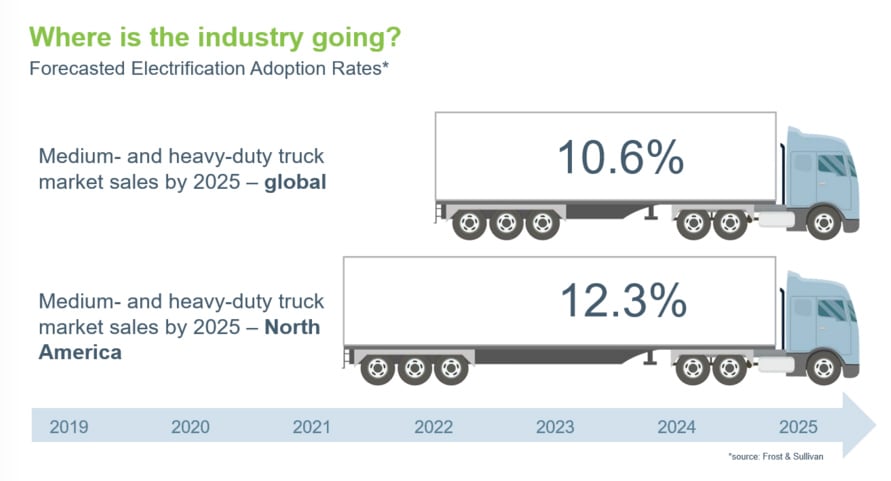
Electrification of Class 6-8 trucks is expected to grow between now and 2025.
Graphic courtesy AxleTech
3 min to read
AxleTech, which turns 100 years old this year, is reinventing itself with a focus on electrified vehicle solutions. By focusing on a “power-agnostic” between-the-wheels electrification technology, it believes it can provide integrated, in-axle systems that provide the same power and efficiency as conventional diesel powertrains – and maybe even better.
“This is key, as vehicle manufacturers and owners will demand this with any powertrain change,” explained Jason Gies, AxleTech director of business development for electric vehicle systems, in a March 1 webinar for reporters.
AxleTech, based in Troy, Michigan, traces its roots back 100 years as part of the original Rockwell International. Since then there have been a number of name changes and ownership transitions. Today, the company is emphasizing the “tech” in its name, providing advanced powertrain systems, axles, brakes, components, and aftermarket and remanufactured parts for heavy-duty commercial and defense applications.
Key in its growth is commercial vehicle electrification.
According to a Frost & Sullivan report, AxleTech said, the electrification adoption rate for medium- and heavy-duty trucks is expected to be 10.6% by 2025 globally, and 12.3% for North America.
The forecast calls for growth to increase starting in 2020. “That’s just next year,” Gies said. “The industry is looking at a lot of growth very quickly.”
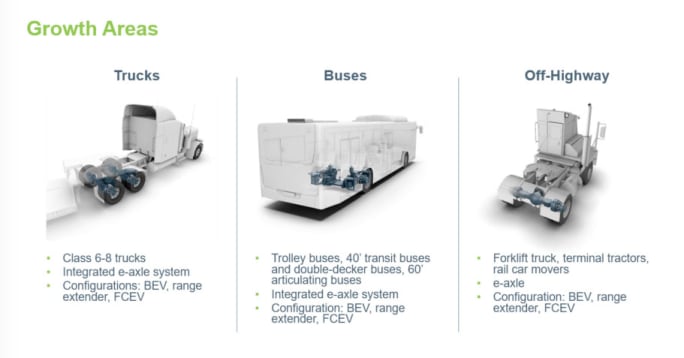
Vehicle electrification for trucks, buses, and off-highway and military equipment is key to AxleTech's growth plan.
Graphic courtesy AxleTech
Three years ago, AxleTech put together a team to develop electrified axle solutions. The company plans to make a big announcement at ACT Expo in April, but already has developed several electrified axle solutions. It has several vehicle partners:
• Thor Trucks. AxleTech is developing an on-highway fully integrated e-axle system that it will pair with Thor’s proprietary batteries
• Wrightspeed, which is making range-extended electric powertrains
• Proterra, an electric bus start-up, which Daimler last year made a big investment in. Part of what AxleTech developed are two-speed gear boxes that give the Proterra system a 20% efficiency improvement. In fact, Gies said, Proterra in 2017 set a world record for longest distance traveled on a single charge, over 1,100 miles, for any vehicle.
AxleTech's “between the wheel” systems are power-agnostic, Gies noted. It could be full battery electric, hydrogen fuel cells, range-extending technology, or even hybrids.
“We require three essential things from the OEM: a cooling line, a control cable, and a power cable – and AxleTech does everything else.”
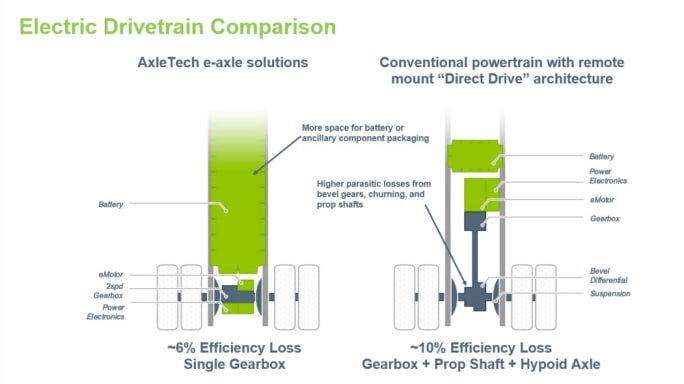
AxleTech says its in-axle electrification technology has advantages over direct-drive systems.
Graphic courtesy AxleTech
AxleTech contends its system-engineered technology has an advantage over early electric truck solutions that involved replacing the truck engine with a single, large electric motor and multi-speed gearbox. This configuration is referred to as a “direct drive” solution, because it follows the traditional longitudinal drivetrain platform. However, AxleTech said, this approach has shortcomings, including poor packaging, efficiency, cost, and compatibility of the major components.
More recent commercial EV powertrains have very specialized configurations, AxleTech says, but varying degrees of customized chassis, suspensions, and e-powertrains raise concerns of long-term supportability and cost.
In contrast, Gies told reporters, AxleTech designs its technology to address four key factors: Performance, cost, maintenance support, and packaging (easily integrated into current vehicle platforms.)
Next month at ACT Expo in Long Beach, California, AxleTech said, it will launch “the most efficient electric powertrain in the world for Class 6-8 trucks,” as well as a compact and powerful system for low-floor transit buses and some new strategic partnerships.
More Fuel Smarts

How Volvo Updated Its D13 for EPA 2027 [Watch]
Volvo’s updated D13 promises lower emissions without sacrificing performance or fuel economy. Take a closer look at what changed inside the engine in this HDT Spotlight video.
Read More →
Diesel Price Spike Shortens Payback for Natural Gas Trucks, Report Says
Energy Vision estimates fleets could recover the higher purchase price of an RNG-fueled Class 8 tractor in 1.3 to 2.8 years under current fuel-price scenarios.
Read More →
Calstart Becomes Catalyst Mobility, Reflecting Broader Focus
Calstart is now Catalyst Mobility, reflecting the nonprofit’s growing national role in clean transportation, including zero-emission trucks, infrastructure and incentive programs.
Read More →

Record Diesel Prices Squeeze Trucking Fleets
Average U.S. diesel prices have climbed to nearly $6 a gallon, surpassing the 2022 record as tight refinery capacity and Middle East disruptions keep fuel costs elevated.
Read More →
Sponsored•September 9, 2026
How Fuel Delivery Shapes Engine Performance
Fuel delivery depends on more than what happens at the injector. For fleet, maintenance and technical professionals, looking at the full path from pump to injector can provide useful context for understanding engine performance.
Read More →
East Coast Port Launches $45M Electric Truck Push
The Port Authority of New York and New Jersey announced millions in incentives for zero-emission drayage trucks, yard tractors, and new charging hubs near the port.
Read More →
California Bill Could Shed Light on Electric Truck Prices
Why do battery-electric Class 8 trucks remain so expensive? A California bill headed to Gov. Gavin Newsom would give fleets and state agencies more visibility into what manufacturers charge.
Read More →
Detroit Opens Orders for EPA 2027 Engines
Detroit isn’t starting from scratch to meet EPA 2027 diesel emissions standards. Its Gen 6 DD13 and DD15 engines keep much of today’s platform while updating the fuel and aftertreatment systems.
Read More →
Zero-Emission Truck Corridor Planned for West Coast
California, Oregon, Washington, British Columbia and Baja California are coordinating plans for truck charging and hydrogen fueling from Canada to Mexico.
Read More →
A Closer Look at Kenworth’s Electric T880E Vocational Truck [Video]
Learn more about Kenworth's T880E battery-electric vocational truck at the Paccar Technical Center, including its range, applications, upfitting considerations, and PTO options, in this HDT Spotlight video.
Read More →