





Related: Congestion Worsens at ATRI's Top Trucking Traffic Bottlenecks
12% of Interstate Miles Cause 89% of Traffic Congestion, ATRI Study Says
A new study by the American Transportation Research Institute looked at a particularly notorious freeway interchange in Atlanta to determine the impact congestion has on truck operations.
March 5, 2019
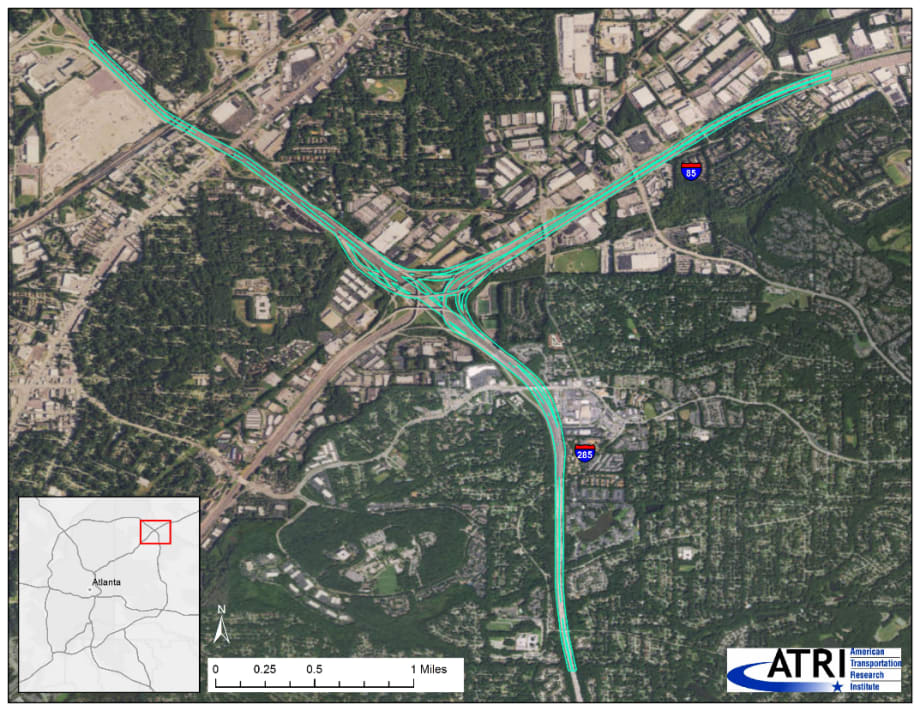
The intersection of Interstate 285 and Interstate 85 in northern DeKalb County, Georgia, chosen by ATRI for its recent traffic study, has a reputation for congestion that reaches far beyond the Peach State.
Image: ATRI
4 min to read
What can one notorious intersection in one of the United State's most congested cities teach us about the impact congestion has on trucking efficiencies? In 2015, the American Transportation Research Institute (ATRI) Research Advisory Committee (RAC) decided to find out.
In a sense, congestion is a “small” problem with massive consequences for the trucking industry. Previous ATRI research showed that 89% of the trucking industry’s congestion costs are created by just 12% of interstate highway miles. And it stands to reason that improving that 12% of bottleneck roads could positively impact the flow of people and goods. Additionally, the agency’s research suggested that an array of small-scale, lower cost solutions could provide travel time benefits for both trucks and passenger vehicles.
Congestion is more than just frustrating delays for drivers. Snarled traffic is estimated to have caused the trucking industry to consume an additional 6.87 billion gallons of fuel in 2016 – representing approximately 13% of the industry’s fuel consumption, while adding $15.74 billion to its fuel bill. From an environmental standpoint, congestion also resulted in 67.3 million metric tons of excess carbon dioxide (CO2) emissions being emitted into the atmosphere.
The resulting study, entitled “Fixing the 12%” examines the potential fuel consumption and emissions benefits which could be derived from improvements to an interstate interchange in Atlanta, Georgia that costs commuters and the trucking industry millions of dollars each year due to congestion.
The intersection of Interstate 285 and Interstate 85 in northern DeKalb County has a reputation for congestion that reaches far beyond the Peach State. The intersection is fed by with several access roads and is known locally as Spaghetti Junction. The intersection connects I-285, which is the beltway around Atlanta, and I-85, a major traffic corridor from the northeastern suburbs into downtown. The interchange is a five-level stack with additional ramps to accommodate traffic on four nearby side roads. It has 14 bridges, the highest rising 90 feet, and handles approximately 300,000 vehicles each day.
The study notes that this location is consistently ranked as one of the worst traffic bottlenecks in the country. In 2019, this intersection was again identified by ATRI as one of the most congested freight bottleneck in the country. ATRI’s Top Truck Bottleneck List assesses the level of truck-oriented congestion at 300 locations on the national highway system. The analysis, based on truck GPS data from nearly 1 million heavy duty trucks, uses several customized software applications and analysis methods, along with terabytes of data from trucking operations to produce a congestion impact ranking for each location.
The first step in this analysis was to utilize ATRI’s truck GPS database to identify average truck speeds by time of day through this intersection, with vehicle positions and speed data derived from the wireless onboard communications systems used by the trucking industry on three specific 2-mile segments of the interchange. This data was assigned to one of 24 one-hour time slots and averaged to estimate truck speeds for the interchange during each hour of the day.
The ATRI study found that average vehicle speeds during the weekday morning commute (7-10 a.m.) slowed to as little as 28 mph, while the evening commute (3 to 7 p.m.) dropped to a low of 14 mph. The average speed during these weekday peak periods is 23 mph while the average during weekday non-peak periods is 47 mph, still below free-flow conditions. The overall average speed throughout the weekday at this interchange is 40 mph, while weekend speeds average 49 mph overallm, with average hourly speeds as low as 37 mph. Taking that data, ARTI researchers then estimated the fuel consumption and emissions benefits of improving the interchange in terms of fuel consumption and emissions from existing traffic conditions and comparing them to an assumed free-flow condition.
The results showed that if improvements to the interchange were made to allow the free-flow of traffic, increasing average vehicle speeds to 55 mph, the change could save a projected 4.5 million gallons of fuel annually among the vehicles passing through the project area. This is equivalent to a fuel economy increase of 7% for gasoline vehicles and nearly 11% for diesel vehicles, the study noted.
Likewise, associated annual emissions fell as well, 5.5% to 41 tons of oxides of nitrogen (NOx) and to 5.5 tons of fine particulate matter or a 17% reduction in PM2.5 emissions when traveling through the project area. Emissions of carbon dioxide, which is the primary pollutant associated with climate change, are estimated by the study to be reduced by nearly 46,000 tons or 8% of the CO2 produced within the project area.
According to ATRI these reductions in fuel consumption and emissions illustrate the potential ancillary benefits which could be achieved by making road improvements which eliminate or reduce congestion at this interchange as well as others throughout the nation.
The full study can be downloaded here.
More Fleet Management

Sponsored•September 16, 2026
Color Match Smarter: Tools That Restore & Perform
For fleet managers and collision repair professionals keeping heavy-duty trucks on the road, getting the color right the first time isn't just about appearance — it's about efficiency, turnaround time, and bottom-line results. Discover how today's digital color tools are transforming the repair process from guesswork to precision.
Read More →
FMCSA Pauses Biennial-Update Enforcement Amid Motus Transition
Carriers whose updates were due on or after June 1 have more time, while FMCSA works to stabilize its new registration system and warns of phishing sites impersonating its new carrier registration system, Motus.
Read More →
Sponsored•September 14, 2026
2026 Blueprint for Countering Smarter Supply Chain Theft
Cargo theft is no longer just the cost of doing business. It's a multi-billion-dollar criminal enterprise exploiting vulnerabilities across your fleet, drivers, and supply chain.
Read More →


Sponsored•September 1, 2026
How Telematics Improves Visibility, Control, and Performance in Refrigerated Fleets
Explore how telematics help refrigerated fleets improve visibility, uptime, efficiency, compliance, and cargo protection across connected cold chain operations.
Read More →
What the U.S.-Canada Trade War Means for Trucking
Escalating U.S.-Canada tariffs could disrupt cross-border freight, reduce truck volumes, raise costs, and create new uncertainty for carriers on both sides of the border.
Read More →
What Are Trucking’s Top Concerns for 2026?
The American Transportation Research Institute wants to know what's worrying trucking fleet managers, drivers, and other stakeholders in its annual Industry Issues survey.
Read More →
American Trucking Associations Looks for a New Leader
ATA President and CEO Chris Spear abruptly left his job at the association on August 21, at a pivotal time for the trucking industry.
Read More →
Public Wi-Fi Cybersecurity Risks: How Truck Drivers and Fleets Can Protect Their Data
Public Wi-Fi can expose truck drivers and fleets to credential theft, malware, and other cyber threats. Here’s how to reduce the risk on the road.
Read More →
For Nicky Cupp, Fleet Innovation Starts With Frustration
HDT Truck Fleet Innovator Nicky Cupp turns everyday pain points at Fraley & Schilling into opportunities for better technology and smarter processes.
Read More →
Adam Buttgenbach’s Approach to Electric Trucks: Start With Where They Fit
HDT Truck Fleet Innovator Adam Buttgenbach helped PepsiCo build one of North America’s largest EV fleets by focusing on where electric trucks make operational sense.
Read More →