





Related: FMCSA Launches Potential Hours of Service Reform Review
ATRI: New Hours-of-Service Split Rest Periods Could Benefit Drivers, Carriers
A new study indicates there are “potential benefits” to allowing truck drivers more flexibility when taking required hours-of-service breaks, according to the American Transportation Research Institute.
August 28, 2018

ATRI said that, using empirical truck GPS data to model the application of split rest beyond the 8- and 2-hour increments allowed under the existing HOS rules, its analysis found that drivers could spend less time and money while driving the same distances.
Credit:
HDT File Image
4 min to read
A new study indicates there are “potential benefits” to allowing truck drivers more flexibility when taking required hours-of-service breaks, according to the American Transportation Research Institute.
ATRI said on Aug. 28 that, using empirical truck GPS data to model the application of split rest beyond the 8- and 2-hour increments allowed under the existing HOS rules, its analysis found that drivers could spend less time and money while driving the same distances.
Under current HOS rules, drivers are required to rest for at least 10 hours before starting a new 14-hour work day. With one exception, the 10 hours must be consecutive. As a result, drivers who take a break to avoid congestion may lose available work hours, ATRI noted.
However, ATRI pointed out, there are “innovative HOS concepts that, if implemented, would enable drivers to avoid congestion by taking strategic periods of rest; a rest period of 3 or more hours that qualifies toward the daily 10-hour rest requirement could effectively help drivers avoid slow-moving peak travel periods.”
The study made use of a representative “freight-significant” 40-mile stretch of urban highway in Atlanta to quantify the operational impacts of congestion. The initial assessment using the truck GPS data showed that the time it took to traverse the congested corridor ranged from a low of 40 minutes to over 90 minutes during rush hours— which amounts to a more than doubling of driving time and related operational costs.
Operational truck GPS data was used to identify a sample of 3,600 truck trips that traversed the study corridor. Average speeds and travel times by hour of day were calculated for each trip – which quantified significant congested periods that lasted well beyond 2 hours. Lost time and operational costs were calculated for each hour of the day; the peak period calculations were found to be more than double the time and cost of off-peak travel.
“Not surprisingly,” states ATRI, “the results indicate that AM and PM peak travel times (when commuters have the greatest demand for urban interstate highways) had the lowest average speeds and highest average travel times across the 40-mile study area.” Travel times indicate a fastest travel time of 39.9 minutes to traverse the corridor from 1:00 to 1:59 am and a slowest travel time of 1 hour and 33.4 minutes to traverse the corridor when trips start between 4:00 and 4:59 pm. “Thus, there is a range of 53.5 minutes between the best and worst travel times, indicating that the 40-mile trip could take nearly one hour longer to complete depending on the time of day travel commences.”
ATRI said it then modeled scenarios in which a “representative driver” operated under the current HOS rules and a “flexible” 6/4 split rest time. Under the flexible hours, the driver was able to avoid congestion, and completed a 585 mile trip with 45 fewer minutes of drive time. Similar results were also found for 7/3 and 5/5 split scenarios.
Per ATRI, the analysis modeled two scenarios with a driver traveling across a heavily congested 40-mile urban corridor as part of a 585-mile trip using current and flexible HOS options. Using the flexible option, traversing the 40 miles required 45.5 minutes less driving time “because a 4-hour rest break allowed the driver to avoid a relatively small (40-mile) segment of urban interstate during peak travel times.”
If only 25 truck trips per day avoided the congested weekday time period presented on the study segment, ATRI added, “truck drivers would drive 4,700 fewer hours annually to move the same goods the same distance. This equates to operational cost savings of more than $300,000 per year for the 25-truck sample at that single location.”
Were the study results replicated across the industry, according to ATRI, “a conservative estimated savings in annual drive time of more than 2.3 million hours could be realized with flexible HOS options,” along with over $150 million in annual operational cost savings.
ATRI said the analysis provides “an assessment of how flexible HOS rules could be applied to enable a single representative driver the ability to avoid congestion in a single study area.” The group noted there hundreds, if not thousands, of “severe chokepoints” in the nation where these rules could be applied by HOS-regulated drivers.
“The time savings, cost savings, and decreased drive time that could result from implementation of a 7/3, 6/4 or 5/5 split sleeper berth rule, while unknown, are likely quite large,” said ATRI.
"One of our biggest challenges with the HOS rules is the lack of flexibility,” commented said Gary Helms, an over-the-road driver for Covenant Transport and an America's Road Team Captain. “Under the current rules, when traveling through congested cities, I really have no choice but to sit stuck in traffic and watch my available hours tick away. As ATRI's study shows, with flexibility in the HOS, I could choose to rest during the worst congested times and make my delivery schedules with less time behind the wheel."
The research group said the study was undertaken, in part, in response to ongoing discussions by industry stakeholders, including the Federal Motor Carrier Safety Administration, on how flexibility in sleep and rest time could benefit drivers.
A copy of the full report is available online from ATRI.
More Safety & Compliance

Trump Administration Expands Homeland Security's Role in Trucking Enforcement
The administration's latest trucking crackdown goes beyond roadside inspections, expanding Homeland Security's role in commercial vehicle enforcement and investigations involving CDL training schools.
Read More →
Paccar Recalls 2027 Trucks Built This Summer for Possible Electrical Problem
The nearly 6,000 Kenworth and Peterbilt trucks in the recall could potentially lose engine power, among other things.
Read More →
Brake Safety Week to Focus on Drums and Rotors
Commercial vehicle inspectors will be focusing on brakes during CVSA's Brake Safety Week, August 23-29.
Read More →
Trump Administration Looks to Put More Veterans Behind the Wheel
The Freedom Haulers program pulls together existing and expanded programs at several federal agencies to recruit veterans to drive commercial heavy-duty trucks and cut the red tape for them to get a CDL, training, and employment.
Read More →
$604 Million Verdict Tests Broker Liability After Supreme Court Ruling
C.H. Robinson plans to appeal after a Texas jury found it bore the largest share of responsibility for a fatal 2021 crash, in a case that follows the Supreme Court's Montgomery decision allowing negligent hiring claims against freight brokers.
Read More →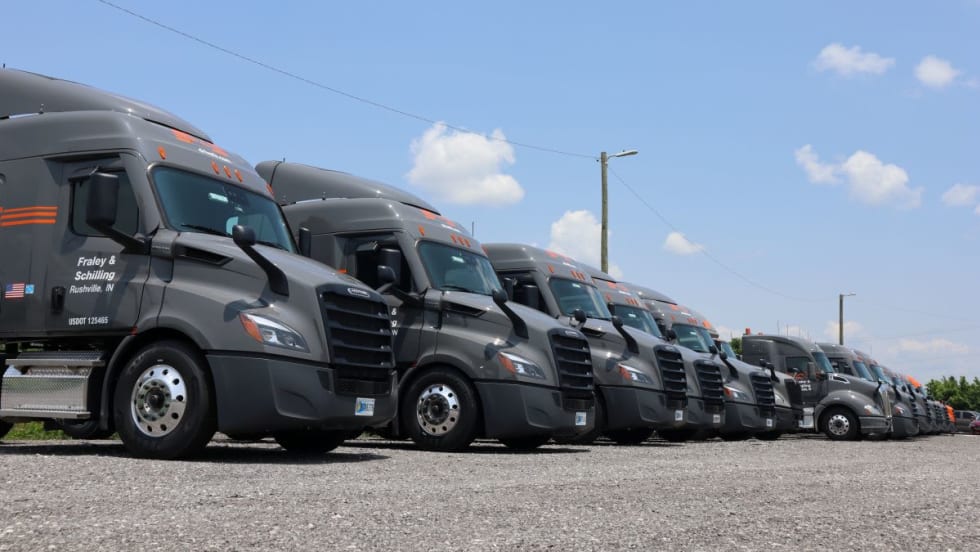
How Fraley & Schilling Improved Logbook Compliance by Over 50%
Fraley & Schilling needed a way to close a compliance workflow gap in its ELD system without adding more work from driver training, reminders, and back-office follow-ups. It found the answer in a custom driver app.
Read More →
Farewell, CDL: Why I'm Giving Up My Commercial Driver's License
After more than 20 years as a CDL holder, HDT Executive Editor Jack Roberts is letting his commercial license expire. Not because he wants to — but because trucking's nuclear verdict crisis has made the risks of public-road test drives too great for editors, manufacturers, and everyone involved.
Read More →
Enhance Fleet Performance with High-Efficiency Auxiliary Power Units
Drive sustainable cost savings while increasing driver comfort during short- and long-haul logistics operations.
Read More →
Wabash Trailers Recalled for Improperly Installed Underride Guards
More than 900 Wabash dry van trailers may not comply with the Federal Motor Vehicle Safety Standard for rear impact guards.
Read More →
Why K&B Trucking Is Embracing AI and Driver Safety Technology
Crunching data and embracing artificial intelligence are key in K&B Trucking's safety efforts, says the company's safety director.
Read More →