





Related: FMCSA Administrator - Please Prepare Now for ELD Deadline
ATBS: 2018 Saw a Reduction in Driver Turnover, Increased ELD Compliance
Revealing the results of its annual Independent Contractor Benchmarking Study, ATBS President and CEO Todd Amen highlighted the record year for the industry and the effects of the ELD mandate and looked into what 2019 might bring by the year’s end.
March 7, 2019
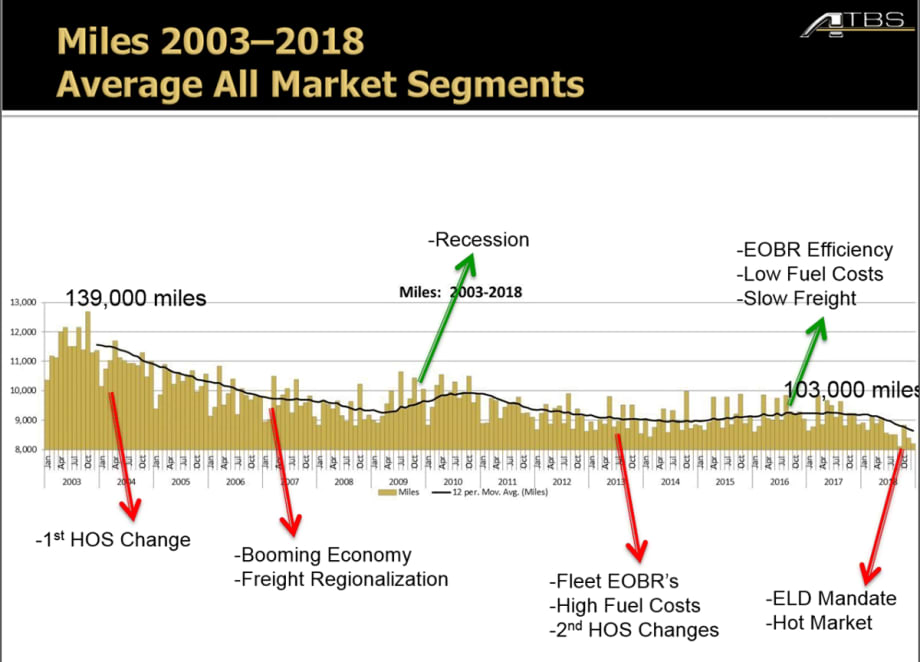
While the average owner-operator was running 139,000 miles annually in 2003, the average is currently around 103,000 miles, a 25% drop in miles in the last 15 years.
Source: ATBS
3 min to read
During a webinar to reveal the results of its annual Independent Contractor Benchmarking Study, ATBS President and CEO Todd Amen, highlighted the record year for the industry and the effects of the ELD mandate and reviewed the predictions for 2018 and looked into what 2019 might bring by the year’s end.
“Last year was truly a record year in many ways for our industry and trucking as a whole, especially for owner-operators,” said Amen.
As in year’s past, the presentation began with a look back on the previous year and the predictions that were made for 2018, which included:
ELD’s full impact won’t be felt until summer 2018 after enforcement in April
Net income will grow significantly throughout 2018 with robust freight market and limited capacity
Fleets with attractive operating models (choice and percentage pay) will gain the most owner-operator capacity
Fleet lease purchase/programs will expand with tax incentives, hot industry and reduced reclassification risks
Good market should last through at least mid-2019
Grass is greener mentality will cause a lot of owner-operator change in 2018 – carrier changes, own authority
All but the last prediction was met, according to Amen. Historically, during boom cycles there is a significant turnover in drivers, with significant sign-on bonuses and pay increases being offered by fleets that want to add capacity. But, in 2018, ATBS saw a reduction of 10-20% in turnover versus 2017 in the fleets they partner with to create the annual Independent Contractor Benchmarking Study.
According to the ATBS survey, the overall owner-operator fleet numbers increased by 2.5%, while large fleets grew by 7.5% and fleets with less than 250 trucks grew by 13.7%.
In terms of the ELD mandate, Amen pointed this out as one of the causes of the reduction in miles driven by owner-operator fleets. In 2003, the average owner-operator was running 139,000 miles annually.
“We all know that today, with ELDs, this is physically impossible and log it legally,” said Amen. “If everything was perfect, the average owner-operator could probably run about 120,000 miles, but right now, the average is about 103,000. We’re down 25% in miles in the last 15 years.”
Approximately 80% percent of owner-operators that were compliant were using ELDs before the mandate’s compliance deadline, according to Amen, but there were some fleets that saw a slowdown due to the addition of the new technology.
Amen concluded the webinar with a list of predictions for 2019, including:
Freight and rates will be moderate through 2019
There will be a move for some owner-operators returning to fleets, as spot markets suffer
As the industry bar has been raised significantly, “we won’t return to pre-2018 contract rates again”
Net income will flatten out and maybe dip a bit in 2019 for owner-operators
Fleet lease purchase program will help those entering the owner-operator market to expand
“This is going to be a year where [fleets] have to transition their thinking away from it’s all about revenue, to [they] have to manage their costs. The average driver can save $2,500 by just slowing down a bit, managing their fuel economy, not idling as much and just focusing on that cost,” Amen added.
More Fleet Management

Sponsored•September 16, 2026
Color Match Smarter: Tools That Restore & Perform
For fleet managers and collision repair professionals keeping heavy-duty trucks on the road, getting the color right the first time isn't just about appearance — it's about efficiency, turnaround time, and bottom-line results. Discover how today's digital color tools are transforming the repair process from guesswork to precision.
Read More →
FMCSA Pauses Biennial-Update Enforcement Amid Motus Transition
Carriers whose updates were due on or after June 1 have more time, while FMCSA works to stabilize its new registration system and warns of phishing sites impersonating its new carrier registration system, Motus.
Read More →
Sponsored•September 14, 2026
2026 Blueprint for Countering Smarter Supply Chain Theft
Cargo theft is no longer just the cost of doing business. It's a multi-billion-dollar criminal enterprise exploiting vulnerabilities across your fleet, drivers, and supply chain.
Read More →


Sponsored•September 1, 2026
How Telematics Improves Visibility, Control, and Performance in Refrigerated Fleets
Explore how telematics help refrigerated fleets improve visibility, uptime, efficiency, compliance, and cargo protection across connected cold chain operations.
Read More →
What the U.S.-Canada Trade War Means for Trucking
Escalating U.S.-Canada tariffs could disrupt cross-border freight, reduce truck volumes, raise costs, and create new uncertainty for carriers on both sides of the border.
Read More →
What Are Trucking’s Top Concerns for 2026?
The American Transportation Research Institute wants to know what's worrying trucking fleet managers, drivers, and other stakeholders in its annual Industry Issues survey.
Read More →
American Trucking Associations Looks for a New Leader
ATA President and CEO Chris Spear abruptly left his job at the association on August 21, at a pivotal time for the trucking industry.
Read More →
Public Wi-Fi Cybersecurity Risks: How Truck Drivers and Fleets Can Protect Their Data
Public Wi-Fi can expose truck drivers and fleets to credential theft, malware, and other cyber threats. Here’s how to reduce the risk on the road.
Read More →
For Nicky Cupp, Fleet Innovation Starts With Frustration
HDT Truck Fleet Innovator Nicky Cupp turns everyday pain points at Fraley & Schilling into opportunities for better technology and smarter processes.
Read More →
Adam Buttgenbach’s Approach to Electric Trucks: Start With Where They Fit
HDT Truck Fleet Innovator Adam Buttgenbach helped PepsiCo build one of North America’s largest EV fleets by focusing on where electric trucks make operational sense.
Read More →