




Related: 10 Tesla Take-Aways
Anheuser-Busch Orders 40 Tesla Semi Tractors
Anheuser-Busch said 40 new Tesla Semi tractors will help the company meet its sustainable transportation goal to reduce its carbon footprint by 30% by 2025.
by Staff
December 7, 2017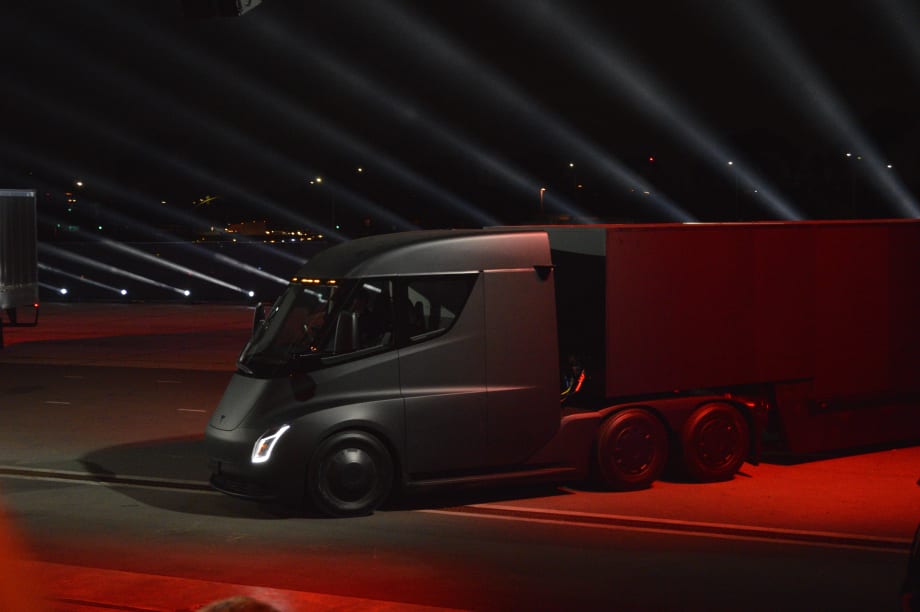
Anhesuer-Busch has ordered 40 Tesla Semi trucks as part of its ongoing sustainable transportion strategy. Photo: Jack Roberts
2 min to read

Anhesuer-Busch has ordered 40 Tesla Semi trucks as part of its ongoing sustainable transportion strategy. Photo: Jack Roberts
Tesla’s new Semi electric truck got a big boost this week when Anheuser-Busch announced it has placed an order for 40 of the new regional haul tractors, which are slated to go into production next year.
The brewing giant said the move is part of a company-wide strategy to employ cutting-edge technology to reduce the environmental impact and increase the efficiency of its operations.
The 40 tractors, which represent one of Tesla’s largest reported pre-orders, will be fully electric-powered and equipped with autonomous driving capabilities, as part of the company’s commitment to improving road safety and reducing carbon emissions.
Integrating the Tesla trucks into the brewer’s distribution network will help Anheuser-Busch achieve its commitment to reduce its operational carbon footprint by 30% by 2025 – the equivalent of removing nearly 500,000 cars from the road globally each year.
“At Anheuser-Busch, we are constantly seeking new ways to make our supply chain more sustainable, efficient, and innovative,” said James Sembrot, senior director of Logistics Strategy. “This investment in Tesla semi-trucks helps us achieve these goals while improving road safety and lowering our environmental impact.”
Anheuser-Busch also said the Tesla technology will also improve safety and efficiency, particularly for truck drivers while they are operating these vehicles, and will help ensure drivers continue to play a central role in beer distribution far into the future.
Anheuser-Busch said it has long been a pioneer and industry leader in supporting innovative technology in its transportation operations to build a more sustainable and efficient beer distribution network.
In addition to its partnership with Tesla, and a range of other recent investments in its transportation operations, Anheuser-Busch is also working with a number of innovative companies. These include Nikola, to develop and implement hydrogen-powered engines within its network; Otto and Uber Freight, to test autonomous driving technology, and Convoy, to access on-demand trucking capacity.
In 2016, an Otto truck carrying 51,744 cans of Budweiser completed an autonomous truckload shipment from Anheuser-Busch’s Fort Collins, Colorado brewery to a wholly owned distributorship in Colorado Springs, a distance of 132 miles, marking the first-ever commercial beer delivery using autonomous driving technology.
“We can’t wait to get these trucks on the road, and keep leading our industry forward to a greener, smarter future in partnership with some of the world’s most innovative companies,” said Sembrot. “The transportation industry is evolving fast, and we’re really excited to play a leadership role in driving this evolution by integrating these new technologies across our network.”
More Fleet Management

How Better Freight Data Helps Trucking Teams Get Ahead of Disruption
Trucking and logistics teams have plenty of data. The problem is getting the right information in front of the right people soon enough to act. Better-connected data can help teams spot trouble earlier and make smarter decisions before small problems become big ones.
Read More →
Trimble: Taking Artificial Intelligence in Trucking Beyond Faster Tasks
At Insight 2026, Trimble executives argued that fleets may need to redesign workflows to get more from AI as it introduced new products and enhancements. AI’s value will depend on how fleets combine automation with their people's knowledge.
Read More →
Nominations Open for HDT Emerging Leaders
Heavy Duty Trucking is looking for accomplished trucking fleet professionals under 40 who are making an impact and helping lead the industry forward.
Read More →


Why Private Fleets Are Taking More Freight
Private fleets are putting their own trucks on demanding customers and high-cost lanes as companies seek greater control over service, costs, and capacity.
Read More →
Sponsored•September 16, 2026
Color Match Smarter: Tools That Restore & Perform
For fleet managers and collision repair professionals keeping heavy-duty trucks on the road, getting the color right the first time isn't just about appearance — it's about efficiency, turnaround time, and bottom-line results. Discover how today's digital color tools are transforming the repair process from guesswork to precision.
Read More →
FMCSA Pauses Biennial-Update Enforcement Amid Motus Transition
Carriers whose updates were due on or after June 1 have more time, while FMCSA works to stabilize its new registration system and warns of phishing sites impersonating its new carrier registration system, Motus.
Read More →
Sponsored•September 14, 2026
2026 Blueprint for Countering Smarter Supply Chain Theft
Cargo theft is no longer just the cost of doing business. It's a multi-billion-dollar criminal enterprise exploiting vulnerabilities across your fleet, drivers, and supply chain.
Read More →
Sponsored•September 1, 2026
How Telematics Improves Visibility, Control, and Performance in Refrigerated Fleets
Explore how telematics help refrigerated fleets improve visibility, uptime, efficiency, compliance, and cargo protection across connected cold chain operations.
Read More →
What the U.S.-Canada Trade War Means for Trucking
Escalating U.S.-Canada tariffs could disrupt cross-border freight, reduce truck volumes, raise costs, and create new uncertainty for carriers on both sides of the border.
Read More →
What Are Trucking’s Top Concerns for 2026?
The American Transportation Research Institute wants to know what's worrying trucking fleet managers, drivers, and other stakeholders in its annual Industry Issues survey.
Read More →