





Related: Chinese Gliders Are Platforms for New American Class 7-8 Trucks
Alkane COE Trucks Get DOT Approval
A big-block V-8 engine will burn propane and deliver diesel-like performance at lower cost, the company says.
November 13, 2015
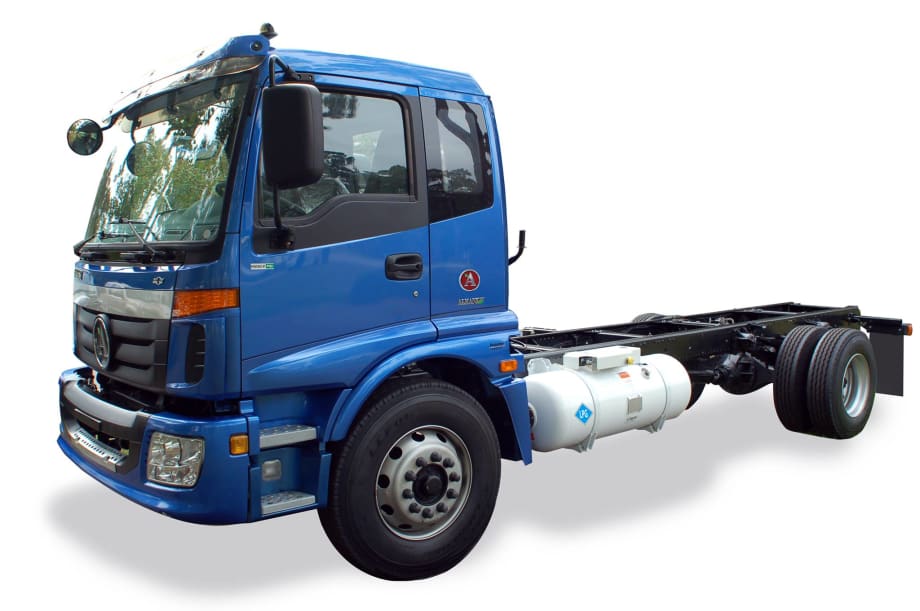
Alkane will use Foton cab-chassis from China with North American components, including a propane-fueled engine. Assembly in South Carolina is set for early 2016.
2 min to read
Alkane will use Foton cab-chassis from China with North American components, including a propane-fueled engine. Assembly in South Carolina is set for early 2016.
Alkane Truck Co. says it has achieved compliance certification from the U.S. Department of Transportation for its propane-fueled Class 7 cab-over-engine trucks, and will begin assembly at a plant in South Carolina early next year.
Brakes, wheels and tires, axles, seat belts, lights, interior fabric and glass had to be submitted to laboratories for testing, said Steve Rayborn, Alkane’s sales vice president. All items have to meet federal standards and regulations, and specialty laboratories tested each component of concern to DOT.
“There’s a lab for every feature,” he said, and the process was expensive. “If we knew five years ago what this was going to cost, we might have thought twice about it. But we’ve done it, and we’re glad we did it.”
The trucks will use cabs and chassis from China, with other components sourced from North American suppliers. The powertrain will include a Power Solutions International 8.8-liter V-8 that’s based on a General Motors block, and an Allison 2500 six-speed automatic transmission. The engine, with 270 hp and 565 lb-ft of torque, delivers diesel-like performance at a lower cost, Rayborn said.
The current fleet-volume discounted price of a diesel-equivalent gallon of liquid propane is $1.15 compared to $2.49 or more for diesel fuel, noted Bob Smith, Alkane’s chief executive officer.
It will be the only medium-duty COE truck in the U.S. that uses propane autogas fuel, he said. A targeted niche market is propane distributors, some of whom have already expressed interest.
COE Class 7 trucks, rated at 26,001 to 33,000 pounds gross weight, are widely used for inter-city operations due to their tight turning radius and excellent maneuverability, he said. They are used for delivery of freight, furniture, fuel and beverages and other applications.
“We are excited about our new truck,” Smith said. “We’re equally excited to bring new skilled jobs to American workers. Our assembly facility in Dorchester County (South Carolina) will employ more than 300 automotive technicians once it reaches full capacity.”
Development continues on a Class 8 truck and tractor, also using Chinese cabs and chassis with domestic powertrain and other components, Rayborn said. The engine will be a Cummins ISX12 G set up to burn compressed natural gas.
The heavy vehicle should be ready for production toward the end of 2016. The Chinese supplier is Foton, one of the largest truck builders in that country.
“We are the agency of service for Foton,” he said. “No one else can bring one in.”
In this video from Alkane, Steve Rayborn highlights the features of the new truck.
More Fuel Smarts

How Volvo Updated Its D13 for EPA 2027 [Watch]
Volvo’s updated D13 promises lower emissions without sacrificing performance or fuel economy. Take a closer look at what changed inside the engine in this HDT Spotlight video.
Read More →
Diesel Price Spike Shortens Payback for Natural Gas Trucks, Report Says
Energy Vision estimates fleets could recover the higher purchase price of an RNG-fueled Class 8 tractor in 1.3 to 2.8 years under current fuel-price scenarios.
Read More →
Calstart Becomes Catalyst Mobility, Reflecting Broader Focus
Calstart is now Catalyst Mobility, reflecting the nonprofit’s growing national role in clean transportation, including zero-emission trucks, infrastructure and incentive programs.
Read More →

Record Diesel Prices Squeeze Trucking Fleets
Average U.S. diesel prices have climbed to nearly $6 a gallon, surpassing the 2022 record as tight refinery capacity and Middle East disruptions keep fuel costs elevated.
Read More →
Sponsored•September 9, 2026
How Fuel Delivery Shapes Engine Performance
Fuel delivery depends on more than what happens at the injector. For fleet, maintenance and technical professionals, looking at the full path from pump to injector can provide useful context for understanding engine performance.
Read More →
East Coast Port Launches $45M Electric Truck Push
The Port Authority of New York and New Jersey announced millions in incentives for zero-emission drayage trucks, yard tractors, and new charging hubs near the port.
Read More →
California Bill Could Shed Light on Electric Truck Prices
Why do battery-electric Class 8 trucks remain so expensive? A California bill headed to Gov. Gavin Newsom would give fleets and state agencies more visibility into what manufacturers charge.
Read More →
Detroit Opens Orders for EPA 2027 Engines
Detroit isn’t starting from scratch to meet EPA 2027 diesel emissions standards. Its Gen 6 DD13 and DD15 engines keep much of today’s platform while updating the fuel and aftertreatment systems.
Read More →
Zero-Emission Truck Corridor Planned for West Coast
California, Oregon, Washington, British Columbia and Baja California are coordinating plans for truck charging and hydrogen fueling from Canada to Mexico.
Read More →
A Closer Look at Kenworth’s Electric T880E Vocational Truck [Video]
Learn more about Kenworth's T880E battery-electric vocational truck at the Paccar Technical Center, including its range, applications, upfitting considerations, and PTO options, in this HDT Spotlight video.
Read More →