




Airman Announces 'Affordable' Automated Landing Gear System
Airman Products' new Automated Landing Gear Deployment and Retraction Technology, with the flip of a switch, eliminates the manual cranking required to raise and lower a trailer’s landing gear, reducing driver exposure to a variety of musculoskeletal injuries.

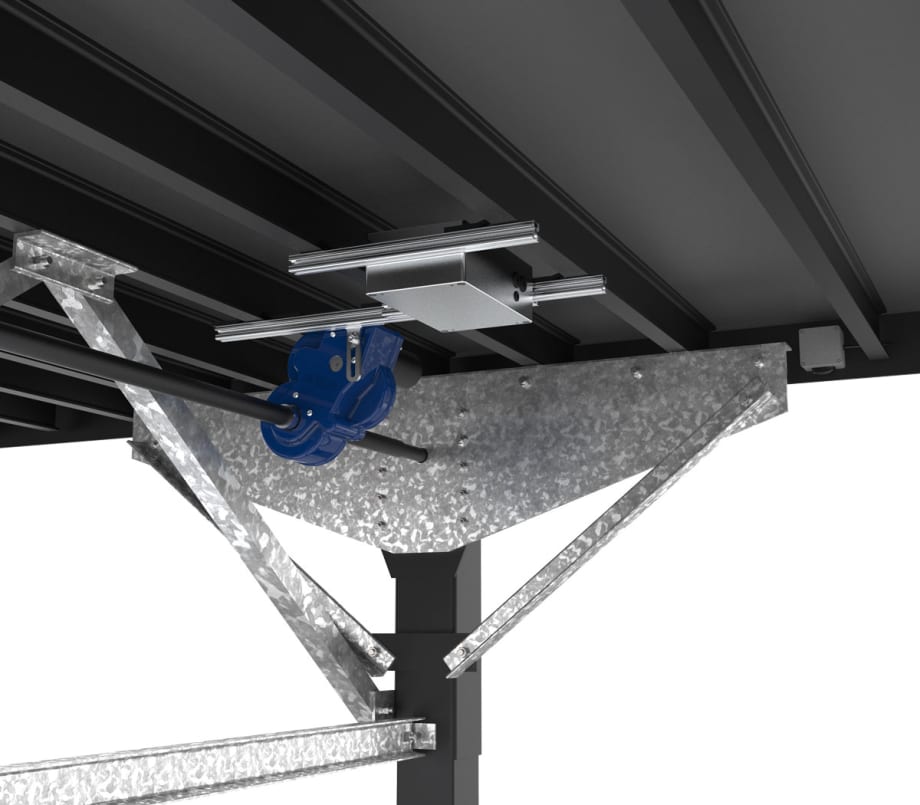
Airman said its new automated landing gear can be purchased and installed for as little as $700 per truck.
Photo: Airman Products
Airman Products gave members of the media their first glimpse of its new Automated Landing Gear Deployment and Retraction Technology during a press conference at the 2020 ATA Technology & Maintenance Council Annual Meeting in Atlanta, Georgia.
With the flip of a switch, Airman’s patent-pending device eliminates the manual cranking required to raise and lower a trailer’s landing gear, reducing driver exposure to a variety of musculoskeletal injuries, including damage to shoulders, knees, the back and upper body.
Jim Babbitt, vice president of sales for Airman, told reporters that the 15-pound, electrically driven unit can be OEM-installed or retrofitted in less than an hour and is compatible with all existing landing gear makes and models. Using the new technology, a driver can effortlessly deploy and retract landing gear in less time than it would take to do either operation manually.
“The fleets we’ve surveyed tell us that shoulder, back and rotator cuff injuries are at the top of their list for workers’ comp claims, and that cranking landing gear up and down can cause or exacerbate these injuries,” Babbitt said. “Truck driving is already a physically demanding profession, so our automated system focuses on one primary stressor, making trailer drops and hookup operations safer and faster, while improving the truck driver experience and as a result, driver retention.”
Babbitt said the sheer repetitive motion of cranking can tax muscles, tendons and joints, particularly in the case of aging drivers, and the fact remains that the median age of truck drivers continues to rise.
“Depending on the equipment and circumstances, it can take between 50 to 60 crank arm rotations to get the legs on a trailer’s landing gear to the ground, and this task can keep some otherwise great drivers from working or coming back to work,” added Shane LaHousse, vice president of engineering for Airman. “Operating the crank arm can be awkward and physically taxing, even if the driver is young and uses the proper technique for landing gear operation, so we’ve taken this task out of the driver equation by automating it.”
LaHousse said the Automated Landing Gear Deployment and Retraction system also makes it possible to increase lot utilization, by enabling trailers to be parked closer together. Because no crank arm needs to be accessed, and the controller is mounted just under the trailer apron, tighter trailer positioning is possible.
Easy to Install
According to Babbitt, the system comes complete in kit form with all components and mounting hardware included. Installation is simple. It requires the removal of just two bolts on the landing gear crossbar, the attachment of the Airman landing gear actuator and the reinstallation of the crossbar.
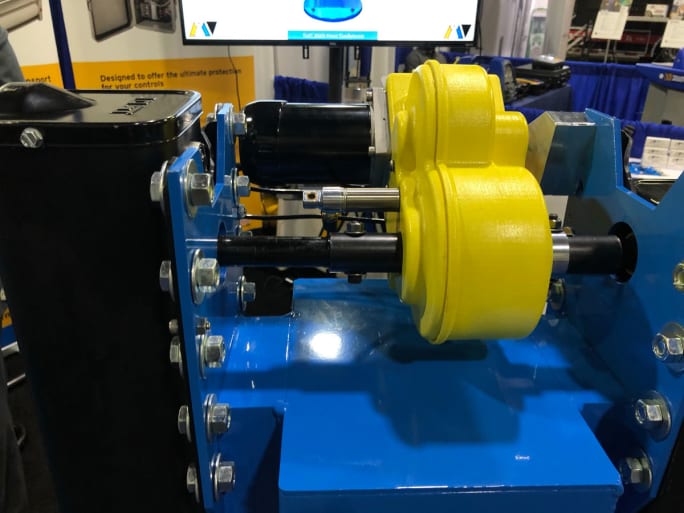
The Airman Automated Landing Gear Deployment and Retraction system fully retracted both legs on a trailer landing gear in 29 seconds during a demonstration on the 2020 TMC Annual Meeting trade show floor in Atlanta, Georgia.
Photo: Jack Roberts
The electrical interface is uncomplicated, requiring only a simple 12-volt power supply. The unit’s solid-state unit control box mounts under the trailer, and its two-way toggle switch user interface mounts to the side of the trailer frame rail for easy access.
Once installed, the unit requires no maintenance, except periodic replacement of its dedicated battery, as needed, according to the company. Airman’s trailer landing gear actuator is self-contained and requires no lubrication.
“Some landing gear manufacturers offer automated systems now, but they are expensive, upgrading requires discarding an existing drive leg, and if the landing gear is damaged, may require complete replacement,” Babbitt said. “Not only is the Airman system about half the cost of other systems, it also works universally with all existing landing gear makes and models, and doesn’t have to be replaced if the landing gear is damaged.”
Babbitt said that currently, fleets would be able to outfit trailers with the new automated landing gear system for approximately $700 per unit.
Fleets with trailer populations made up of multiple trailer brands fitted with varying types of landing gear can now upgrade using one piece of equipment and one single source. So, whether a fleet is ordering the Airman Automated Landing Gear Deployment and Retraction Technology on new trailer builds, retrofitting its existing trailers, or both, it will still be increasing its parts inventory by just one SKU, noted the company.
During the development of the Automated Landing Gear Deployment and Retraction Technology, Airman conducted temperature, shock and endurance testing in its own lab. As part of the evaluation, units were put through the equivalent of 10 drop and hook cycles per day for a period of 10 years, or 36,000 cycles, with no observable wear and no failures.
The product is now undergoing final fleet field-testing on trailers operated by both regional and national carriers.
Automated Landing Gear Deployment and Retraction Technology is expected to be in commercial production by the third quarter of 2020, and the company can help fleets and OEMs with specification information now. The product will come with a five-year warranty standard, and a seven-year warranty is available under a fleet agreement.
More Equipment

How Volvo Updated Its D13 for EPA 2027 [Watch]
Volvo’s updated D13 promises lower emissions without sacrificing performance or fuel economy. Take a closer look at what changed inside the engine in this HDT Spotlight video.
Read More →
Michelin Tire Improves Efficiency and Durability for Regional Fleets
The Michelin X Multi Energy D2 is a regional haul drive tire engineered to help fleets improve fuel efficiency, durability and traction in demanding stop-and-go operations.
Read More →
ZF Expands Commercial Vehicle Push in North America
ZF is expanding its North American commercial-vehicle presence with new transmission applications, electrification, trailer technology and autonomous-driving systems.
Read More →
Tesla Wants a Self-Driving Semi. Are Cameras Enough?
Could Tesla’s camera-only autonomous driving technology work on an 80,000-pound Semi? In this commentary, HDT's Deborah Lockridge takes a look at Tesla, Cybercab, and how autonomous trucks see the road.
Read More →
Kodiak: Driverless Long-Haul Truck Launch on Track for 2026
Kodiak AI says its driverless long-haul safety case is 93% complete and it remains on track to begin commercial operations by year-end 2026.
Read More →
What DOT’s Automated Vehicle Strategy Means for Trucking
The U.S. Department of Transportation issued a new automated-vehicle strategy that outlines plans for driverless-truck regulations, cross-state freight corridors, and federal safety standards.
Read More →
East Coast Port Launches $45M Electric Truck Push
The Port Authority of New York and New Jersey announced millions in incentives for zero-emission drayage trucks, yard tractors, and new charging hubs near the port.
Read More →
PlusAI Going Public to Fund Autonomous Truck Launch
A SPAC deal could provide PlusAI with up to $300 million as it works toward a 2027 commercial launch of factory-built autonomous trucks.
Read More →
NHTSA Moves to Rewrite Truck Fuel-Economy Rules
The National Highway Traffic Safety Administration says it lacks authority to regulate medium- and heavy-duty truck engines separately from complete vehicles, but the existing standards have not yet been eliminated.
Read More →
Detroit Opens Orders for EPA 2027 Engines
Detroit isn’t starting from scratch to meet EPA 2027 diesel emissions standards. Its Gen 6 DD13 and DD15 engines keep much of today’s platform while updating the fuel and aftertreatment systems.
Read More →