




34-Hour Restart Faces Test
The stage is set for a political grilling of the Federal Motor Carrier Safety Administration at a House hearing Thursday on the hours-of-service rule. Amid relentless criticism of the 34-hour restart and 30-minute break provisions of the rule, agency administrator Anne Ferro will be called on to explain and defend the agency’s decision-making.
The stage is set for a political grilling of the Federal Motor Carrier Safety Administration at a House hearing Thursday on the hours-of-service rule.
Amid relentless criticism of the 34-hour restart and 30-minute break provisions of the rule, agency administrator Anne Ferro will be called on to explain and defend the agency’s decision-making.
The hearing before the House Subcommittee on Contracting and Workforce will be chaired by Rep. Richard Hanna, R-N.Y., an author of a bill that would suspend the restart provision pending an assessment by the Government Accountability Office.
Hanna has described the rule as “ideological” because it was implemented before FMCSA completed a field study of its effects.
The study was required by last year’s highway bill but it appears that Congress did not intend for the agency to complete the study before the rule took effect. The bill gave the agency until Sept. 30 to finish the study while the rule took effect July 1.
The agency missed that deadline. It has finished collecting data for the study but still is working on the analysis and review. The findings will have to be reviewed by the DOT Secretary’s office and the White House Office of Management and Budget, a process that could take into next year
Hanna’s criticism reflects the concern of trucking interests about how the provisions have affected their operations.
This week both the American Trucking Associations and the Owner-Operator Independent Drivers Association released studies indicating that the provisions have led to carrier productivity losses, driver income losses and deterioration in driver quality of life.
The ATA study, prepared by its research arm, American Transportation Research Institute, is built on surveys that netted 2,370 driver responses and 446 carrier responses, mostly from the long-haul truckload sector.
“This report demonstrates clear evidence that the rules have generated a financial consequence on individual drivers as well as motor carriers, the majority of whom are small businesses,” the report concludes.
Included in the study is an analysis of logbook data from more than 49,000 drivers. In general, it shows an increase in the length of restart periods after the new rule took effect. This might be due to the requirement that drivers take two successive periods off between 1 a.m. and 5 a.m. during their 34-hour break, ATRI said.
OOIDA said its study shows that the provisions have made it harder for drivers to drive when they are rested.
“The agency’s insistence on micromanaging a driver’s time is actually undermining highway safety,” said Todd Spencer, OOIDA executive vice president in a statement.
“Instead of providing the flexibility to drive when rested and stop when tired, the new rules have put drivers in the position of driving more hours than ever and in the worst traffic conditions, and spending less time at home. How is that safe?”
FMCSA has defended the restart provision on grounds that by creating more time for driver rest it will improve safety and save lives. It has said that the provision affects only the drivers who have the most severe schedules, and that most operations are not impacted.
The agency also says that the fatigue studies it conducted while drafting the rule justify the changes. ATA, on the other hand, has said that the laboratory studies were not convincing.
More Drivers

EEOC Sues KLLM Over Alleged Sex Discrimination in Driver Training
KLLM is facing a federal sex-discrimination lawsuit over policies the EEOC alleges put female truck driver trainees at a disadvantage.
Read More →
FMCSA Moves to Codify English Language Requirements for Commercial Drivers
By changing regulations on English-language proficiency requirements for commercial drivers, rather than relying on a guidance memo, the FMCSA said future administrations won't be able to walk back the Trump administration's stricter enforcement with just a memo.
Read More →
Drivers Put Western Star Trucks to the Test at Star Nation Experience
Watch to get an inside look at the Western Star trucks, technology, and community behind the Star Nation Experience 2026!
Read More →
Trump Administration Looks to Put More Veterans Behind the Wheel
The Freedom Haulers program pulls together existing and expanded programs at several federal agencies to recruit veterans to drive commercial heavy-duty trucks and cut the red tape for them to get a CDL, training, and employment.
Read More →
Putting Mack’s Command Steer to the Test
A test drive of Mack’s Command Steer active steering system evaluates how it can make truck driving easier and less tiring.
Read More →
Competition Heating Up for Truck Drivers
New report reveals rising driver hiring costs, the return of sign-on bonuses, growing AI advantages, and the operational factors shaping driver retention.
Read More →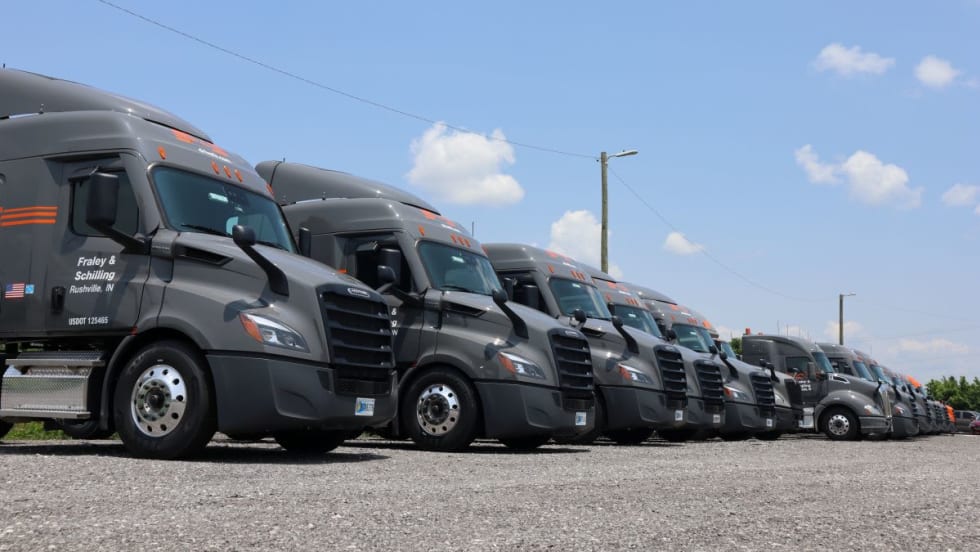
How Fraley & Schilling Improved Logbook Compliance by Over 50%
Fraley & Schilling needed a way to close a compliance workflow gap in its ELD system without adding more work from driver training, reminders, and back-office follow-ups. It found the answer in a custom driver app.
Read More →
Volvo Goes Gaming
Volvo has roared into American Truck Simulator with two new flagship trucks.
Read More →
What the Best Fleets to Drive For Teach About Driver Retention
Survey fatigue, AI-powered routing, owner-operator expectations, and the decline of social media all emerged as themes from this year's Best Fleets to Drive For program.
Read More →
Driver Retention Lessons From the Best Fleets to Drive For
What separates trucking's best workplaces from the rest? Jane Jazrawy shares the biggest lessons from this year's Best Fleets to Drive For program on driver retention, communication, AI, and workforce trends on the HDT Talks Trucking podcast.
Read More →