




Whoa, How'd This Rig Hold Together?
There are no federal government or SAE strength requirements, so standards were set by the marketplace, and now by European rules.

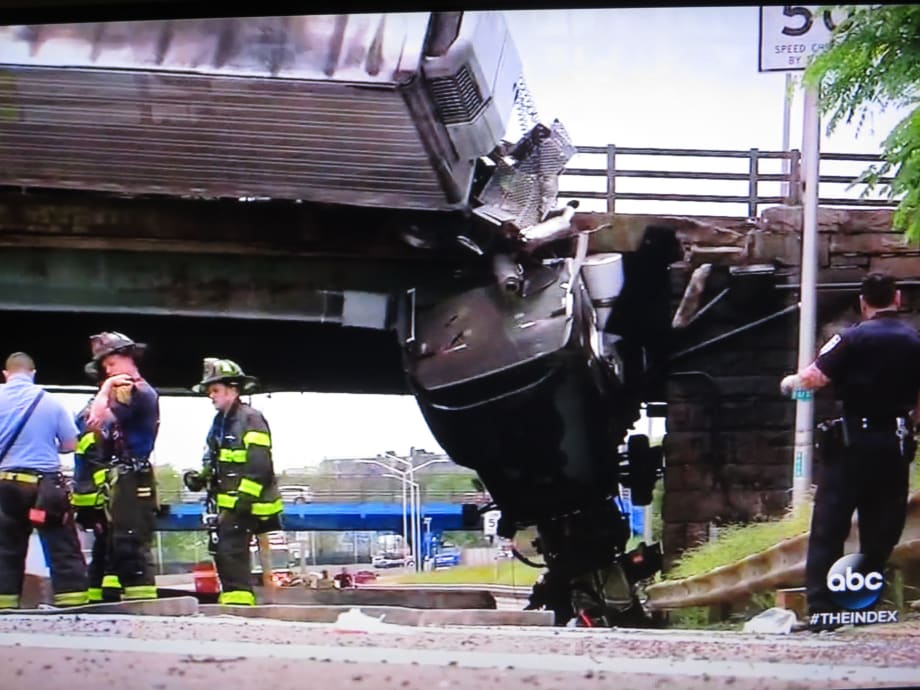
Strong coupling mechanisms supported the tractor and kept it from falling onto the street below. Photos: Tom Berg, from ABC World News Tonight
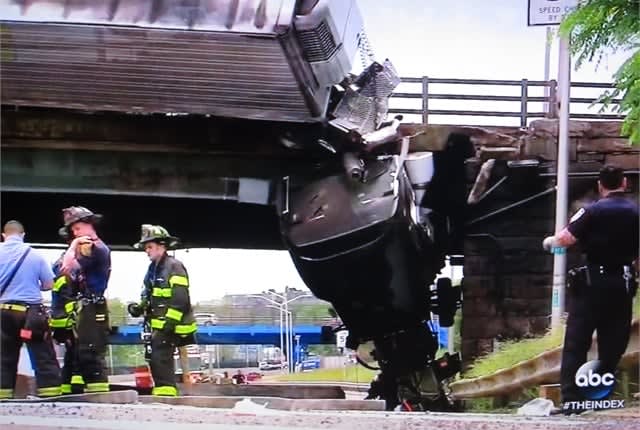
Strong coupling mechanisms supported the tractor and kept it from falling onto the street below. Photos: Tom Berg, from ABC World News Tonight
Whoa, look at this! A big rig skidded and slipped partly off the edge of a bridge on the Cross-Bronx Expressway in New York City, leaving the reefer trailer on its side still on the span, and the tractor dangling with its nose facing the street below. The images were so compelling that ABC put them on its World News Tonight show the evening of Memorial Day.
To Joe Public it’s probably amazing that the tractor stayed hanging there instead of breaking loose and falling onto the street. That was my first reaction, too, but then I thought about the strength built into fifth wheels and trailer kingpins. They are very strong, so of course the two vehicles would hold together, right?
That depends, according to experts at two companies that make fifth wheels, Fontaine and Jost International. If it’s just a matter of supporting the tractor weighing maybe 20,000 pounds, that’s well within the ratings of its coupling mechanisms. A fifth wheel for a road tractor is tested to withstand 150,000 pounds of drawbar force, said Greg Laarman, Jost's vice president of engineering.
“A fifth wheel and its jaws, and the kingpin and upper coupler assembly, all their components — they’re all like links in a chain, and they’re all tested to a 150,000-pound drawbar load” for normal, 80,000-pound highway service, he said. “So it’s not surprising at all” that the tractor would be supported. ”In fact, we would expect that to happen.”
Tom Moulton, Fontaine's test lab manager, agreed, and added that there’s also a 50,000 to 55,000-pound vertical rating, which might also have come into play in this accident.
“Those standards were set through the marketplace in general,” he said. “There are ISO [International Standards Organization] standards, 8717, and European Union standards, ECE-55. Since we all supply fifth wheels to those markets, I believe we all build and test to them. Fontaine has additional internal tests that go beyond the international standards.”
Interestingly, there is no federal government strength requirement, such as from the National Highway Traffic Safety Administration, or even from the Society of Automotive Engineers, Moulton said. SAE once had a committee that considered heavy-duty coupling standards, but members decided to defer to the ISO and European numbers.
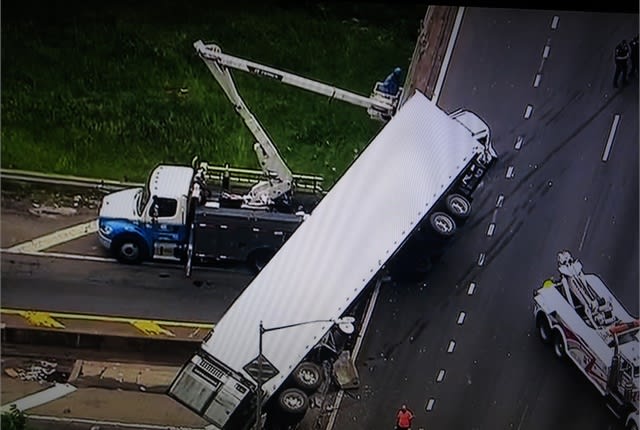
Trailer seems to teeter on the edge of the bridge as recovery gets underway. Skid marks suggest a collision might've occurred first.
The Fontaine and Jost engineers also noted that crashes often involve much stronger dynamic forces that occur in collisions, and they determine whether the coupling holds together. “It depends on what kind of forces are involved – the speed of the vehicle, and how fast it’s stopping,” Laarman said, citing an equation involving mass and velocity.
“A truck might be going 65 mph and hit something solid or run into a ditch, and decelerate to zero in a tenth of a second. The force can become very large,” he said, and the coupling could break. “If you had to make a coupling device strong enough to hold against any collision, you would not have room to haul any freight.”
We can surmise that this wreck in New York might have involved some powerful dynamic forces as the rig smashed against the bridge’s railings and the tractor plunged off the span, jarring to a stop in midair. But they, too, were within the coupling mechanisms’ limits.
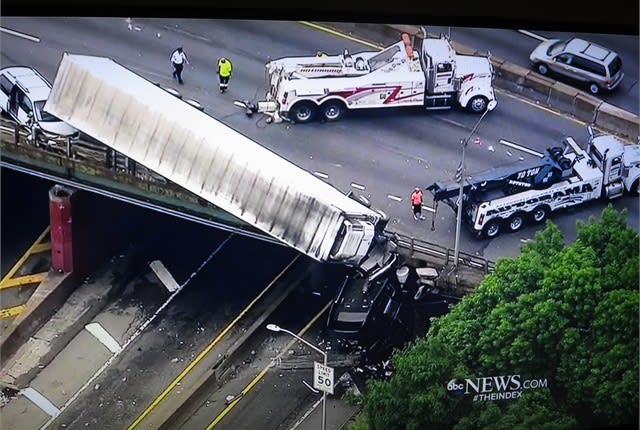
Powerful wreckers will pull rig from the abyss. Driver scrambled out of the cab and hopped to the pavement.
Now, if I had been more humane, I’d have stated this tale with, “My gosh, what happened to the driver?” He scrambled out of the cab and hopped to the ground, and is fine, ABC reported. But he might still be explaining to authorities and his boss how his rig got into that precarious position.
Watch the ABC World News Tonight story here.
More Blog Posts

Pulsing Back-of-Trailer Lamps Aim to Prevent Crashes
Can the addition of a pulsing brake lamp on the back of a trailer prevent rear-end collisions? FMCSA seems to think so, if its exemptions are any indication.
Read More →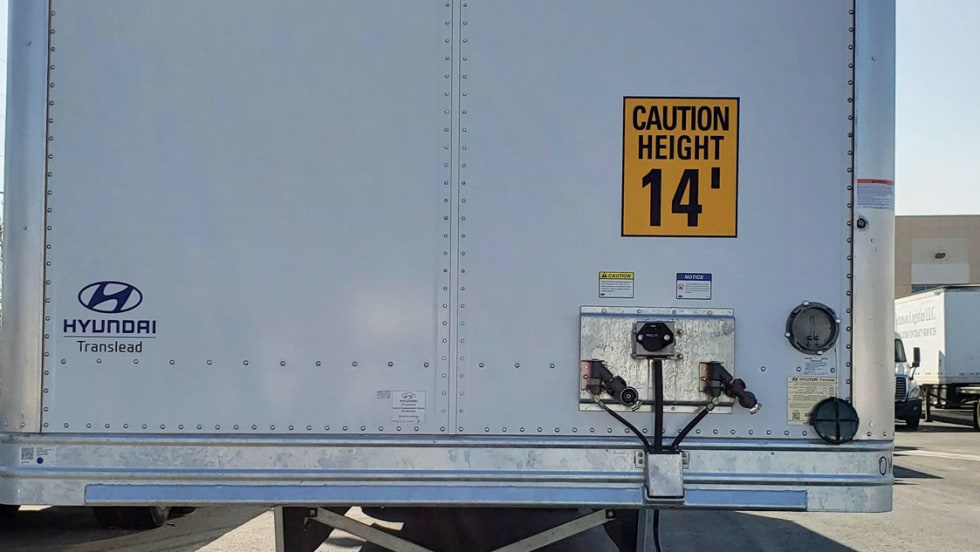
Designing a 14-Foot Trailer
Trailers are 13 feet, 6 inches high, right? Not for Hub Group, which developed a special 14-foot-high trailer spec for a dedicated customer based in California. Learn more in the Trailer Talk blog.
Read More →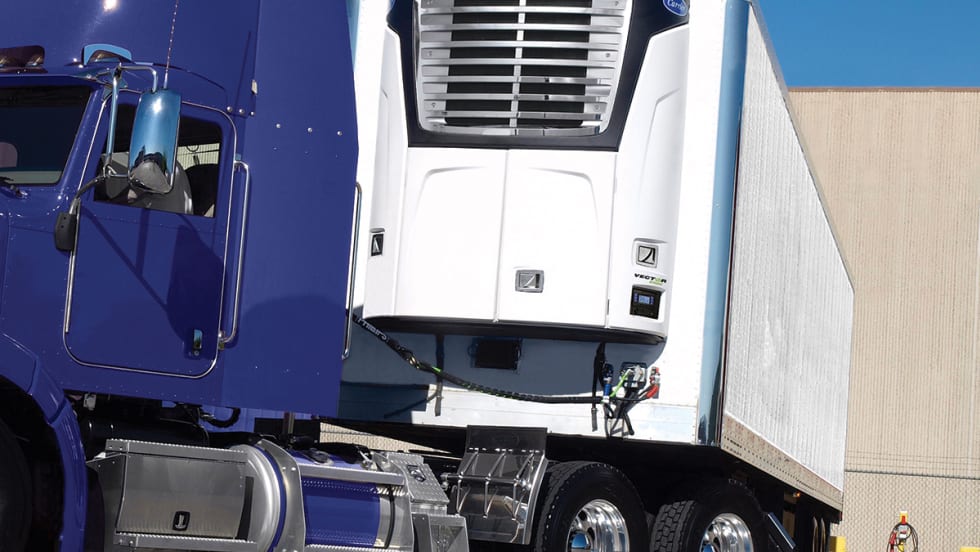
CARB Comes for Reefer Trailers
A new round of emissions control regulations decreed by the California Air Resource Board will begin affecting refrigerated trailer and TRU design and operations next year.
Read More →
5 Ways Data Analysis Maximizes the Value of Trailer Telematics
Are you getting the most out of your trailer telematics investment?
Read More →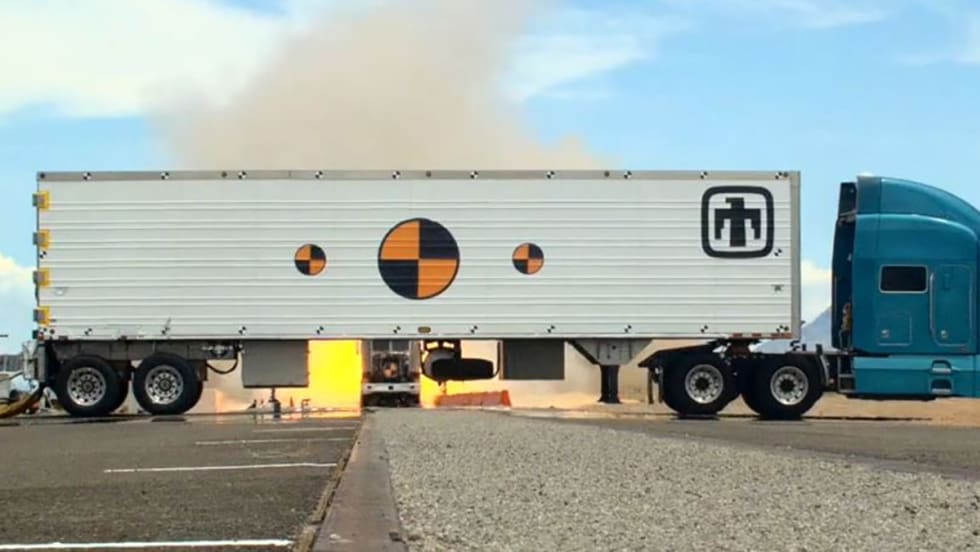
Can You Guess What's in That Trailer?
You don’t always know what’s in the trailers that pass you on the road. But some of those trailers are carrying something a little more dangerous that frozen food or new bedding…like, maybe, a nuclear weapon. But this isn’t an ordinary trailer; this is a trailer specifically made to not only carry this type of payload, but protect it at all costs.
Read More →
How Trailers Are Harnessing 'Free' Energy
Can trailers play a more active role in sustainable transport beyond aerodynamic add-ons or low-rolling-resistance tires? Some companies think so.
Read More →
Wrapping a Trailer for COVID’s Everyday Heroes
“We don’t only deliver freight. We deliver awareness.” That’s what Jim Barrett, president and CEO of Road Scholar Transport, likes to say about the Dunmore, Pennsylvania-based carrier’s “awareness fleet.” Its latest trailer wrap honors the everyday heroes of the pandemic.
Read More →
How a Tanker Fleet is Using Unorthodox Trailer Lighting to Fight Rear-End Collisions
Groendyke Transport watched the number of rear-end collisions with its trailers rise steadily until it tried an unorthodox and then unapproved method of alerting following drivers that its trucks were applying brakes and slowing down.
Read More →
The Role Trailers are Playing in COVID-19 Funerals
In places such as New York City and Detroit, overwhelmed hospitals and mortuaries are using refrigerated trailers to store the bodies of people killed by COVID-19.
Read More →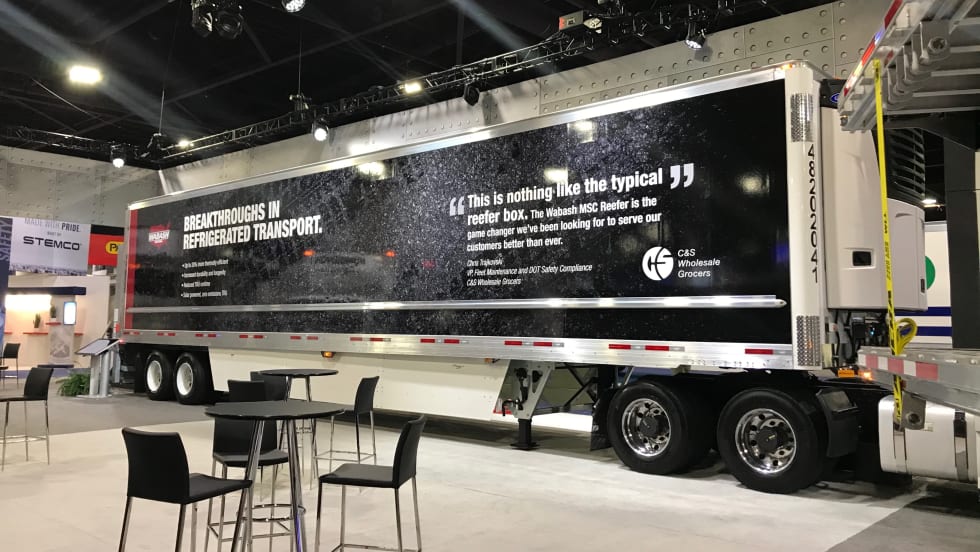
Reefer Trailer Aims to Help Reach Zero Emissions
Wabash National is partnering with C&S Wholesale Grocers to test a new type of zero-emissions refrigerated trailer.
Read More →