




Wabash Shows What a 33-Foot Pup Would Look Like
Congress is supposedly inclined to approve a proposal to allow twin 33-foot doubles. If so, trailers like this would probably become common. Tom Berg has the story from last month's TMC meeting in his Trailer Talk blog.


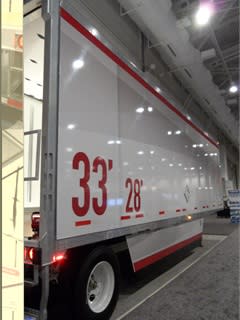
What would a 28-foot pup trailer look like if it were stretched to 33 feet? The photo of a Wabash National van at the Technology & Maintenance Council’s annual meeting and expo a few weeks ago in Nashville gives us an idea, but here are some details.
In the name of productivity and for the sake of cutting traffic congestion, the less-than-truckload segment of the industry has asked Congress to approve the idea. It would require altering a federal law limiting pups to 28 feet in length.
A pair of 33-foot pups would offer 18% more volume than the current federally approved double-trailer combination, and would require fewer trucks to move the same amount of freight over the highways. As the economy recovers and the country continues to grow, more and more freight will have to be hauled, and the industry doesn’t see how it can do it with the current restrictions and a worsening driver shortage.
Significantly, the proposal does not ask for an increase to the federally imposed weight limit of 80,000 pounds for a set of doubles (or any other five-axle rig) – a sticking point for previous ideas because more weight per axle will put more wear and tear on pavement and bridges. And it has nothing to do with long combination vehicles operating in certain states and on some toll roads.
Staying with 80,000 pounds would work for LTL carriers because their rigs usually “cube out” before they “weigh out,” meaning the trailers are filled with relatively light commodities before reaching the weight limit.
Members of Congress concerned with highway legislation are reportedly inclined to OK the idea, and passage has a good chance, observers say. If it happens, we’ll soon see a rapid conversion of 28s to 33s, and of course the building of new 33-footers.
We old-timers recall similar expansion of the nation’s fleet of 40-foot trailers to 45 feet, then 45 to 48 feet, and finally to the current 53-foot standard.
Thousands of van trailers were stretched from 45 to 48 feet in the early to mid-1980s. It was a relatively simple procedure where mechanics inserted additional wall, floor and roof material somewhere along a 45-footer’s body. Usually it was at the tail, just ahead of the doors and behind the tandem, so the stretched frame wasn’t stressed much where it was grafted on.
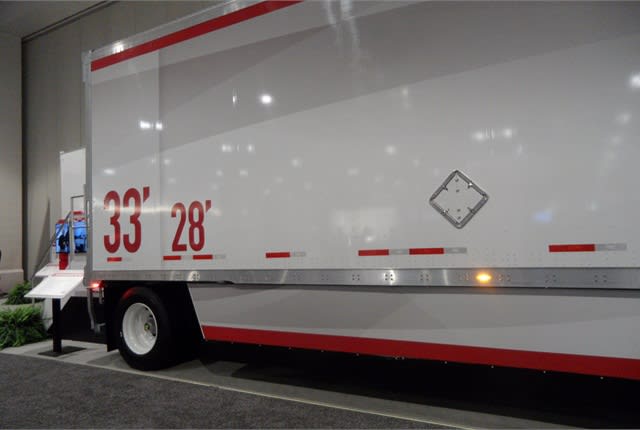
So it would mostly go with a 5-foot stretch needed for a 28-to-33-foot conversion, according to Mark Ehrlich, Wabash’s business development manager. “It would not be difficult. We have a procedure all ready,” he said, but declined to describe it for competitive reasons.
The 33-footer shown at the TMC expo was built from scratch, and carried graphics describing where its end would be if it were a common 28. Its construction is like a 28, with composite walls and other details from Wabash’s line of van trailers.
Its rear axle is close the trailer’s rear end, as with a 28. That's where it would likely stay in a stretch, to preserve the dynamics between a lead trailer and a converter dollie’s tongue, and therefore the second trailer, while going through turns. This would require moving the axle rearward after adding 5 feet of body -- nothing too complicated.
Anyway, take a look, for this could be the future.
More Blog Posts

Pulsing Back-of-Trailer Lamps Aim to Prevent Crashes
Can the addition of a pulsing brake lamp on the back of a trailer prevent rear-end collisions? FMCSA seems to think so, if its exemptions are any indication.
Read More →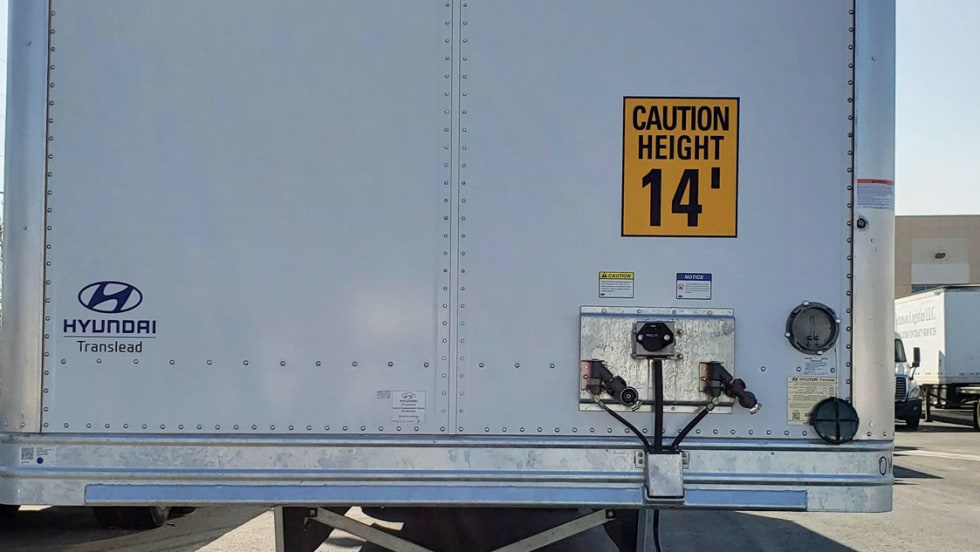
Designing a 14-Foot Trailer
Trailers are 13 feet, 6 inches high, right? Not for Hub Group, which developed a special 14-foot-high trailer spec for a dedicated customer based in California. Learn more in the Trailer Talk blog.
Read More →
CARB Comes for Reefer Trailers
A new round of emissions control regulations decreed by the California Air Resource Board will begin affecting refrigerated trailer and TRU design and operations next year.
Read More →
5 Ways Data Analysis Maximizes the Value of Trailer Telematics
Are you getting the most out of your trailer telematics investment?
Read More →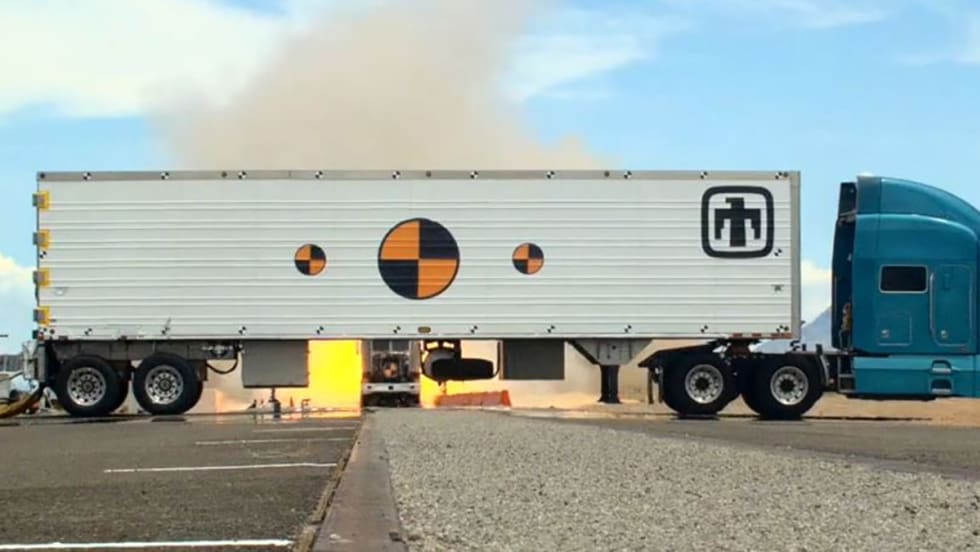
Can You Guess What's in That Trailer?
You don’t always know what’s in the trailers that pass you on the road. But some of those trailers are carrying something a little more dangerous that frozen food or new bedding…like, maybe, a nuclear weapon. But this isn’t an ordinary trailer; this is a trailer specifically made to not only carry this type of payload, but protect it at all costs.
Read More →
How Trailers Are Harnessing 'Free' Energy
Can trailers play a more active role in sustainable transport beyond aerodynamic add-ons or low-rolling-resistance tires? Some companies think so.
Read More →
Wrapping a Trailer for COVID’s Everyday Heroes
“We don’t only deliver freight. We deliver awareness.” That’s what Jim Barrett, president and CEO of Road Scholar Transport, likes to say about the Dunmore, Pennsylvania-based carrier’s “awareness fleet.” Its latest trailer wrap honors the everyday heroes of the pandemic.
Read More →
How a Tanker Fleet is Using Unorthodox Trailer Lighting to Fight Rear-End Collisions
Groendyke Transport watched the number of rear-end collisions with its trailers rise steadily until it tried an unorthodox and then unapproved method of alerting following drivers that its trucks were applying brakes and slowing down.
Read More →
The Role Trailers are Playing in COVID-19 Funerals
In places such as New York City and Detroit, overwhelmed hospitals and mortuaries are using refrigerated trailers to store the bodies of people killed by COVID-19.
Read More →
Reefer Trailer Aims to Help Reach Zero Emissions
Wabash National is partnering with C&S Wholesale Grocers to test a new type of zero-emissions refrigerated trailer.
Read More →