





Podcast: Does California's AB-5 law mean the end of the owner-operator?
The Cons of the Pro Act
The ABC test raises its head on Capitol Hill: Sweeping federal labor legislation could threaten trucking's independent contractor model.
March 22, 2021
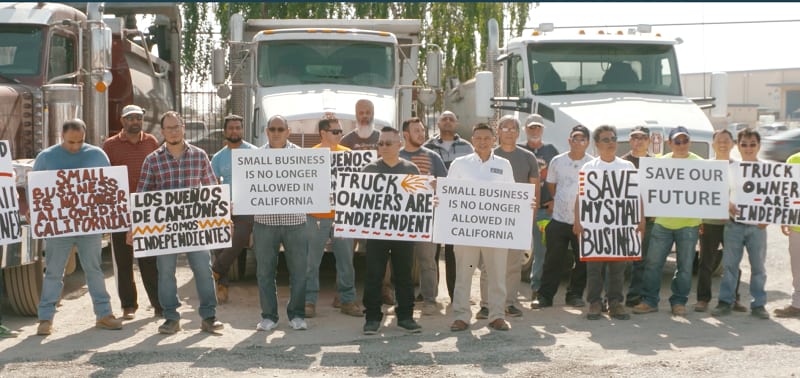
California owner-operators protest the state's AB5 law. Critics say a provision of the federal Pro Act would extend a controversial provision of AB5 nationwide.
Photo: California Trucking Association
6 min to read
In theory, labor unions can be a good thing. In the past, they have helped address workplace abuses that we would see as unthinkable today, such as child labor and incredibly dangerous working conditions.
Unions have been in the headlines lately. I live in Alabama, where an effort to unionize the first Amazon warehouse has drawn national attention. Workers have said the work is dehumanizing, citing an unrelenting pace set by algorithms, a risk of being terminated at any point, constant surveillance, and not having time to leave a workstation to get water or go to the bathroom.
Officially, Amazon says it respects its employees’ rights to join a union. But the widely reported tactics the e-commerce behemoth has been taking to fight the union drive doesn’t seem to back up that statement. According to published reports, the company has been sending anti-union text messages to workers’ personal cellphones, covered the warehouse with anti-union signs and flyers (including in the bathrooms), and allegedly even asked the county to change the traffic light patterns in front of the warehouse to empty the lot more quickly after a shift – so union organizers would have less time to hand out union information to workers stopped at the light.
Against that backdrop, the U.S. House of Representatives earlier this month passed H.R. 842, the Protecting the Right to Organize Act (Pro Act), which it says would make it easier for unions to organize. In fact, some legal observers have said the Pro Act would be the biggest labor relations legislation since the National Labor Relations Act of 1935.
Many business organizations have spoken out against it, including in trucking. I'm not going to get into the details of the union-organizing aspects of the bill here. The most troubling aspect of the Pro Act, from my perspective, is how it would attack the independent contractor model.
Independent Contractor Model Under Fire
I started off in this business more than 30 years ago writing for a magazine for owner-operators, and I’ve spent nearly 23 years writing and editing for the fleet management readers who are the primary audience of HDT. So I’ve heard about independent contractor issues from both the contractor and the company side of things.
The issue here is “worker misclassification,” where employers say their workers are independent contractors so they can avoid employment taxes, workers’ comp and other expenses. And to be sure, this does exist, including in trucking. There have been some really problematic lease-purchase programs where drivers seemed to be set up to fail. Abuses of contractor drivers have been documented in port/drayage trucking.
But the government simply decreeing that these types of workers are employees is not the right way to address these abuses. And that’s basically what the “ABC test” does, which the Pro Act would adopt.
The ABC test isn’t new, but it generated a great deal of controversy in California when the state legislature decided to enshrine it into law in 2019 in Assembly Bill 5. An article I wrote about that bill, California Bill Means 'End for Independent Trucking' in State, shattered our company records for the most traffic for a web story.
Under the ABC test, all workers are considered employees unless the hiring business demonstrates that three factors are established:
A. That the worker is free from the control and direction of the hirer in connection with the performance of the work, both under the contract for the performance of the work and in fact.
B. That the worker performs work that is outside the usual course of the hiring entity’s business.
C. That the worker is customarily engaged in an independently established trade, occupation or business of the same nature as that involved in the work performed.
Opponents say the B prong could make it impossible for truck drivers to work as an independent contractor for a motor carrier. If you’re a trucking company, you could get an independent contractor to do your landscaping, but you couldn’t get an independent contractor to drive a truck, because driving a truck is part of the “usual course of business.”
Currently, enforcement of the ABC test against trucking companies in California is on hold while litigation challenging the law works its way through the courts.
Now the Pro Act would extend the ABC test well beyond the borders of California.
Just How Sweeping Would Federal ABC Test Be?
Trucking groups such as the Truckload Carriers Association are asking Congress to consider the impact the legislation would have on trucking and the long history of success of the leased owner-operator model.
Even the Owner-Operator Independent Drivers Association, which has spoken out against abuse of owner-operator lease programs, said this law is not the right way to go about addressing those abuses.
“While we believe there is much that must be done to improve working conditions and compensation in trucking, the Pro Act would create confusion for drivers and motor carriers and jeopardize small-business truckers’ ability to utilize the owner-operator model,” OOIDA wrote in a letter to the U.S. House of Representatives signed by President Todd Spencer.
The National Retail Federation puts the independent contractor issue at the top of its reasons to hate the bill, which it called "the worst bill in Congress."
Proponents of the Pro Act say that unlike California’s AB 5, the Pro Act does not regulate employees’ wages and benefits, meaning companies won’t suddenly have to pay for new perks to those who are being reclassified. The Pro Act would only apply the ABC test to determine if workers are employees for the purposes of union organizing.
However, critics believe the change would likely have a greater effect.
“While we understand that the Pro Act is designed to specifically address classification issues for the purposes of labor organizing, we believe that in practice the test may also be expanded to classify workers under other laws,” OOIDA wrote. “We are also concerned with the precedent this legislation would set, as we anticipate that Congress will expand this ‘employee’ definition to cover other federal laws.”
The U.S. Chamber of Commerce said in a blog post: “It also is quite likely that once this ABC test is established under one law, it will be the pretext for it to spread into other areas.” In that blog, Sean P. Redmond, executive director of labor policy at chamber, goes on to explain:
Other parts of the PRO Act mean that the impact on independent contractors and freelancers will not be limited just to those who “choose to organize.” For example, the PRO Act eliminates right-to-work laws, so that any freelancer pulled into a union would be forced to pay union fees or likely lose their job. And even freelancers and independent contractors who voted “no” on a union would still be bound by all the wages and working conditions negotiated in a union contract because of the laws around exclusive representation. Moreover, because these elections are decided by a majority of those who actually vote (and given the decentralized nature of independent contracting, many workers would be unlikely to even realize there’s an election) independent workers could easily be dragged into a union that only enjoyed minority support.
The good news is, passage in the Senate is viewed as unlikely. However, it’s a good indication of the Democrats’ and Biden administration’s views on labor issues and the contractor-vs-employee debate.
Subscribe to Our Newsletter
More Blog Posts

Beyond the Central Transport Settlement: Lessons on Hiring and Risk
The $5.5 million discrimination settlement raises broader questions about hiring practices, safety performance, and the hidden risks that can lurk in a fleet's recruiting process.
Read More →
Are Diesel Shortages Something to Worry About Again?
There’s a certain déjà vu when tensions flare in the Middle East and diesel price spikes can give you panic attacks. What parallels are there between the current situation and the 1970s energy crisis?
Read More →
NOx Isn’t Laughing Gas. Let’s Clear That Up.
A recent EPA reference mixed up NOx and nitrous oxide. It’s an easy mistake. Just not one you expect to see in emissions policy. Let’s look at the difference.
Read More →
TMC 2025 Takeaway 2: Buy... or Subscribe?
TaaS. Does that mean trucks as a service, trailers as a service, or tires as a service? HDT's Deborah Lockridge has another takeaway from the Technology & Maintenance Council meeting in her blog.
Read More →
TMC 2025 Takeaway: The Journey Toward Vertical Integration
HDT's Deborah Lockridge on how the trucking industry has moved toward "vertical integration" over the past 25 years.
Read More →
Trucks Are For Girls!
HDT Editor and Associate Publisher Deborah Lockridge is a longtime Girl Scout leader and loves to connect her passion for inspiring girls with her love of the trucking industry.
Read More →
Trucking Advocacy: Impact Beyond the 2024 Elections
No matter who wins the election, trucking continues to work to educate the people who pass the laws and make the rules that affect the industry. HDT's Deborah Lockridge shares insights from two major trucking associations in her All That's Trucking blog.
Read More →
Recharge Your Brain for Better Business
Skimping on vacation may be the worst thing you can do for your business, your career, and your mental health. In her All That's Trucking blog, Deborah Lockridge writes about the importance of giving your brain what it needs to be innovative.
Read More →
Trucker Pre-Trip Leads to Mission 'Im-paw-sible'
See what happened when a truck driver found an unexpected stowaway during his pre-trip inspection.
Read More →
HDT Editor: 2023's Most Important Trucking Topics
Read Deborah Lockridge's picks for the most significant stories we covered at HDT in 2023: freight recession, zero-emission trucks, drivers and marijuana, and more.
Read More →