




Some states are backing away from 'killer chemical' de-icers
Here's some welcome news: Some states are looking for alternatives to de-ice their roads, instead of the extremely corrosive magnesium chloride and calcium chloride de-icers that have vexed the trucking industry for the past decade
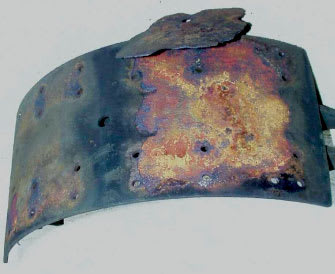
Brake shoe corrosion was one of the early indicators of a problem with new de-icers.
Here's some welcome news: Some states are looking for alternatives to de-ice their roads, instead of the extremely corrosive magnesium chloride and calcium chloride de-icers that have vexed the trucking industry for the past decade.
Last week, the Great Falls (Montana) Tribune reported on how the state is expanding its use of a salt brine mixture, with less than one-fourth salt, instead of the magnesium chloride that's been used in recent years to melt the snow on state highways going through Great Falls. (The chemical will still be used in some outlying areas where there's no brine-mixing facility.)
Ironically, that article reports that people are worried about the effect of the salt brine on their cars. Obviously they don't know what those in trucking learned the hard way, that magnesium chloride is much worse.
Killer Chemicals
We first reported on these "killer chemicals" back in 2001, in the September issue of HDT.
Back in the early 1990s, the people who maintain roads in cold climates thought they had found a miracle. It came in the form of a chemical compound, a liquid solution of magnesium and chloride, that lowers the freezing point of water. When sprayed onto roads before a storm, mag chloride prevents snow from sticking and ice from forming.
Everywhere they looked, state road departments saw benefits from mag chloride. By keeping roads clear they prevented accidents and kept traffic moving. They didn't have to use as much sand, so they had less pollution. Less salt meant fewer complaints about corrosion, and less environmental damage to farmers' fields. The chemical was more expensive than their traditional tools, but when they were done with the math it was no contest: mag chloride delivered more than it cost.
But like so many things, if it sounds too good to be true, it probably is. By 2001, fleets that had been exposed to mag chloride were reporting that their wiring systems were deteriorating at an alarming rate. Others were seeing corrosion in structural elements that could lead to catastrophic failure at highway speed. One maintenance vice president at a national LTL fleet described pushing his pen clean through a structural element on a trailer suspension that he believes had been rotted by mag chloride. And as then-Executive Editor Jim Winsor reported in his column in that issue, rust-jacking of brakes was a major concern.
By November 2007, when we ran my article "The Monster That's Eating Your Rigs," we had learned that some of the properties that make mag chloride and calcium chloride so good at keeping roads clear are the same characteristics that make them so destructive.
They don't evaporate, so they stick around, not only keeping the snow melted, but also getting on vehicles even after the snow's gone. They are highly soluble in water, making for a finer mist of spray that gets into tinier cracks and crevices, And they are hygroscopic, meaning the absorb moisture -- so even when the weather and your equipment are dry, they can suck moisture out of the air, continuing their deadly work of seeping into the tiniest cracks.
The American Trucking Associations' Technology & Maintenance Council calculated what corrosion is costing the industry, based on a 2004 survey of fleets and available statistics on the number of commercial vehicles.
If you assume that during a four-year period, each of the 2.35 million Class 6-8 commercial vehicles in the country has to have its wiring, two sets of brake shoes and drums, lights, a fuel tank, a radiator and a mirror bracket replaced, you're looking at $2.4 billion to $4 billion a year. That doesn't even take into account trailer corrosion costs, the costs of frequent washings, or the cost of road calls - and 63% of the fleets responding to the TMC survey said they had experienced road calls due to corrosion.
Better alternatives
Now it seems that states in the Pacific Northwest are looking for better alternatives. Montana, Idaho, Washington, Oregon and the Canadian province British Columbia joined together several years ago to develop specifications for the chemicals used to combat snow and ice on roadways. The group is known as the Pacific Northwest Snowfighters Association. According to its website, it was formed to evaluate and establish specifications "for products used in winter maintenance that emphasize safety, environmental preservation, infrastructure protection, cost-effectiveness and performance."
Transportation Nation reports that Montana also is using a "green" corn-sugar mix to help with the de-icing.
The Montana DOT recently awarded a one-year contract to Rivertop Renewables of Missoula, Mont., to provide about 110,000 gallons of a corn-sugar based inhibitor named "Headwaters" to mix with its salt brine de-icer.
As Rivertop's Dave Wilkening told Transportation Nation, "There's a growing understanding that corrosion is a large expense. For example, a bridge deck costs multi-millions of dollars. So if you can reduce that by reducing the corrosive effects of de-icing salts you've saved the taxpayers millions of dollars in replacement fees just by increasing the service life of bridge decks, equipment, guard rails, signage."
Not to menton truck parts!
More Blog Posts
The Diesel Price Crisis Has No Easy Fix
Washington is trying everything from oil-reserve releases to longer driving hours for fuel haulers. None addresses all the forces keeping diesel prices high.
Read More →
Beyond the Central Transport Settlement: Lessons on Hiring and Risk
The $5.5 million discrimination settlement raises broader questions about hiring practices, safety performance, and the hidden risks that can lurk in a fleet's recruiting process.
Read More →
Are Diesel Shortages Something to Worry About Again?
There’s a certain déjà vu when tensions flare in the Middle East and diesel price spikes can give you panic attacks. What parallels are there between the current situation and the 1970s energy crisis?
Read More →
NOx Isn’t Laughing Gas. Let’s Clear That Up.
A recent EPA reference mixed up NOx and nitrous oxide. It’s an easy mistake. Just not one you expect to see in emissions policy. Let’s look at the difference.
Read More →
TMC 2025 Takeaway 2: Buy... or Subscribe?
TaaS. Does that mean trucks as a service, trailers as a service, or tires as a service? HDT's Deborah Lockridge has another takeaway from the Technology & Maintenance Council meeting in her blog.
Read More →
TMC 2025 Takeaway: The Journey Toward Vertical Integration
HDT's Deborah Lockridge on how the trucking industry has moved toward "vertical integration" over the past 25 years.
Read More →
Trucks Are For Girls!
HDT Editor and Associate Publisher Deborah Lockridge is a longtime Girl Scout leader and loves to connect her passion for inspiring girls with her love of the trucking industry.
Read More →
Trucking Advocacy: Impact Beyond the 2024 Elections
No matter who wins the election, trucking continues to work to educate the people who pass the laws and make the rules that affect the industry. HDT's Deborah Lockridge shares insights from two major trucking associations in her All That's Trucking blog.
Read More →
Recharge Your Brain for Better Business
Skimping on vacation may be the worst thing you can do for your business, your career, and your mental health. In her All That's Trucking blog, Deborah Lockridge writes about the importance of giving your brain what it needs to be innovative.
Read More →
Trucker Pre-Trip Leads to Mission 'Im-paw-sible'
See what happened when a truck driver found an unexpected stowaway during his pre-trip inspection.
Read More →