




Sensing a Disruption
In his new Passing Zone blog, Executive Editor David Cullen examines vehicle-mounted sensors - a deceptively disruptive technology that has in many ways reshaped the trucking landscape.

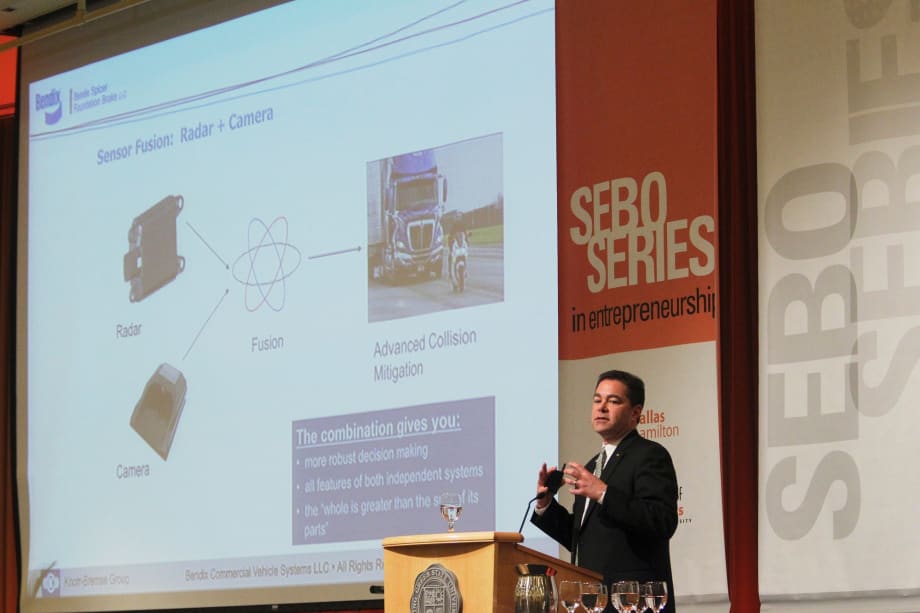
Joe McAleese, speaking at the Sebo Series in Entrepreneurship conference. Photo: Bendix
Joe McAleese, speaking at the Sebo Series in Entrepreneurship conference. Photo: Bendix
To paraphrase Merriam-Webster, “disruptive” defines an action that interrupts the normal progress or activity of something.
Protesting in public can be described as disruptive, as can a bad patch of weather that plays havoc with our travel plans or a barking dog that deprives us of sleep.
Yet a disruptive action can be positive, indeed very constructive; even radically game-changing. And so it is with vehicle-mounted sensors.
Yes, sensors. Everyone who deals up close and personal with today’s vehicles— cars, trucks, even trailers—knows they are chockablock with electronic sensors. But so long as sensors function, why pay them any thought?
Because sensors are a perfect example of how even a truly unassuming bit of technology can have a powerful impact on business, according to Joe McAleese, chairman, president, and CEO of Bendix Commercial Vehicle Systems LLC.
Addressing the Sebo Series in Entrepreneurship conference held this month at Bowling Green (Ohio) State University (BGSU), McAleese explained how “sensing technologies” are reshaping the vehicle landscape.
In his talk, McAleese, a BGSU alumnus, detailed how sensors are evolving in both the automotive and commercial vehicle industries to work positively as a “disruptive technology” that's "driving new approaches that provide significant performance and efficiency benefits.”
Making his case, McAleese pointed out that sensors initially changed the scope of combustion- engine management in the automotive sector. Sensors enabled the move from carburetors to fuel injectors, which he said “contributed to a restructuring of the industry.”
As for trucks, he explained how sensors “evolved the braking system.” That process began with the development of ABS, which in turn led to electronic stability-control systems.
And now, by integrating advanced sensor and mechatronic systems development, McAlesse said sensors are serving as “the foundation” for the development of what he termed driver-assistance systems.
“The topic of advanced technologies in automobiles and commercial vehicles is close to my heart, and I was delighted to offer a look at sensing innovations that represent a fundamental change in vehicle development,” McAleese said in a post-conference statement.
“Being part of a company that is a longtime leader in pioneering game-changing technologies,” he added, “I’m fortunate to have a close-up view of advancements that are truly ‘disruptive.’ These technologies will continue to have a major impact on our lives.”
More Blog Posts

Congress Dancing on the Ceiling. Again.
It’s time once more on Capitol Hill to battle over the debt ceiling, rather than conduct the nation’s urgent business, says HDT Business/Washington Contributing Editor David Cullen.
Read More →
Infrastructure on Capitol Hill: On Two Tracks to Somewhere
It’s likely an infrastructure bill will pass. But how big it will be, and who will pay for it, rides on lots of politicking.
Read More →
Gaming Out The Biden Infrastructure Proposal on Capitol Hill
The Biden Administration's American Jobs Act, the core of which is infrastructure funding, is on a long road to becoming law – replete with more twists and turns than a mountain highway.
Read More →
4 Ways Washington May Change Trucking Laws and Regulations
As the balance of power in Washington has shifted, trucking likely will see changes in laws and regulations. But how that happens isn't just like the Schoolhouse Rock version of "I'm Just a Bill."
Read More →
Regulatory Outlook 2020: Keep an Eye on Hours of Service
What's in store for trucking from the regulators in Washington, D.C., this year? Executive Editor David Cullen says the government wheels move slowly, but hours-of-service is among those to watch in 2020.
Read More →
Logistics Ain't What it Used to Be
You can no longer expect to run a motor carrier of any size without at least a glancing appreciation for the impact logistics— in one way or another-- has on every link in the supply chain.
Read More →
Will Dustup over Cleanup of Car Emissions Gut Truck GHG Rules?
What does Trump's revocation of California's vehicle emission waiver mean for the federal Phase 2 GHG emission rules already in place for commercial vehicles? Commentary by Executive Editor David Cullen.
Read More →
Some Sober Advice on the Drug & Alcohol Clearinghouse
The Federal Motor Carrier Safety Administration's prep work for the Drug & Alcohol Clearinghouse includes amassing an impressive amount of informational guidance online that can be accessed at a dedicated website. Commentary by Executive Editor David Cullen.
Read More →
Here's to Our Winners
The managers, executives, and owners of truck operations who are honored each year by Heavy Duty Trucking with our Truck Fleet Innovator awards so often seem to be moving at a fast clip in how they think about things. Blog Commentary by Executive Editor David Cullen.
Read More →
ATA Takes Madison Avenue to Pitch Highway Funding on Capitol Hill
A new advertising and grassroots campaign by ATA might just sell Congress on fixing our roads. Commentary by David Cullen, Executive Editor.
Read More →