




One Trucking Fleet's Quest for Fuel Savings
Royal Jones was an 18-year-old truck driver when he founded a trucking company in 1981 with truck mechanic Jimmy Ray. The two, who also were race car drivers, were early on obsessed with aerodynamics and fuel efficiency.

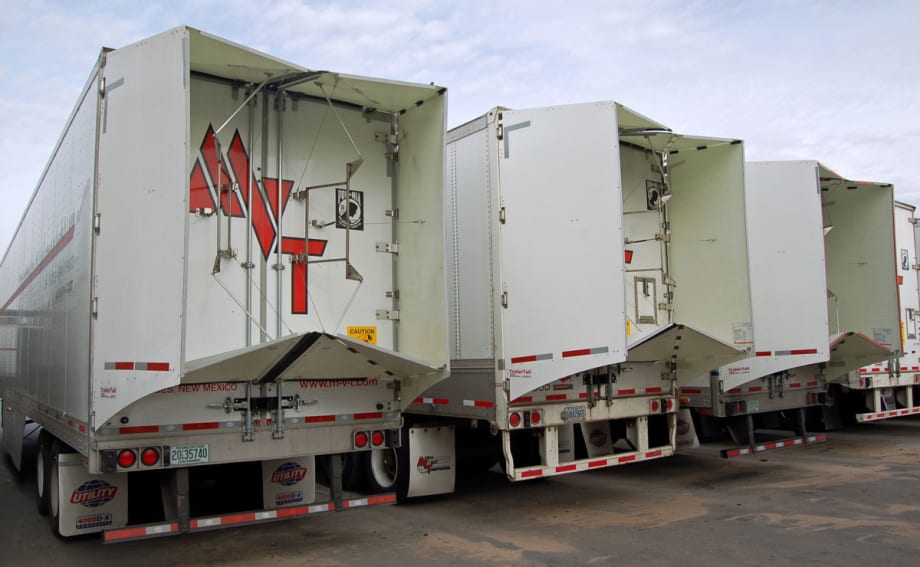
Aerodynamic TrailerTails are just part of an exhaustive fuel-economy spec at Mesilla Valley Transportation.
Photo: Mesilla Valley Transportation
As I was working on our "100 Ways to Save on Fuel" project for our June issue (which actually ended up at 121 ways), I remembered a session on fuel economy with Scott Webb, an executive from Mesilla Valley Transportation, presented at the ATA's Technology & Maintenance Council Meeting earlier this year. MVT and co-founder Royal Jones are known in their industry for their attention to fuel economy.
Royal Jones was an 18-year-old truck driver when he founded the company in 1981 with truck mechanic Jimmy Ray. They began with three rigs, hauling refrigerated perishable goods from Las Cruces, N.M.
The two, who also were race car drivers, Webb said, "were early on obsessed with aerodynamics and fuel efficiency."
In 1984, just three years after it was founded, MVT tried to quantifiably test the effect of aerodynamic specs. So they painted a line across eastbound I-10 and let the truck coast down a long gradual hill.
"If the truck went faster, we knew we were doing something good," explained Webb. "Of course we're a lot more sophisticated now."
Headquartered in Las Cruces, N.M., MVT has a high average length of haul, so aerodynamics are a big deal. Right now it's averaging 1,150 miles – and unlike a lot of companies that are pulling down their average length of haul, MVT would like to get its numbers up closer to 1,300.
About 40% of the loads originate or terminate in Mexico. There are 1,150 trucks, 850 of them company trucks, and about 4,700 trailers.
"We support a lot of drop and hook initiatives, which we think are great for driver retention and utilization," Webb noted, "but it's bad from an aerodynamic standpoint because of the investment needed."
MVT's average fuel mileage started off at 3.5 in the early '80s, got to 6.5 by 2010, and saw some extraordinary performance. In 2009, more than 15 drivers achieved more than 12 mpg. Because of the EGR engines in the 2000s, mileage dropped to about 8 mpg — performance many fleets would love to have — but has since been trending back upward.
Some Highlights of Mesilla Valley's Fuel Efficiency Journey
1981: From the start, Royal and Jimmy Ray both realized the importance of human factors on fuel economy, so they put a strong emphasis on driving habits during orientation – things such as driving the top of the pedal and not following too closely. They also were early adopters of on/off fan clutches.
1985: MVT realized that minimizing the gap between tractor and trailer was a critical piece of the puzzle, so they put in a fixed fifth wheel and over time have continued to reduce the gap.
1986: You can't manage what you can't measure, so as soon as it was available, MVT started doing laptop downloads from the engine control module and providing that information to the driver. Today, with onboard telematics, the driver gets that feedback daily.
2003: MVT started running super-single low-rolling-resistance tires.
2005: The company started giving away a big prize, like a new car or Harley Davidson, each quarter to the driver with the best fuel economy, as well as $25,000 cash for the driver with the best fuel economy of the year.
2007: MVT a major spec change and went with the International ProStar for aerodynamic reasons, with a 6x2 transmission and non-powered tag axle on the duals. They went with all APUs, tractor wheel covers and other things, including more extensive use of wide-based singles.
2008: Installed trailer skirts on 100% of trailers. "We started with ones we manufactured ourselves, but ended up going with aftermarket skirts later after the ones we made got torn up."
2010: Mesilla Valley Transportation discovered narrower mudflaps would streamline airflow, so they started cutting them down. They also started using tire sealant to prevent costly air loss.
2010: A conversion to electronic logs has actually cut into fuel economy. "We found under paper logs, drivers would drive slower," and fudge their logbooks. "We've seen the average velocity of trucks going up quite a bit" as drivers struggle to get the loads delivered in the time legally allowed.
2013: The switch to all-SCR engines helped bring fuel economy back up, as well as a more complex and more lucrative driver performance incentive that also includes non-fuel-economy items such as hours of service violations and service failures.
"The point of all of this is that high mpg is profitably attainable," Webb said.
Read more about MVT's fuel-saving strategies:
More Blog Posts

Beyond the Central Transport Settlement: Lessons on Hiring and Risk
The $5.5 million discrimination settlement raises broader questions about hiring practices, safety performance, and the hidden risks that can lurk in a fleet's recruiting process.
Read More →
Are Diesel Shortages Something to Worry About Again?
There’s a certain déjà vu when tensions flare in the Middle East and diesel price spikes can give you panic attacks. What parallels are there between the current situation and the 1970s energy crisis?
Read More →
NOx Isn’t Laughing Gas. Let’s Clear That Up.
A recent EPA reference mixed up NOx and nitrous oxide. It’s an easy mistake. Just not one you expect to see in emissions policy. Let’s look at the difference.
Read More →
TMC 2025 Takeaway 2: Buy... or Subscribe?
TaaS. Does that mean trucks as a service, trailers as a service, or tires as a service? HDT's Deborah Lockridge has another takeaway from the Technology & Maintenance Council meeting in her blog.
Read More →
TMC 2025 Takeaway: The Journey Toward Vertical Integration
HDT's Deborah Lockridge on how the trucking industry has moved toward "vertical integration" over the past 25 years.
Read More →
Trucks Are For Girls!
HDT Editor and Associate Publisher Deborah Lockridge is a longtime Girl Scout leader and loves to connect her passion for inspiring girls with her love of the trucking industry.
Read More →
Trucking Advocacy: Impact Beyond the 2024 Elections
No matter who wins the election, trucking continues to work to educate the people who pass the laws and make the rules that affect the industry. HDT's Deborah Lockridge shares insights from two major trucking associations in her All That's Trucking blog.
Read More →
Recharge Your Brain for Better Business
Skimping on vacation may be the worst thing you can do for your business, your career, and your mental health. In her All That's Trucking blog, Deborah Lockridge writes about the importance of giving your brain what it needs to be innovative.
Read More →
Trucker Pre-Trip Leads to Mission 'Im-paw-sible'
See what happened when a truck driver found an unexpected stowaway during his pre-trip inspection.
Read More →
HDT Editor: 2023's Most Important Trucking Topics
Read Deborah Lockridge's picks for the most significant stories we covered at HDT in 2023: freight recession, zero-emission trucks, drivers and marijuana, and more.
Read More →