




For greener roads, make them stiffer
Think about how much more energy it takes you to walk on a sandy beach than on a firm floor. That's essentially what's happening when cars and trucks drive on asphalt roads, say researchers, and if those roads could be made stiffer, the nation could save a lot of fuel and greenhouse gas emissions.
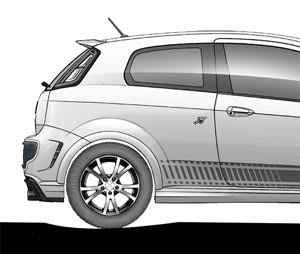
When the tires roll over a roadway, the maximum pavement deflection is just behind the path of travel. It's like continually driving up a slope (exaggerated in this illustration).
Think about how much more energy it takes you to walk on a sandy beach than on a firm floor. That's essentially what's happening when cars and trucks drive on asphalt roads, say researchers, and if those roads could be made stiffer, the nation could save a lot of fuel and greenhouse gas emissions.
A study by MIT civil engineers found stiffening the nation's pavements could cut fuel use by 3%, the equivalent of 273 million barrels of crude oil, or $15 billion, per year. As a result, CO2 emissions would fall by 46.5 million metric tons per year (more than Oregon emits from burning fossil fuels annually).
When the tires of a car or truck roll over a roadway, the maximum pavement deflection is just behind the path of travel. This has the effect of making the vehicle's tires roll continuously up a slight slope.
The researchers compare it to walking on beach sand: With each step, the foot tamps down the sand from heel to toe, requiring the pedestrian to expend more energy than when walking on a hard surface. On the roadways, even a 1% increase in aggregate fuel consumption leaves a substantial environmental footprint.
We all know asphalt is essentially soft; the rutting seen at busy intersections is proof of that.
Stiffer pavements can be achieved by improving the material properties or increasing the thickness of the asphalt layers, switching to a concrete layer or asphalt-concrete composite structures, or changing the thickness or composition of the sublayers of the road. This would decrease deflection and reduce that footprint.
A recent science blog reports that one study found nanoclay additions (nanoparticles of layered mineral silicates) improve the shear resistance of asphalt mixtures, and believes the additions may also improve the stability of future asphalt pavements.
Of course, proponents of concrete say this means road builders should be turning to concrete, rather than asphalt: "Can Building Concrete Roads Safe 50 Million Tons of C02?"
"Better pavement design over a lifetime would save much more money in fuel costs than the initial cost of improvements," MIT says in a statement. "And the state departments of transportation would save money while reducing their environmental footprint over time, because the roads won't deteriorate as quickly."
The MIT researchers say the study is the first to use mathematical modeling rather than roadway experiments to look at the effect of pavement deflection on vehicle fuel consumption across the entire U.S. road network.
Read more: MIT News: Civil engineers find savings where the rubber meets the road
More Blog Posts

Beyond the Central Transport Settlement: Lessons on Hiring and Risk
The $5.5 million discrimination settlement raises broader questions about hiring practices, safety performance, and the hidden risks that can lurk in a fleet's recruiting process.
Read More →
Are Diesel Shortages Something to Worry About Again?
There’s a certain déjà vu when tensions flare in the Middle East and diesel price spikes can give you panic attacks. What parallels are there between the current situation and the 1970s energy crisis?
Read More →
NOx Isn’t Laughing Gas. Let’s Clear That Up.
A recent EPA reference mixed up NOx and nitrous oxide. It’s an easy mistake. Just not one you expect to see in emissions policy. Let’s look at the difference.
Read More →
TMC 2025 Takeaway 2: Buy... or Subscribe?
TaaS. Does that mean trucks as a service, trailers as a service, or tires as a service? HDT's Deborah Lockridge has another takeaway from the Technology & Maintenance Council meeting in her blog.
Read More →
TMC 2025 Takeaway: The Journey Toward Vertical Integration
HDT's Deborah Lockridge on how the trucking industry has moved toward "vertical integration" over the past 25 years.
Read More →
Trucks Are For Girls!
HDT Editor and Associate Publisher Deborah Lockridge is a longtime Girl Scout leader and loves to connect her passion for inspiring girls with her love of the trucking industry.
Read More →
Trucking Advocacy: Impact Beyond the 2024 Elections
No matter who wins the election, trucking continues to work to educate the people who pass the laws and make the rules that affect the industry. HDT's Deborah Lockridge shares insights from two major trucking associations in her All That's Trucking blog.
Read More →
Recharge Your Brain for Better Business
Skimping on vacation may be the worst thing you can do for your business, your career, and your mental health. In her All That's Trucking blog, Deborah Lockridge writes about the importance of giving your brain what it needs to be innovative.
Read More →
Trucker Pre-Trip Leads to Mission 'Im-paw-sible'
See what happened when a truck driver found an unexpected stowaway during his pre-trip inspection.
Read More →
HDT Editor: 2023's Most Important Trucking Topics
Read Deborah Lockridge's picks for the most significant stories we covered at HDT in 2023: freight recession, zero-emission trucks, drivers and marijuana, and more.
Read More →