




Flowers Foods Facing Employee Misclassification Problems
The Department of Labor may be getting involved in an employee “misclassification” situation involving delivery drivers at Flowers Foods, the Georgia-based company that owns Wonder Bread, Nature’s Own, Tastykake and other brands.

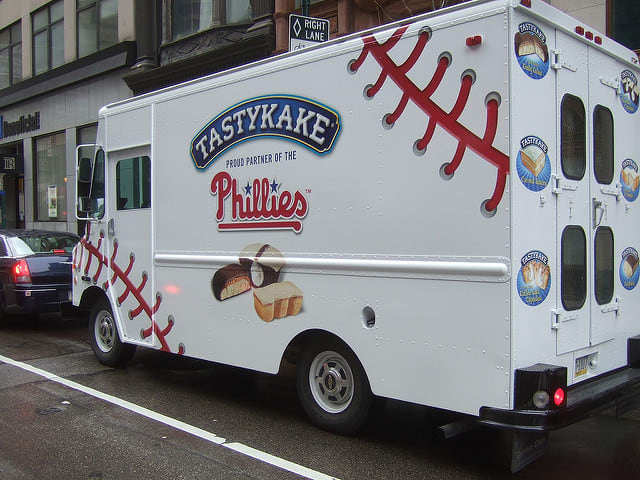
Tastykake is one of many brands owned by Flowers Foods. 2009 photo by Ezra Wolfe, used under Creative Commons license.
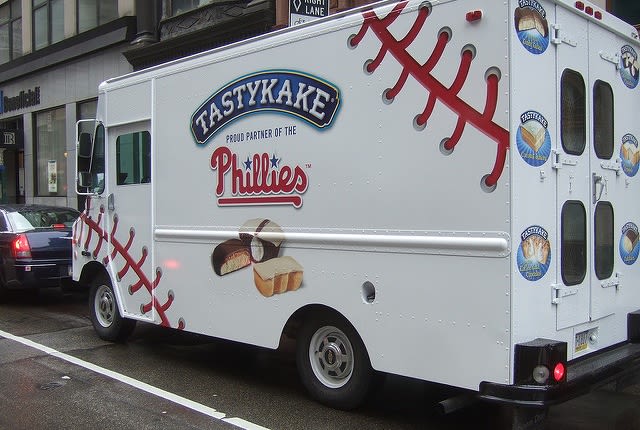
Tastykake is one of many brands owned by Flowers Foods.2009 photo by Ezra Wolfe, used under Creative Commons license.
The Department of Labor may be getting involved in an employee “misclassification” situation involving delivery drivers at Flowers Foods, the Georgia-based company that owns Wonder Bread, Nature’s Own, Tastykake and other brands.
This week, the U.S. Department of Labor notified Flowers Foods Inc. that it has been scheduled for a compliance review under the Fair Labor Standards Act. The company simply said it intends to cooperate, but because the review process is confidential, it has no further comment at this time.
However, observers believe the review has to do with the bakery giant’s alleged misclassification of drivers.
According to a report in the Wall Street Journal, the company already faces nearly two dozen lawsuits from delivery drivers saying they are misclassified as independent contractors and really should be classified as employees.
“One of the first misclassification claims against Flowers, brought in North Carolina in 2012 and granted class status in March of last year, is slated for trial in October,” says the WSJ.
The paper also notes that “FLSA investigations have been rare. But last July the Labor Department issued guidance suggesting businesses examine the issue of misclassification and consider designating more of their independent contractors as employees. Since then, the Labor Department has brought at least two cases against other companies over misclassification.”
A Forbes article from earlier this year explains how Flowers’ system appears to run afoul of guidance issued last year by the Department of Labor that was characterized as a “shot across the bow” by one legal advisor.
As I reported last year, that guidance offered an interpretation of “economic realities” as it applies to the Fair Labor Standards Act (FLSA). The guidance said “most workers are employees under the FLSA,” and that a worker is an employee based on the “economic realities…not by job titles or any agreement the parties may make.”
The “economic realities” test has been used by several courts and regulatory agencies for years and includes the following factors:
The extent to which the work performed is an integral part of the employer’s business;
The worker’s opportunity for profit or loss depending on his or her managerial skill;
The extent of the relative investments of the employer and the worker;
Whether the work performed requires special skills and initiative;
The permanency of the relationship; and
The degree of control exercised or retained by the employer.
Let’s look at just one of those: the relative investments of the employer and the worker. The Forbes article reports that according to the Flowers 10-k, “when an independent distributor terminates their relationship with the company, the company, although not legally obligated, generally purchases and operates that territory utilizing the leased truck of the former distributor….Once the territory is resold to an independent distributor, the truck lease is assumed by the new independent distributor.”
So the contractor doesn’t really appear to be having to bear the risk.
In February, as Forbes.com reported, as most Wall Street analysts rated Flowers a “buy,” Timothy Ramey of Pivotal Research rated it a “sell.”
Why? Ramey said much of Flowers’ earnings growth was due to the fact that since drivers were independent contractors rather than company employees, Flowers enjoyed a lower distribution cost than competitors.
After the news came out about the Department of Labor case, Ramey cut his price target on the stock in half, to $4 per share.
This story is just the latest in a string of employee misclassification cases faced by trucking operations. Just last month, a class-action lawsuit representing nearly 400 Southern California port truck drivers resulted in a $5 million settlement agreement with port trucking company group QTS.
Many states have been trying to crack down on what they see as a serious labor issue, and California is a hotbed of such activity, especially with the Teamsters union pushing for port drayage drivers to become employees that can participate in organized labor. New York and New Jersey legislators have worked to pass laws making it harder to classify drivers as contractors, with varying degress of success.
But now it looks like the federal government is getting more involved. If you use owner-operators and haven't taken a close look at your independent contractor program lately, you should.
More Blog Posts

Beyond the Central Transport Settlement: Lessons on Hiring and Risk
The $5.5 million discrimination settlement raises broader questions about hiring practices, safety performance, and the hidden risks that can lurk in a fleet's recruiting process.
Read More →
Are Diesel Shortages Something to Worry About Again?
There’s a certain déjà vu when tensions flare in the Middle East and diesel price spikes can give you panic attacks. What parallels are there between the current situation and the 1970s energy crisis?
Read More →
NOx Isn’t Laughing Gas. Let’s Clear That Up.
A recent EPA reference mixed up NOx and nitrous oxide. It’s an easy mistake. Just not one you expect to see in emissions policy. Let’s look at the difference.
Read More →
TMC 2025 Takeaway 2: Buy... or Subscribe?
TaaS. Does that mean trucks as a service, trailers as a service, or tires as a service? HDT's Deborah Lockridge has another takeaway from the Technology & Maintenance Council meeting in her blog.
Read More →
TMC 2025 Takeaway: The Journey Toward Vertical Integration
HDT's Deborah Lockridge on how the trucking industry has moved toward "vertical integration" over the past 25 years.
Read More →
Trucks Are For Girls!
HDT Editor and Associate Publisher Deborah Lockridge is a longtime Girl Scout leader and loves to connect her passion for inspiring girls with her love of the trucking industry.
Read More →
Trucking Advocacy: Impact Beyond the 2024 Elections
No matter who wins the election, trucking continues to work to educate the people who pass the laws and make the rules that affect the industry. HDT's Deborah Lockridge shares insights from two major trucking associations in her All That's Trucking blog.
Read More →
Recharge Your Brain for Better Business
Skimping on vacation may be the worst thing you can do for your business, your career, and your mental health. In her All That's Trucking blog, Deborah Lockridge writes about the importance of giving your brain what it needs to be innovative.
Read More →
Trucker Pre-Trip Leads to Mission 'Im-paw-sible'
See what happened when a truck driver found an unexpected stowaway during his pre-trip inspection.
Read More →
HDT Editor: 2023's Most Important Trucking Topics
Read Deborah Lockridge's picks for the most significant stories we covered at HDT in 2023: freight recession, zero-emission trucks, drivers and marijuana, and more.
Read More →