




Fans and fuel
One of the fun things about researching articles is how you can end up in a totally different place than where you started
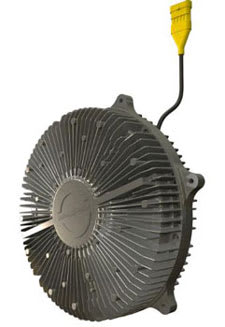
Fan operation can significantly affect fuel economy. BorgWarner this year started offering its electronic Visctronic viscous variable-speed fan drives as optional equipment for Freightliner Cascadia trucks.
One of the fun things about researching articles is how you can end up in a totally different place than where you started.
A few weeks ago, I was working on a story for the October issue of HDT on oil and coolant analysis. That led to what I'm going to talk about today, which is fans and fuel economy.
It started out when I was talking to Mike Tourville with Evans, which makes a waterless coolant. The first time I heard of it, I thought maybe it was some sort of a powder. Common reaction, Tourville said, but Evans' product is indeed a liquid - in fact it looks a bit like the color of iced tea.
"Powder does seem funny, but you aren't the only one, as we've heard that before," Tourville said. "More often people have asked if it's a gel. One guy asked if it was 'a bunch of little fans everywhere.' Waterless doesn't mean 'liquidless,' but it's an initial perception."
Unlike traditional coolants, none of that liquid is water. It's all a blend of glycols and the necessary additives to protect the cooling system (although you don't need some of the same additives that protect against what water can do to the system.)
Because its Heavy Duty Coolant has a boiling point about 150 degrees higher than that of coolants with water, Evans contends, the coolant allows the engine to run a bit hotter. That, in turn, allows you to up temperature where the fan kicks on, reducing fan-on time, and that translates into fuel savings.
Tourville says the company is seeing 3% to 8% fuel economy improvement in real-world testing with owner-operators and fleets. At the upper end of that are inner city trucks, such as refuse trucks, which don't get much in the way of ram air to cool engines. The Evans coolant allows them to reduce their fan-on time by 40% to 50%. For an over-the-road trucker, where speeds going down the road allow the air to help cool the engine, the savings would be closer to the bottom of that range at 3%. Veolia is getting about 4.5% fuel economy improvement in their Macks.
At the American Trucking Associations' Technology & Maintenance Council annual meeting earlier this year, one fleet said it was expanding its testing after using the coolant in a feed truck and realizing about 5% fuel savings.
Tourville also says that without the fan siphoning away some of the engine's power, he says, "Some guys have said, 'I feel like I have an extra hundred horsepower in my truck.'"
Radical idea?
"A lot of people think that's a radical idea, to raise the engine temperature," Tourville said. "But it's not really that radical; let's take the water out and see what we gain. But we're talking about maybe 10%, 20 degrees, if that."
Critics say water is used for a reason; it's a better thermoconducter than the glycols Evans uses. Tourville admits that it is - as long as it remains in its liquid state. "Once it turns to vapor, it loses almost all that thermoconductivity. And it doesn't stay liquid very long."
Tourville says because Evans coolant doesn't create water vapor in the cooling system, the resulting lower pressure also avoids stress on cooling system hoses and gaskets. He also says it avoids the kind of boiling that can create cavitation erosion in the cylinder liners.
More on the fan's role
I'm thinking that we will continue to see fans come up as the industry pushes for ever-greater fuel economy.
For instance, earlier this year, Equipment Editor Jim Park reported that Freightliner is talking fuel consumption reductions in the order of 15% by 2015. Among the many ways it's going to do that is by promoting additional fuel saving technology such as variable speed fans and predictive cruise control in spec'ing packages that emphasize fuel efficiency.
At TMC's annual meeting this year, I attended a panel discussion of the Engine Study Group about the use of variable-speed fans. The moderator pointed out that fan power has had to increase substantially over the past decade due to increased airflow requirements and higher fan drive ratios required by new lower-emission engines. Fans have gotten larger, with more blades, and take twice the horsepower to turn them. Yet more fan power consumption means less power to wheels, higher thermal stress, lower fuel economy, and more dust and debris being sucked in the system.
Ten to 15 years ago, traditional on/off fans only came on 10%-15% percent of time, explained Marty Hayward with Linnig Corp. Today, he said, it may be 60%.
Yet the engine may not need that full blast of cooling power for that whole 60%. A lower speed, which draws less horsepower and sucks less fuel, may be adequate for much of that on time. That's why makers of various types of variable-speed fans say their products can save fuel and increase driver satisfaction. You also get improved heat exchanger life and less noise.
Jim Benson of BorgWarner Thermal Systems said in his company's tests, a traditional on/off fan drive used 0.8% of the truck's energy; variable speed fans used less than half, 0.3%.
Yet as of 2010, the on/off fan drive still had more than 80% of the market.
Increasing market share
"I think the important thing moving forward with new truck purchases is making an educated decision," Benson said. "Each type of variable speed fan drive may be best suited to a particular duty cycle. It's also important to understand there are integration challenges for the OEM when you go to variable speed, because they are ECM-controlled."
Mark Hadley with Central Refrigerated Services in Salt Lake City said his fleet has been operating the variable-speed, ECM-controlled fans for about three years, and drivers love them.
He says his fleet has only seen a minimal fuel economy improvement, but there plenty of other benefits. Among them:
* The engine maintains a constant temperature
* Drivers note "no mood swings"
* It's quiet
* There's less downshifting
* Under hood components last longer with better managed under hood heat. S
* Very low failure rate.
* Improved life for belts, air-to-air coolers, radiators.
* They don't find bugs between the air to air and the radiator like they used to.
In fact, he said, "the only reason we don't have them in all our tractors yet is because some of our OEs don't have them on their spec sheet yet."
More Blog Posts

Beyond the Central Transport Settlement: Lessons on Hiring and Risk
The $5.5 million discrimination settlement raises broader questions about hiring practices, safety performance, and the hidden risks that can lurk in a fleet's recruiting process.
Read More →
Are Diesel Shortages Something to Worry About Again?
There’s a certain déjà vu when tensions flare in the Middle East and diesel price spikes can give you panic attacks. What parallels are there between the current situation and the 1970s energy crisis?
Read More →
NOx Isn’t Laughing Gas. Let’s Clear That Up.
A recent EPA reference mixed up NOx and nitrous oxide. It’s an easy mistake. Just not one you expect to see in emissions policy. Let’s look at the difference.
Read More →
TMC 2025 Takeaway 2: Buy... or Subscribe?
TaaS. Does that mean trucks as a service, trailers as a service, or tires as a service? HDT's Deborah Lockridge has another takeaway from the Technology & Maintenance Council meeting in her blog.
Read More →
TMC 2025 Takeaway: The Journey Toward Vertical Integration
HDT's Deborah Lockridge on how the trucking industry has moved toward "vertical integration" over the past 25 years.
Read More →
Trucks Are For Girls!
HDT Editor and Associate Publisher Deborah Lockridge is a longtime Girl Scout leader and loves to connect her passion for inspiring girls with her love of the trucking industry.
Read More →
Trucking Advocacy: Impact Beyond the 2024 Elections
No matter who wins the election, trucking continues to work to educate the people who pass the laws and make the rules that affect the industry. HDT's Deborah Lockridge shares insights from two major trucking associations in her All That's Trucking blog.
Read More →
Recharge Your Brain for Better Business
Skimping on vacation may be the worst thing you can do for your business, your career, and your mental health. In her All That's Trucking blog, Deborah Lockridge writes about the importance of giving your brain what it needs to be innovative.
Read More →
Trucker Pre-Trip Leads to Mission 'Im-paw-sible'
See what happened when a truck driver found an unexpected stowaway during his pre-trip inspection.
Read More →
HDT Editor: 2023's Most Important Trucking Topics
Read Deborah Lockridge's picks for the most significant stories we covered at HDT in 2023: freight recession, zero-emission trucks, drivers and marijuana, and more.
Read More →