





“Tires in this application are arguably the most abused of any in the trucking industry."
Designing, Testing Tires for Drop-Deck Trailers Challenging
Dropdeck trailers with spread-axle tandems are torture on tires. Tom Berg explores one tire maker's quest to design a product to stand up to the beating in his Trailer Talk blog.
July 2, 2015
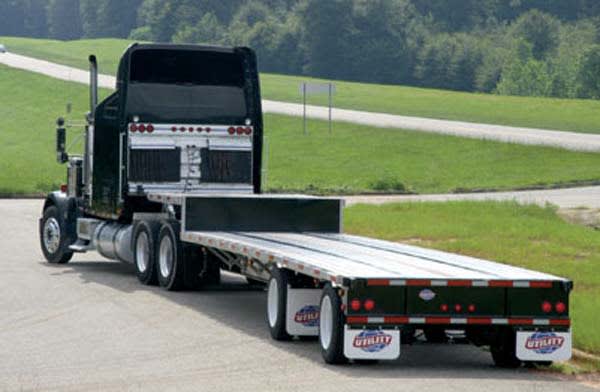
Wide-spread tandems, especially on drop-decks, can subject tires to extreme lateral forces in sharp turns. Photo via Utility Trailer Mfg.
4 min to read
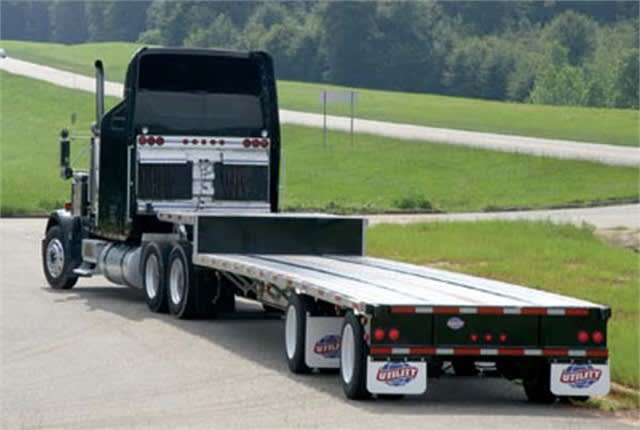
Wide-spread tandems, especially on drop-decks, can subject tires to extreme lateral forces in sharp turns. Photo via Utility Trailer Mfg.
Some years ago I stood on a truckstop's lot and watched a hot-headed driver, who seemed to be looking for something, do two U-turns with his rig. His tractor pulled a loaded flatbed trailer with a wide-spread tandem, and I cringed as I watched the tires skid sideways and hop along the pavement.
The high lateral forces in such moronic maneuvers have been known to tear up treads, pull tire beads away from rims and even break wheels.
Turns out it could’ve been worse. Engineers at Cooper Tire & Rubber say that drop-deck trailers with spread tandems are even harder on tires than flatbeds because tire sizes tend to be smaller to accommodate the lower decks.
That's why the engineers used a drop-deck to design and test a new Roadmaster-brand tire, the RM272, to specifically withstand the demands of this service.
“Tires in this application are arguably the most abused of any in the trucking industry,” said Reuben DeBolt, commercial technical services manager for Cooper Tire. “We set out to engineer a tire that could take the punishment that carriers dish out, but we also wanted to ensure we stayed true to what Roadmaster is all about: excellent quality at a reasonable price.”
For several months, DeBolt and his team used computer modeling and advanced finite element analysis to test various tire shapes and structures, along with different tread compounds, for their ability to withstand the enormous lateral pressures the tires endure, especially at their edges.
“We looked at a variety of tread profiles that could minimize the load on the shoulder rib,” DeBolt said. “We worked toward a design that allowed the tire to slide more easily and distributed the load more evenly across the tire’s entire footprint so that the shoulder would take less of the brunt of the lateral forces.”
'10-one' Tandem
Spread axles are usually 10 feet, 1 inch apart to allow each axle to legally carry up to 20,000 pounds (vs. 17,000 on a standard tandem). This adds no extra payload, but allows flexibility while loading the trailer. Federal Bridge Formula B requires 10 feet for the higher axle loading, and manufacturers add the extra inch to be sure it’s legal. That’s why they’re called “10-one” tandems.
As a spread-tandem trailer turns, it tends to pivot on its back axle, and the tires on the trailer’s forward axle scub sideways across the pavement through the turn, DeBolt said. As much as 60% of a tire’s 5,000-pound load transfers from the full footprint to the shoulder rib of the front-axle tire on the inside of a sharp turn. This can tear the shoulder rib, causing big chunks of the tread to rip off.
“Imagine the force at play here,” DeBolt said. “With 3,000 pounds of lateral force now concentrated on the shoulder rib, any tire that’s not designed to handle this kind of abuse can experience significant damage.
"It’s no wonder that when we tested several other tires sold in this market, the shoulder ribs literally tore apart, just as they can do in the field. Drop-deck spread-axle trailers without a doubt represent one of the very toughest applications in the industry for highway tires.
“What’s more, that damage can cause roadside inspectors to take a more critical look at all of the tires, and the vehicle as well,” he said. “That’s why drop-deck trailer operators often have to replace tires long before their treads are worn.”
The RM272 that resulted from the tests has a four-belt steel casing and a slightly rounded tread footprint, along with a reinforced shoulder, to help withstand extreme side forces. And its tread compound provides the best balance between resistance to side forces and optimum wear, he added.
Special test procedures
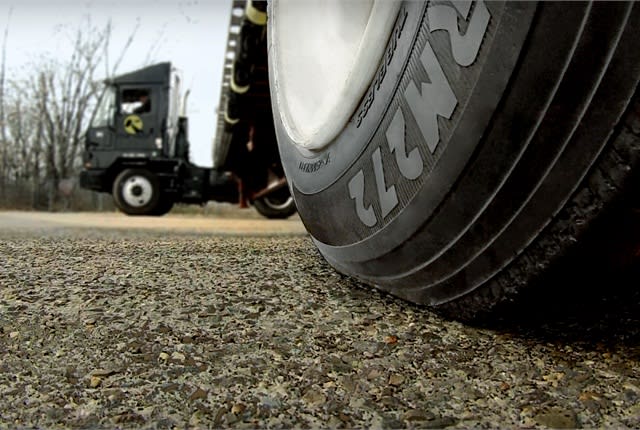
Cooper engineers poured concrete pads to duplicate certain pavement surfaces for testing of their RM 272 tire.Photo via Cooper Tire & Rubber
Testing proved to be a challenge. “We tried several different test protocols at commercially available test sites, but we were not able to replicate the conditions we had seen on some tires returned from the field,” DeBolt explained. “We had to create our own,” and that included building a small test facility near Cooper’s corporate offices in Findlay, Ohio.
“We poured three concrete test pads and treated the pads to simulate three different road surfaces,” DeBolt said. “We then dragged the tires, under full loads, across each of the test surfaces to simulate the dragging they would experience out in the field maneuvering in tight quarters. Think of running your fingernails down a chalkboard. That’s what we were doing to our test tires, and those of our competitors.
“What we put the tires through in testing—all the stresses and forces—is comparable to the worst conditions one could expect to see in the field,” DeBolt said. “We think we’ve succeeded in designing a great tire. We also back the tire with a strong warranty, offering six years and two retreads.”
The RM272 is available now and Cooper will happily sell you some. For more information and to find a dealer, visit www.RoadmasterTires.com or call 800-854-6288.
Subscribe to Our Newsletter
More Blog Posts
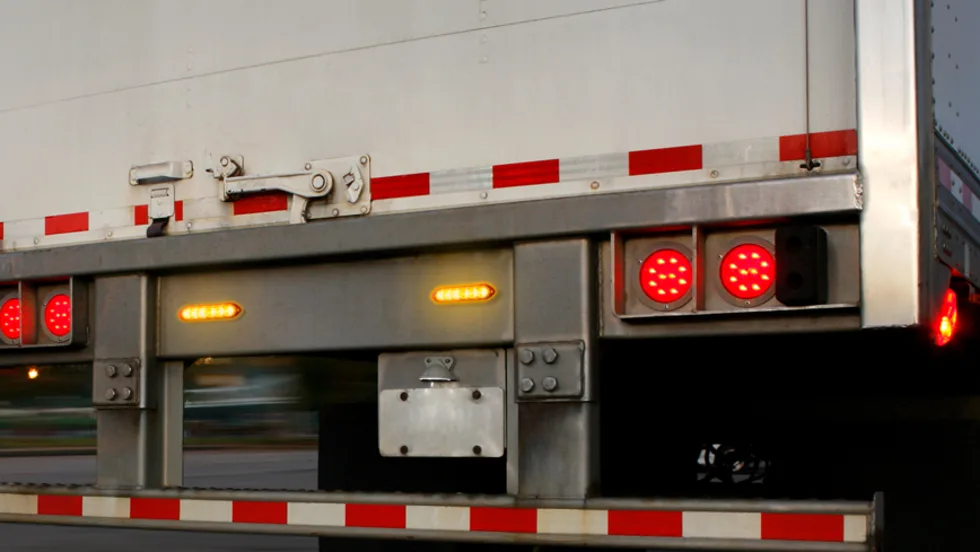
Pulsing Back-of-Trailer Lamps Aim to Prevent Crashes
Can the addition of a pulsing brake lamp on the back of a trailer prevent rear-end collisions? FMCSA seems to think so, if its exemptions are any indication.
Read More →
Designing a 14-Foot Trailer
Trailers are 13 feet, 6 inches high, right? Not for Hub Group, which developed a special 14-foot-high trailer spec for a dedicated customer based in California. Learn more in the Trailer Talk blog.
Read More →
CARB Comes for Reefer Trailers
A new round of emissions control regulations decreed by the California Air Resource Board will begin affecting refrigerated trailer and TRU design and operations next year.
Read More →
5 Ways Data Analysis Maximizes the Value of Trailer Telematics
Are you getting the most out of your trailer telematics investment?
Read More →
Can You Guess What's in That Trailer?
You don’t always know what’s in the trailers that pass you on the road. But some of those trailers are carrying something a little more dangerous that frozen food or new bedding…like, maybe, a nuclear weapon. But this isn’t an ordinary trailer; this is a trailer specifically made to not only carry this type of payload, but protect it at all costs.
Read More →
How Trailers Are Harnessing 'Free' Energy
Can trailers play a more active role in sustainable transport beyond aerodynamic add-ons or low-rolling-resistance tires? Some companies think so.
Read More →
Wrapping a Trailer for COVID’s Everyday Heroes
“We don’t only deliver freight. We deliver awareness.” That’s what Jim Barrett, president and CEO of Road Scholar Transport, likes to say about the Dunmore, Pennsylvania-based carrier’s “awareness fleet.” Its latest trailer wrap honors the everyday heroes of the pandemic.
Read More →
How a Tanker Fleet is Using Unorthodox Trailer Lighting to Fight Rear-End Collisions
Groendyke Transport watched the number of rear-end collisions with its trailers rise steadily until it tried an unorthodox and then unapproved method of alerting following drivers that its trucks were applying brakes and slowing down.
Read More →
The Role Trailers are Playing in COVID-19 Funerals
In places such as New York City and Detroit, overwhelmed hospitals and mortuaries are using refrigerated trailers to store the bodies of people killed by COVID-19.
Read More →
Reefer Trailer Aims to Help Reach Zero Emissions
Wabash National is partnering with C&S Wholesale Grocers to test a new type of zero-emissions refrigerated trailer.
Read More →