




ZCube Trailers Are Back To the Future
Zenith Global Logistics, which hauls and delivers home and hotel furnishings across much of the nation, needed more capacity. So its managers looked around and rediscovered low-floor, high-cube van trailers that the fleet used 20 years ago.

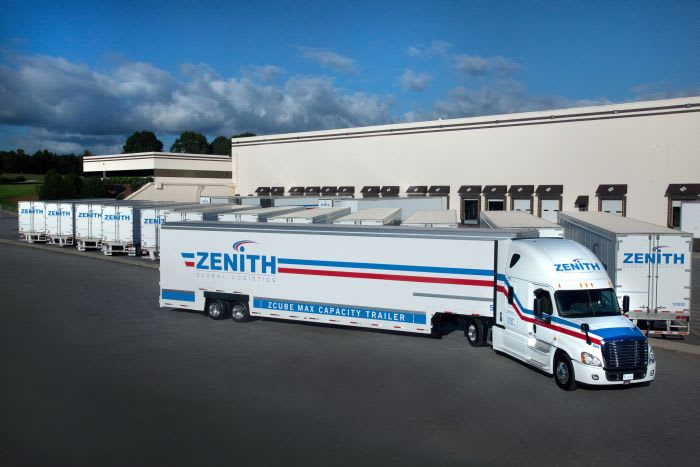
Low-floor vans are like the household goods trailers that Kentucky specializes in, but without the belly boxes and side doors. Freightliner single-rear-axle tractors are driven by teams.
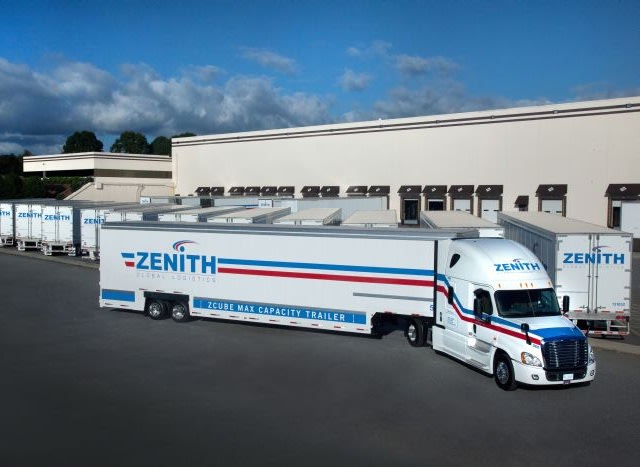
Low-floor vans are like the household goods trailers that Kentucky specializes in, but without the belly boxes and side doors. Freightliner single-rear-axle tractors are driven by teams.
Zenith Global Logistics, which hauls and delivers home and hotel furnishings across much of the nation, needed more capacity. So its managers looked around and rediscovered low-floor, high-cube van trailers that the fleet used 20 years ago.
They ordered 14 units from Kentucky Trailer. The 53x102-inch vans have thin walls and their floors are nearly 2 feet lower than normal vans. That adds about 600 cubic feet of capacity to a van, says Jack Hawn, Zenith’s president and CEO. He and his colleagues at the firm’s headquarters in Conover, N.C., call the design “ZCube Max Capacity.”
“We’re in the business of hauling big items fast,” he says in explaining the operation, whose long-haul tractors are speed-limited to 68 mph to balance velocity and safety. The trailers carry furniture, lamps, rugs and other products among six hubs across the southern tier of states. Three more hubs are planned for the Northeast.
Last fall, the company added 30 regular-floor Utility 53x102-foot vans to its fleet to further support an increase in shipping volumes.
“We can’t backhaul with them” because the low floor precludes forklift loading, Hawn says. “If we showed up at a shipper with one of them, they’d scream. The reason they work for us is that we use them to haul between our hubs.”The freight is big, bulky and light, with gross combination weights typically at 45,000 pounds, so the ZCube trailers are pulled by single-rear-axle tractors. The latest of those are Freightliner Cascadias with long sleepers for long-haul team-driver operation. They are going into service as they’re delivered. With Detroit DD15 diesels and DT12 automated manual transmissions, the ones now operating get above 9 mpg, Hawn says.
“If we showed up at a shipper with one of them, they’d scream. The reason they work for us is that we use them to haul between our hubs.”
A ZCube resembles household goods vans that Kentucky specializes in, but without their belly boxes and side doors. Its low floor is interrupted by wheel wells and a rise for the nose that’s supported by the tractor. Cargo is hand-loaded, like household goods, because that’s what a lot of the items are.
The ZCube design is not new, he observes.
“I grew up in this business, and this is what we used 20 years ago,” Hawn says. The need to backhaul general commodities swung operators toward “straight-floor” vans, so a return to the low-floor van “is back to the future.”
More Equipment

How Volvo Updated Its D13 for EPA 2027 [Watch]
Volvo’s updated D13 promises lower emissions without sacrificing performance or fuel economy. Take a closer look at what changed inside the engine in this HDT Spotlight video.
Read More →
Michelin Tire Improves Efficiency and Durability for Regional Fleets
The Michelin X Multi Energy D2 is a regional haul drive tire engineered to help fleets improve fuel efficiency, durability and traction in demanding stop-and-go operations.
Read More →
ZF Expands Commercial Vehicle Push in North America
ZF is expanding its North American commercial-vehicle presence with new transmission applications, electrification, trailer technology and autonomous-driving systems.
Read More →
Tesla Wants a Self-Driving Semi. Are Cameras Enough?
Could Tesla’s camera-only autonomous driving technology work on an 80,000-pound Semi? In this commentary, HDT's Deborah Lockridge takes a look at Tesla, Cybercab, and how autonomous trucks see the road.
Read More →
Kodiak: Driverless Long-Haul Truck Launch on Track for 2026
Kodiak AI says its driverless long-haul safety case is 93% complete and it remains on track to begin commercial operations by year-end 2026.
Read More →
What DOT’s Automated Vehicle Strategy Means for Trucking
The U.S. Department of Transportation issued a new automated-vehicle strategy that outlines plans for driverless-truck regulations, cross-state freight corridors, and federal safety standards.
Read More →
East Coast Port Launches $45M Electric Truck Push
The Port Authority of New York and New Jersey announced millions in incentives for zero-emission drayage trucks, yard tractors, and new charging hubs near the port.
Read More →
PlusAI Going Public to Fund Autonomous Truck Launch
A SPAC deal could provide PlusAI with up to $300 million as it works toward a 2027 commercial launch of factory-built autonomous trucks.
Read More →
NHTSA Moves to Rewrite Truck Fuel-Economy Rules
The National Highway Traffic Safety Administration says it lacks authority to regulate medium- and heavy-duty truck engines separately from complete vehicles, but the existing standards have not yet been eliminated.
Read More →
Detroit Opens Orders for EPA 2027 Engines
Detroit isn’t starting from scratch to meet EPA 2027 diesel emissions standards. Its Gen 6 DD13 and DD15 engines keep much of today’s platform while updating the fuel and aftertreatment systems.
Read More →