




Work-Truck Body or Upfitted Cargo Van?
Large Eurovans are taking over some work-truck roles, but there’s still a big place for service bodies.

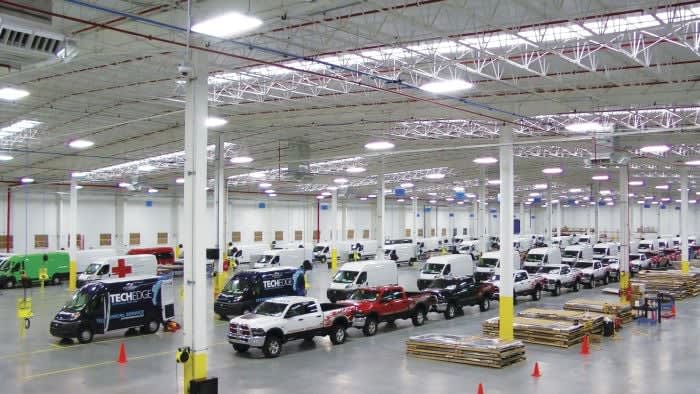
Utilimaster’s upfit facility for Ram Truck in Saltillo, Mexico, installs equipment on heavy pickups and ProMaster vans, which are sent directly to dealers for delivery to customers.
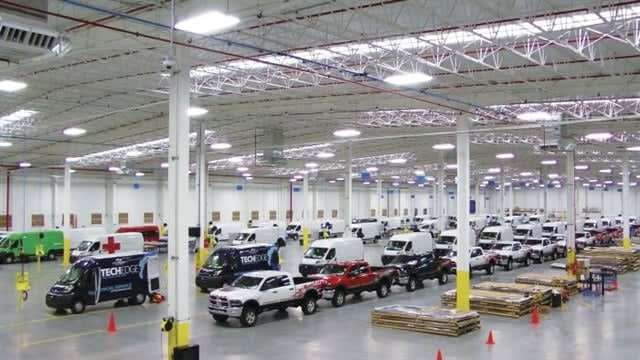
Utilimaster’s upfit facility for Ram Truck in Saltillo, Mexico, installs equipment on heavy pickups and ProMaster vans, which are sent directly to dealers for delivery to customers.
Weight and fuel savings advantages mean Euro-style cargo vans are catching on quickly, changing how work-truck operators buy and use vehicles.
“This is a really good opportunity for clients to reevaluate their total cost of ownership,” says John Marshall, senior vice president of sales and marketing at Utilimaster. “It can be done in two ways. One is a high-fuel economy, high-cube van that comes from the OEMs, and the second is the ability to have it upfitted at the factory.”
The smallest full-size Eurovans offered by Ford, Ram and Sprinter are considerably larger than traditional North American cargo vans, like the out-of-production Ford E-series and General Motors’ Chevrolet and GMC G-vans, which are still being offered. Daimler’s Sprinter was the original large unibody van in North America.
At the Saltillo upfit center at the Ram ProMaster factory in Mexico, Utilimaster installs equipment from makers such as Adrian, Knapheide and Ranger. This skips the stop the van would otherwise make at the upfitter’s, saving on transportation costs. Marshall says one fleet saved $104,000 on 100 trucks, at $950 per truck. And delivery is quicker – 21 days, compared to 60 before.
“On smaller service bodies, the amount of equipment encompassed can be installed in a ProMaster,” he explains. “So customers can switch from separate bodies to Euro-style vans. This appeals to folks that work in pickups with small-cube service bodies, and don’t want to stand out in the cold anymore. Some objects have to be carried outside, but the advantages are safety, being out of the elements and material not being compromised, like salt spray hurting copper pipe.”
Good fuel economy and higher anticipated resale values will lower ownership costs, Marshall and others predict. Buyers like the vans’ high capacity and roomy, comfortable cabs. Ram executives say the ProMaster, which entered the market early last year, has captured about 18% of the market segment. Ford execs say the big Transit, which went into production in Kansas City last summer, has become the largest-selling vehicle in the segment, handily replacing the E-series cargo van (though cab-chassis and cutaways are still offered).
Knapheide runs upfit facilities for Ford’s Transit in Kansas City, Mo. There workers install shelves, racks, bins and cabinets in Transits’ commodious unibodies, but also mount service bodies to cab-chassis versions.
“We do a lot of KUVs (Knapheide Utility Vehicles) on them,” says Chris Weiss, Knapheide marketing manager. “The KUV is a covered service body … You can carry stuff inside but still get at tools from outside.”
He says Knapheide has always done this with the Sprinter, though in a very low volume, and now is doing ship-throughs with Transit and ProMaster. “We also do some with Utilimaster in Mexico. They’re not so much competitors as partners,” he says of the other body and equipment manufacturers.
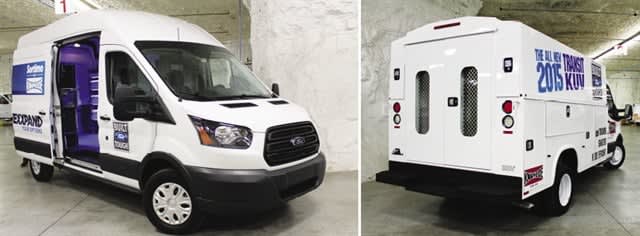
In “Subtropolis” limestone caves under Kansas City, Knapheide installs shelves, cabinets and racks in Ford’s large Transit vans (left) produced in above-ground plant nearby. Meanwhile, Knapheide Utility Vehicle bodies are mounted on Transit cab-chassis vehicles (right) while smaller Transit Connect vans, produced in Spain, are brought in for upfitting.
Like ProMasters and Sprinters, bodyless Transits have fabricated steel frames extending behind the cabs, and come in single- and dual-rear-wheel versions.
Knapheide also upfits the smaller Transit Connect vans in Kansas City, where they go after coming in from Spain. This van, along with the ProMaster City and Nissan NV200/Chevy City Express, as well as Daimler’s upcoming Metris van, are smaller takes on the Eurovan.
Weiss sees people wanting to do more with smaller vehicles, moving to more optimized use of materials. “We’re using high-strength steel, aluminum and plastics. We’re doing partitions in ABS plastic, which is strong but light ... the trend is doing more with the space that you have.”
As useful as the big Eurovans are, it’s harder to install generators, welders and compressors – large, somewhat heavy equipment used in some trades – inside the bodies. These go better on open service bodies, Weiss says.
Don’t count out the service body
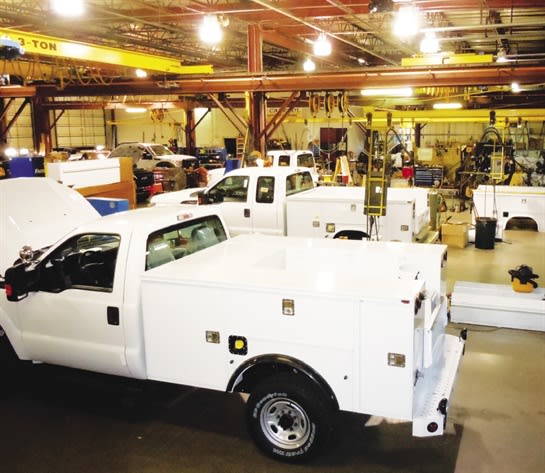
Reading builds and installs steel and aluminum service bodies in its plant in eastern Pennsylvania.
The increasing popularity of Eurovans has not affected business at Reading, another builder of service bodies, says Craig Bonham, vice president of new business development. He credits that to the company’s lightweight aluminum products that allow greater payloads and resistance to corrosion than steel bodies. An aluminum body costs about 30% more but weighs 50% less and comes with a 10-year warranty vs. three years for steel.
“Since the recession, people are wiser with their money and want long life, good appearance and higher resale value,” Bonham says.
Another disadvantage of an integrated cargo van is that separation from the driver is more difficult unless there’s a partition that’s sealed off, he says. Separation is necessary for carrying certain substances that would be dangerous if they escaped from packaging.
All service bodies come with deep bins that result in “forced organization — they encourage you to file it instead of pile it,” he says. “If there’s an empty bin, you know, ‘Oh-oh, something’s missing.’”
Of course, that’s also an attribute of a properly upfitted cargo van.
Other service body advantages include streetside-curbside accessibility to tools and supplies. “You don’t have to crawl inside to get at them. In downtown Manhattan, parking is so tight that you might be able to get the truck into a space but sometimes you can’t open the rear doors” of a van.
Bob Raybuck, technical services director at the National Truck Equipment Association, says suppliers have noted more interest from customers in aerodynamics. Aero designs and light weight save fuel and add payload. “It doesn’t matter if fuel is 4 dollars a gallon or 2 dollars a gallon,” he says. “They’re saying, ‘Saving fuel puts money on my bottom line. And if I can carry more, I make more revenue.’"
More Equipment

How Volvo Updated Its D13 for EPA 2027 [Watch]
Volvo’s updated D13 promises lower emissions without sacrificing performance or fuel economy. Take a closer look at what changed inside the engine in this HDT Spotlight video.
Read More →
Michelin Tire Improves Efficiency and Durability for Regional Fleets
The Michelin X Multi Energy D2 is a regional haul drive tire engineered to help fleets improve fuel efficiency, durability and traction in demanding stop-and-go operations.
Read More →
ZF Expands Commercial Vehicle Push in North America
ZF is expanding its North American commercial-vehicle presence with new transmission applications, electrification, trailer technology and autonomous-driving systems.
Read More →
Tesla Wants a Self-Driving Semi. Are Cameras Enough?
Could Tesla’s camera-only autonomous driving technology work on an 80,000-pound Semi? In this commentary, HDT's Deborah Lockridge takes a look at Tesla, Cybercab, and how autonomous trucks see the road.
Read More →
Kodiak: Driverless Long-Haul Truck Launch on Track for 2026
Kodiak AI says its driverless long-haul safety case is 93% complete and it remains on track to begin commercial operations by year-end 2026.
Read More →
What DOT’s Automated Vehicle Strategy Means for Trucking
The U.S. Department of Transportation issued a new automated-vehicle strategy that outlines plans for driverless-truck regulations, cross-state freight corridors, and federal safety standards.
Read More →
East Coast Port Launches $45M Electric Truck Push
The Port Authority of New York and New Jersey announced millions in incentives for zero-emission drayage trucks, yard tractors, and new charging hubs near the port.
Read More →
PlusAI Going Public to Fund Autonomous Truck Launch
A SPAC deal could provide PlusAI with up to $300 million as it works toward a 2027 commercial launch of factory-built autonomous trucks.
Read More →
NHTSA Moves to Rewrite Truck Fuel-Economy Rules
The National Highway Traffic Safety Administration says it lacks authority to regulate medium- and heavy-duty truck engines separately from complete vehicles, but the existing standards have not yet been eliminated.
Read More →
Detroit Opens Orders for EPA 2027 Engines
Detroit isn’t starting from scratch to meet EPA 2027 diesel emissions standards. Its Gen 6 DD13 and DD15 engines keep much of today’s platform while updating the fuel and aftertreatment systems.
Read More →