




Wide, Heavy and High, Oh My
After traveling more than 124 million miles in space, the Space Shuttle Endeavour had one more 14.2-mile journey to make through the streets of Los Angeles to its final resting space at the California Science Center.

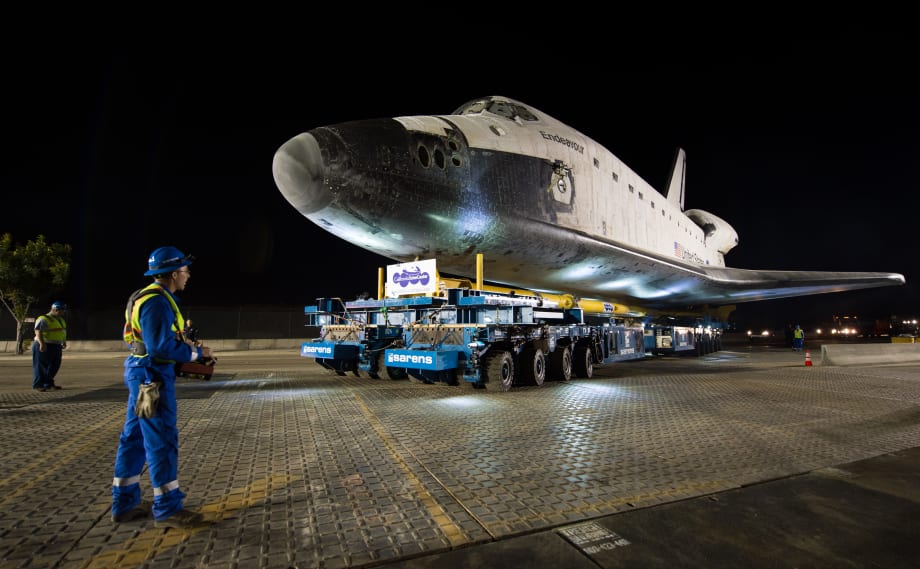
To transport the Endeavour, Sarens used four specially designed Kamag self-propelled modular trailers, which were controlled by a person walking alongside using a remote joystick panel.
After traveling more than 124 million miles in space, the Space Shuttle Endeavour had one more 14.2-mile journey to make through the streets of Los Angeles to its final resting space at the California Science Center.
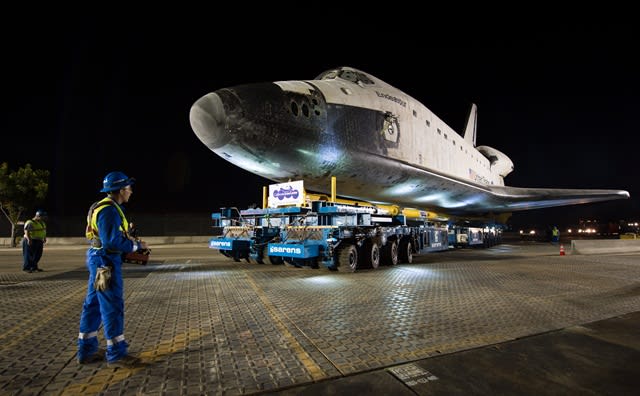
To transport the Endeavour, Sarens used four specially designed Kamag self-propelled modular trailers, which were controlled by a person walking alongside using a remote joystick panel.
The company chosen to help this piece of U.S. history make its final journey was The Sarens Group. Sarens notes the transport took eight months and thousands of man-hours of planning many details.
“There were literally hundreds of people involved in the planning and execution phases of the project,” says Jim Hennessy, sales and marketing manager for Sarens. “Sarens’ contribution to the planning effort was a project manager and a team of engineers who mapped out the entire haul route and determined optimum equipment configurations to support the move.”
When moving day arrived, the Sarens team grew to more than 40 people working two shifts.
To transport the 150,000-pound Space Shuttle Endeavour, with a wingspan of 78 feet, a length of 125 feet and a total height of 56 feet, Sarens used specially designed Kamag self-propelled modular trailers. The SPMTs comprised four independent, multi-axle, computer-controlled wheeled vehicles, which added up to 20-axle lines. Attached to the SPMTs was a system of beams, which supported the overland transport fixture to which the Endeavour was secured.
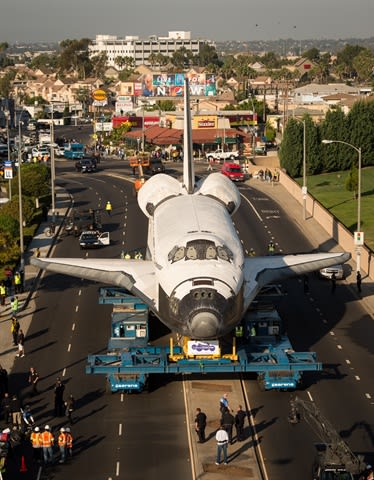
A typical scene as the Endeavour travels through residential neighborhoods and business districts along the transport route. Note in the photo on the left that the SPMT setup has been altered to a wide stance to span over the median.
The SPMTs were controlled and steered as a single vehicle by a person walking alongside the shuttle using a remote joystick control panel.
Additional spotters were positioned near the nose, tail and wingtips to help manuever near potential obstructions such as buildings, poles and trees, according to Saren’s website.
Because of the historic nature of the final move of the Space Shuttle Endeavour, Toyota was able to acquire the rights to tow the Endeavour across a bridge over the I-405 freeway in Los Angeles with an unmodified Toyota Tundra.
To cross the 405 freeway in Los Angeles, the Endeavour had to be shifted from the Kamags to a dolly system to get the axle spacing and weight distribution to meet the standards defined by the California Department of Transportation. The dolly system was designed and fabricated by Rackley Bilt Custom Trailers.
The Endeavour has traveled at speeds topping more than 17,000 mph, but during the transport to its final resting place, it was reduced to speeds of less than 2 mph. The entire 14.2-mile trip took approximately three days.
“This was not the biggest, heaviest or most complicated transport that we have performed, but it certainly was the most historic,” Hennessey says.
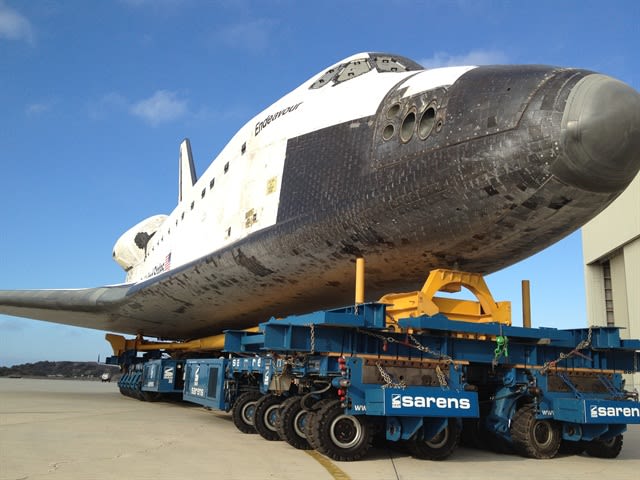
“While there were some challenging obstacles to clear along the route, the journey itself was the easy part.”
The difficult part, he says, “was the months of planning, engineering, route surveying and coordination with a myriad of public and private entities, all of whom worked long hours to ensure minimal impact to the communities through which the shuttle would pass.”
More Fleet Management

How Telematics Improves Visibility, Control, and Performance in Refrigerated Fleets
Explore how telematics help refrigerated fleets improve visibility, uptime, efficiency, compliance, and cargo protection across connected cold chain operations.
Read More →
What the U.S.-Canada Trade War Means for Trucking
Escalating U.S.-Canada tariffs could disrupt cross-border freight, reduce truck volumes, raise costs, and create new uncertainty for carriers on both sides of the border.
Read More →
What Are Trucking’s Top Concerns for 2026?
The American Transportation Research Institute wants to know what's worrying trucking fleet managers, drivers, and other stakeholders in its annual Industry Issues survey.
Read More →

American Trucking Associations Looks for a New Leader
ATA President and CEO Chris Spear abruptly left his job at the association on August 21, at a pivotal time for the trucking industry.
Read More →
Public Wi-Fi Cybersecurity Risks: How Truck Drivers and Fleets Can Protect Their Data
Public Wi-Fi can expose truck drivers and fleets to credential theft, malware, and other cyber threats. Here’s how to reduce the risk on the road.
Read More →
For Nicky Cupp, Fleet Innovation Starts With Frustration
HDT Truck Fleet Innovator Nicky Cupp turns everyday pain points at Fraley & Schilling into opportunities for better technology and smarter processes.
Read More →
Adam Buttgenbach’s Approach to Electric Trucks: Start With Where They Fit
HDT Truck Fleet Innovator Adam Buttgenbach helped PepsiCo build one of North America’s largest EV fleets by focusing on where electric trucks make operational sense.
Read More →
Deen Albert: Let Automation Do the Math, People Make the Decisions
HDT Truck Fleet Innovator Deen Albert makes sure people are still at the heart of operations at Grand Island Express, even while adopting artificial intelligence tools. AI-assisted dispatch helped boost revenue 25% with the same number of trucks.
Read More →
Trimble’s New AI Agent Takes Aim at Fleet Back-Office Busywork
Arc Agent works across Trimble TMS products to automate repetitive tasks such as freight orders, maintenance, invoices, fuel costs and more.
Read More →
How HDT’s 2026 Truck Fleet Innovators Are Rethinking Fleet Operations
Meet five trucking leaders who are challenging assumptions, solving operational problems, and putting innovative ideas to work.
Read More →