




When Should You Replace a Truck for Best TCO?
Truck age is an important factor in total cost of ownership/life cycle cost calculations. The longer you keep a truck, the more it costs in maintenance and repairs.

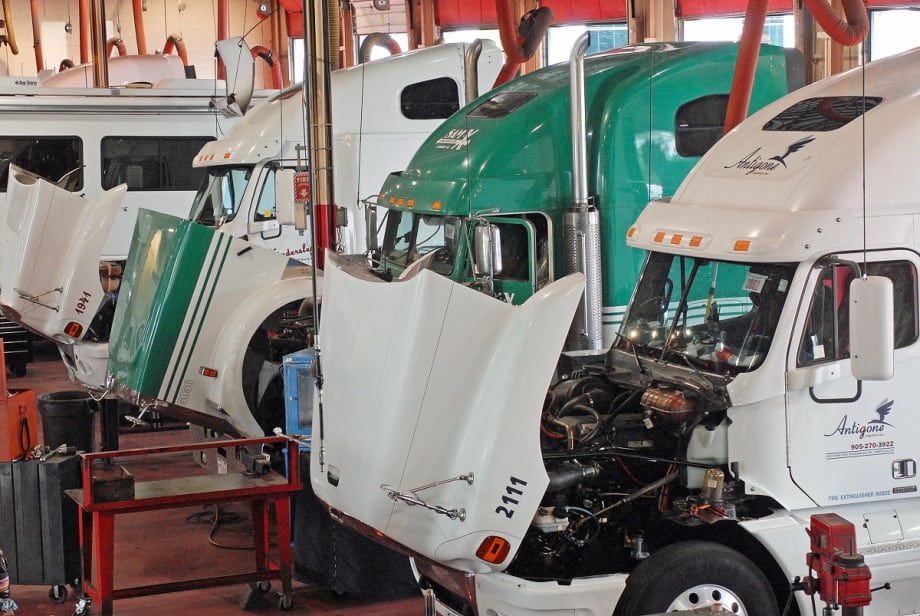
The longer you keep a truck, the more it costs in maintenance and repairs.
Photo: Jim Park
Truck age is an important factor in total cost of ownership/life cycle cost calculations. The longer you keep a truck, the more it costs in maintenance and repairs.
A white paper put out last year by Fleet Advantage, Mitigating Rising Maintenance & Repair Costs for Class-8 Truck Fleets, uses data from 5 billion miles of real-world fleet operations, including food service, grocery distribution and chemical tank. It found that typical maintenance costs over a vehicle’s life cycle are fairly flat in the first three years of its life, but there’s quite a jump between years three and four and between years four and five. It levels out in year six, and then takes another jump in the seventh year.
According to Fleet Advantage, fleets adopting a three-year lifecycle, replacing with new equipment in year four, could see savings of $42,830 in maintenance and repair costs alone, compared to a fleet driving the same truck for a full seven years. Switching from a five-year to a three-year lifecycle would produce savings of $17,150.
“On a new tractor, there’s minimal maintenance expense – tires and PM, mostly – but a few corrective maintenance items are included, and that tends to vary with the make and model of the tractor,” says Matt Hendrix, director of fleet services at Fleet Advantage. “Based on the data we collected, we believe it’s beneficial to trade the asset some time in its third year of life, before the big costs appear. Starting with a new truck at that point keeps the maintenance costs as low as possible.”
Cost aside, the increased maintenance requirements of older equipment also put a strain on shop resources. Service bays and mechanics are tied up longer dealing with older equipment, and equipment is down longer, and ultimately less productive. On average, Hendrix says, a tractor requires 2.5 hours a month to maintain in its first year, but 4.5 hours in year three, nearly doubling the demand while the available resources remain the same.
“This will become an important consideration in the future with the shortage of qualified technicians and shop managers,” he warns. “It follows that as repairs costs go up, so too will labor costs, which is a proxy for labor hours. If you’re short of qualified technicians, how will you be able to keep up with the needed repair on the truck in the later years of its life?”
While some may take issue with the figures Fleet Advantage uses in the white paper, the upward trend in cost with age is undeniable. Fleets today have the advantage of data-driven analytics to see exactly what a vehicle costs to maintain in their own operation, and thus make better decisions about when a truck might become economically obsolete.
More Equipment

How Volvo Updated Its D13 for EPA 2027 [Watch]
Volvo’s updated D13 promises lower emissions without sacrificing performance or fuel economy. Take a closer look at what changed inside the engine in this HDT Spotlight video.
Read More →
Michelin Tire Improves Efficiency and Durability for Regional Fleets
The Michelin X Multi Energy D2 is a regional haul drive tire engineered to help fleets improve fuel efficiency, durability and traction in demanding stop-and-go operations.
Read More →
ZF Expands Commercial Vehicle Push in North America
ZF is expanding its North American commercial-vehicle presence with new transmission applications, electrification, trailer technology and autonomous-driving systems.
Read More →
Tesla Wants a Self-Driving Semi. Are Cameras Enough?
Could Tesla’s camera-only autonomous driving technology work on an 80,000-pound Semi? In this commentary, HDT's Deborah Lockridge takes a look at Tesla, Cybercab, and how autonomous trucks see the road.
Read More →
Kodiak: Driverless Long-Haul Truck Launch on Track for 2026
Kodiak AI says its driverless long-haul safety case is 93% complete and it remains on track to begin commercial operations by year-end 2026.
Read More →
What DOT’s Automated Vehicle Strategy Means for Trucking
The U.S. Department of Transportation issued a new automated-vehicle strategy that outlines plans for driverless-truck regulations, cross-state freight corridors, and federal safety standards.
Read More →
East Coast Port Launches $45M Electric Truck Push
The Port Authority of New York and New Jersey announced millions in incentives for zero-emission drayage trucks, yard tractors, and new charging hubs near the port.
Read More →
PlusAI Going Public to Fund Autonomous Truck Launch
A SPAC deal could provide PlusAI with up to $300 million as it works toward a 2027 commercial launch of factory-built autonomous trucks.
Read More →
NHTSA Moves to Rewrite Truck Fuel-Economy Rules
The National Highway Traffic Safety Administration says it lacks authority to regulate medium- and heavy-duty truck engines separately from complete vehicles, but the existing standards have not yet been eliminated.
Read More →
Detroit Opens Orders for EPA 2027 Engines
Detroit isn’t starting from scratch to meet EPA 2027 diesel emissions standards. Its Gen 6 DD13 and DD15 engines keep much of today’s platform while updating the fuel and aftertreatment systems.
Read More →