





Learn more: Tight, but Not Too Tight With Wheel Bearing Adjustments
Wheel-Ends: Torque Your Nuts
Attaching wheels to a truck hub is serious business. Yet it's not uncommon to see some big bruiser of a mechanic, one foot against the bottom of the tire, whaling away with a 1-inch-drive impact gun driving the wheel nuts home. That's not the right way to do it.
November 2, 2010
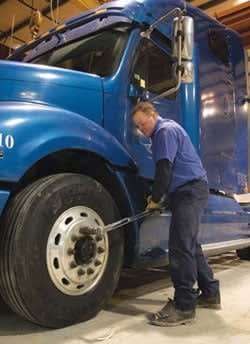
Manually torque the truck's wheel nuts to recommended values using a manual torque wrench with the wheel seated on the ground.
Photo: Jim Park
3 min to read
Attaching wheels to a truck hub is serious business. Yet it's not uncommon to see some big bruiser of a mechanic, one foot against the bottom of the tire, whaling away with a 1-inch-drive impact gun driving the wheel nuts home.
As with anything technical, there's a process for ensuring the job is done properly and safely. The above procedure is not recommended.
Prevent Damaged Equipment
Wheel nuts must be torqued to specified values, and the stud, nuts, and wheel must be in good condition, otherwise torque values could be compromised and the equipment damaged.
When mounting wheels on a hub and securing them with a typical M22x1.5 stud and 33 mm two-piece flange nut, the clamped material will compress slightly and the stud will stretch slightly under the recommended 450-500 foot-pounds of torque applied to the lug nuts.
The tension between the compressed and stretched material (called preload) is where we get the clamping force to secure the wheels - about 50,000 pounds per stud.
When this preload is exceeded by external load created by the operation of the vehicle, or if the preload is relaxed, the joint will loosen.
This could happen in several ways:
Over-torquing the nut can stretch the stud beyond its design yield, causing it to fracture or break.
Torque readings could be lower than required due to contaminated or damaged threads, providing lower clamping force on the face of the flange nut.
Contamination between the wheels or between the inside wheel and the hub face could compress or fall away, relieving the tension in the clamping system.
The contact surfaces of the hub face and the wheels must be clean and free of contamination such as dirt, peeling paint, rust, grease, etc. to ensure proper clamping force. The studs should be clean and corrosion free, and the nuts should hand-turn onto the treads. Any resistance to hand-turning could indicate the stud has stretched and threads have deformed. The studs should be carefully examined and damaged studs replaced.
Two-piece 33 mm flange nuts used with hub-piloted wheels should be tightened to a torque of 450 to 500 foot-pounds. Other nut designs have different torque requirements. Check the manufacturer's recommendations for your equipment.
Alcoa recommends applying a coat of non-water-based lubricant to the wheel pilot or hub pads prior to mounting to minimize corrosion build-up between the wheel and hub pilot, which can make wheel removal difficult. Do not lubricate the face of the wheel, hub, or brake drum.
Lubricate the stud threads and the contact surfaces between the cap nut and the flange with a couple of drops of 30-weight oil. Lubrication isn't necessary with new hardware.
Position one of the hub's pilot pads at the twelve o'clock position, and lift the wheel onto the pilot. Hand tighten or use a low-torque nut runner to firm down the flange nuts.
Lower the truck off the jack, and then tighten to the recommended torque following the proper sequence for your wheel type using a manual torque wrench. Never use a high-torque impact wrench to do the final torque. They aren't very accurate, and they could well over-torque the nut and damage the stud and/or the wheel.
Since the wheel and hub will further seat itself after a short distance, and the torque will drop, Alcoa strongly recommends retorquing the wheels after 5 to 50 miles of operation.
Subscribe to Our Newsletter
More Maintenance

Sponsored•September 16, 2026
Color Match Smarter: Tools That Restore & Perform
For fleet managers and collision repair professionals keeping heavy-duty trucks on the road, getting the color right the first time isn't just about appearance — it's about efficiency, turnaround time, and bottom-line results. Discover how today's digital color tools are transforming the repair process from guesswork to precision.
Read More →
Wrong Repair Prompts Recall of Freightliner, Western Star 4x2 Trucks
DTNA is recalling more than 2,400 trucks that received an incompatible software fix instead of the hardware repair required to address brake valve corrosion.
Read More →
Truck Drivers Need More Than Another Alert
Fleets have more visibility into truck health, safety events, and driver activity than ever. The next challenge is turning all that information into useful guidance for the person who has to decide what to do next.
Read More →
The Maintenance Checks Trucking Fleets Should Prioritize Before Fall Freight Picks Up
Making it through August isn’t the same as being ready for the next several months of operation. Find out what systems may have suffered from summer heat and need to be checked out before fall.
Read More →
What Three Fleets Are Doing Differently When Buying Truck Parts in 2026
With freight improving but costs still climbing, fleet maintenance executives explain how they're balancing price, quality, and supplier relationships.
Read More →
Paccar Recalls 2027 Trucks Built This Summer for Possible Electrical Problem
The nearly 6,000 Kenworth and Peterbilt trucks in the recall could potentially lose engine power, among other things.
Read More →
Will API PC-12 Oil Change Trucking Fleet Maintenance?
The new API PC-12 heavy-duty engine oil category reflects the changing demands of modern diesel engines. But fleets like Foodliner are looking to getting their own data before making decisions on adopting the new oils and questions such as extending oil drain intervals.
Read More →
Brake Safety Week to Focus on Drums and Rotors
Commercial vehicle inspectors are focusing on truck brakes during CVSA's Brake Safety Week, August 23-29.
Read More →Possible Battery-Cable Fires Prompt Recall of 15,000+ International MV and HV Trucks
On the recalled vehicles, manufacturing variations can cause the battery interconnect cable to contact the auxiliary stud and hold down the bracket.
Read More →
Rush, MCT Team Up to Grow Refrigeration Service Network
The joint venture will operate MCT's network of Carrier Transicold dealerships and mobile service locations, with the companies promising greater service capacity and uptime for refrigerated fleets.
Read More →