





Related: Demise of the Dumb Dump Truck
What's New in Dump Trailers?
Think you’re seeing a lot of aluminum end-dump trailers in recent years? You are. Aluminum’s in, but steel still has a place.
October 2, 2017
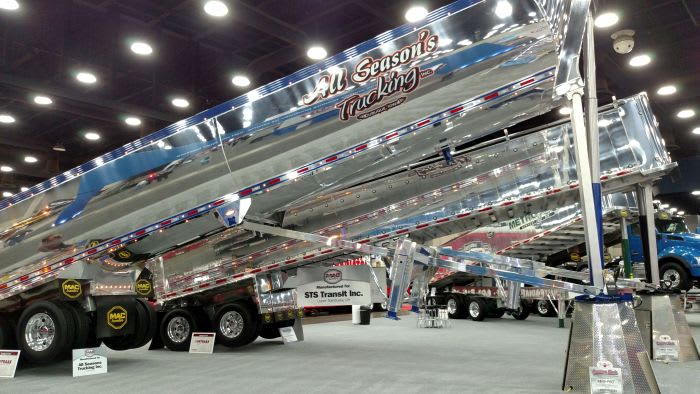
New Mac aluminum end-dumps gleam in the lights of the Mid-America Trucking Show earlier this year. Many lose their luster in day-to-day work, but are still are valued for their light weight and corrosion resistance. Photo: Tom Berg
4 min to read
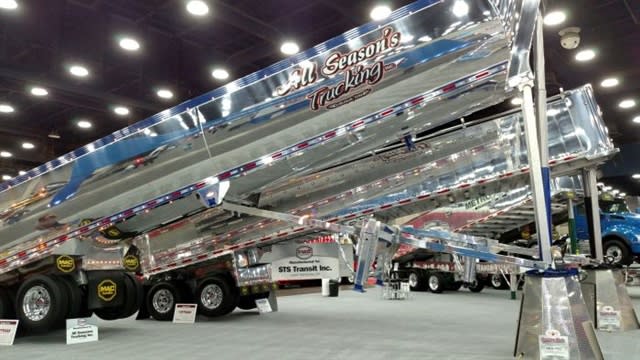
New Mac aluminum end-dumps gleam in the lights of the Mid-America Trucking Show earlier this year. Many lose their luster in day-to-day work, but are still are valued for their light weight and corrosion resistance.Photo: Tom Berg
Think you’re seeing a lot of aluminum end-dump trailers in recent years? You are. Aluminum’s light weight and resistance to corrosion means they now account for eight out of 10 new dump trailers in the United States, builders say. In addition, there has been a trend toward smooth-sided double-wall dumps and away from the outside-braced, sheet-and-post type. Meanwhile, hardened steel has become the chosen material for steel dump trailers and bodies, which are preferred for loading and hauling of rough materials.
“The market is somewhat regional and industry-specific, where industries transporting rock and demolition debris will use steel, and industries transporting processed materials will go with aluminum,” says Bill Riggs, president of J&J Truck Bodies and Trailers in Somerset, Pennsylvania. “Aluminum has been the material of choice for at least 20 years. Only recently has thin, very strong steel become available.” That makes it usable in some weight-sensitive operations formerly limited to more expensive aluminum. But “due to corrosion of steel, aluminum should continue to be popular for years to come.”
Smooth-sided aluminum dumps are now widely available, notes Charlie Wells, vice president, sales and marketing, at East Manufacturing in Randolph, Ohio. “We were the first, with our Genesis in 2001,” he claims, “and now everybody’s pretty much copied it.” Genesis uses square-tube aluminum extrusions that are welded in a line to form the double-sided walls. The main advantages are inherent strength and confining of dings, dents and bulges to the inside surfaces. Lessons learned from early models required engineers to revise the types of alloys employed and certain structural details – an “expensive learning curve,” he says. The type of aluminum alloy used in Genesis sides is proprietary.
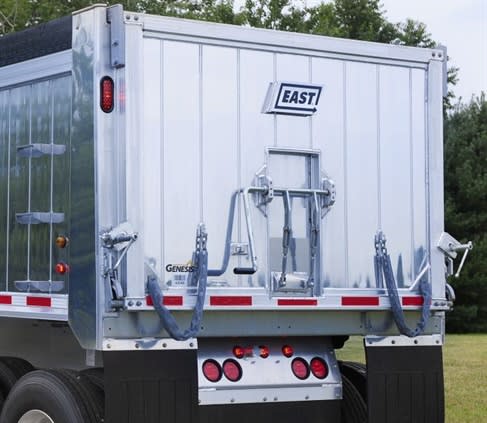
Square-tube aluminum extrusions that are welded in a line form the double-sided walls on East’s Genesis dumps. Photo: East Mfg.
Sand, gravel, crushed stone, and asphalt, the materials commonly carried by aluminum construction dumps, are comparatively easy on walls, floors and other parts. But trash-transfer dumps encounter pieces of wood and metal, even whole washing machines and other appliances that can batter interior components. Sheet-and-post trailers show such wear, but Genesis sides do not, Wells says. They also are very rigid, so resist twisting.
Mac Trailer, East’s principal rival down the road in Alliance, Ohio, offers the smooth-sided Mac Vertical Panel, or MVP, says Joe Dennis, director of dump products. Its sidewalls are also square-tube aluminum extrusions, though joining of the tubes differs somewhat.
“It’s very popular, because the wear is on the inside and you do not show dents on the outside of the trailer,” he says. “A sheet-and-post trailer will show that dent to the outside.” About 75% of the aluminum trailers Mac builds are MVP.
“It also helps with aerodynamics, and the tractor pulling it uses less fuel,” he continues. How much less? “It’s so hard to put number on that. You and I could get in a truck and pull the same trailer with the same loads, and our (fuel economy) numbers will differ because our driving habits differ. I’ve had one customer tell me it’s a half-a-mile per gallon better with an MVP, but I can’t claim that because we haven’t tested it.”
Round noses aid the aerodynamics of end-dumps built by Vantage Trailer in Beaumont, Texas. “At the end of a day, a tractor pulling one of these will use 4 gallons less fuel” compared to a common flat-nose end-dump, says one customer, Mike Culbertson, founder and president of Mike’s Trucking at West Jefferson, Ohio. Vantage sales representative Brian Lemmons says that’s typical of what other customers say for fuel savings. “We’ve been doing the rounded nose for a long time.”
Vantage’s end-dump trailers have single side sheets with top rails and center ribs. Thickness of the metal varies from 0.130 to 0.25 inch, based on stresses encountered by different areas of the body during service. The material is a type 5454 aluminum-magnesium alloy with an H32 surface hardening. East and Mac also use type 5454 and other 5000-series alloys for wear surfaces; Wells says East employs 6061 for top-rail and crossmember extrusions.
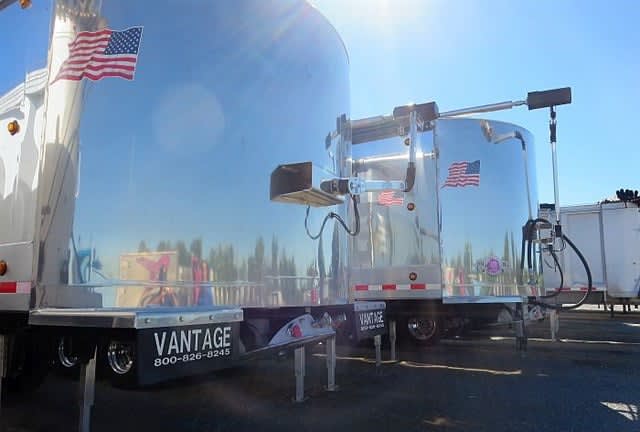
Operators testify that rounded noses on Vantage end-dumps make the trailers easier to pull and save fuel. An 8-foot radius is used on these 96-inch-wide trailers.Photo: Tom Berg
Although East and Mac are best known for their aluminum trailers and truck bodies, they also build steel trailers. Wells says East got into them in the 1980s due to dealer and customer demand for vehicles that must carry sharp-shaped and abrasive materials.
“Basic design specs were sort of duplicates of aluminum trailers,” which East began making in the late ’60s. “But after five, six years of use, you find crevices that are OK with aluminum, places where corrosion can occur because water gathers. Most builders have tried to eliminate places where water can congregate” and steel begins rusting.
Subscribe to Our Newsletter
More Equipment

How Volvo Updated Its D13 for EPA 2027 [Watch]
Volvo’s updated D13 promises lower emissions without sacrificing performance or fuel economy. Take a closer look at what changed inside the engine in this HDT Spotlight video.
Read More →
Michelin Tire Improves Efficiency and Durability for Regional Fleets
The Michelin X Multi Energy D2 is a regional haul drive tire engineered to help fleets improve fuel efficiency, durability and traction in demanding stop-and-go operations.
Read More →
ZF Expands Commercial Vehicle Push in North America
ZF is expanding its North American commercial-vehicle presence with new transmission applications, electrification, trailer technology and autonomous-driving systems.
Read More →
Tesla Wants a Self-Driving Semi. Are Cameras Enough?
Could Tesla’s camera-only autonomous driving technology work on an 80,000-pound Semi? In this commentary, HDT's Deborah Lockridge takes a look at Tesla, Cybercab, and how autonomous trucks see the road.
Read More →
Kodiak: Driverless Long-Haul Truck Launch on Track for 2026
Kodiak AI says its driverless long-haul safety case is 93% complete and it remains on track to begin commercial operations by year-end 2026.
Read More →
What DOT’s Automated Vehicle Strategy Means for Trucking
The U.S. Department of Transportation issued a new automated-vehicle strategy that outlines plans for driverless-truck regulations, cross-state freight corridors, and federal safety standards.
Read More →
East Coast Port Launches $45M Electric Truck Push
The Port Authority of New York and New Jersey announced millions in incentives for zero-emission drayage trucks, yard tractors, and new charging hubs near the port.
Read More →
PlusAI Going Public to Fund Autonomous Truck Launch
A SPAC deal could provide PlusAI with up to $300 million as it works toward a 2027 commercial launch of factory-built autonomous trucks.
Read More →
NHTSA Moves to Rewrite Truck Fuel-Economy Rules
The National Highway Traffic Safety Administration says it lacks authority to regulate medium- and heavy-duty truck engines separately from complete vehicles, but the existing standards have not yet been eliminated.
Read More →
Detroit Opens Orders for EPA 2027 Engines
Detroit isn’t starting from scratch to meet EPA 2027 diesel emissions standards. Its Gen 6 DD13 and DD15 engines keep much of today’s platform while updating the fuel and aftertreatment systems.
Read More →