If a motor carrier does not keep on top of the biennial updates of its Motor Carrier Identification Report (MCS-150), it could face deactivation of its USDOT number and daily fines.
If a motor carrier does not keep on top of the biennial updates of its Motor Carrier Identification Report (MCS-150), it could face deactivation of its USDOT number and daily fines.
Graphic: HDT
3 min to read
Every other year, motor carriers must complete an updated Motor Carrier Identification Report, referred to as the MCS-150. But it can cause headaches, especially for small carriers, including independent owner-operators with their own operating authority.
If an MCS-150 form falls out of date, the Federal Motor Carrier Safety Administration could deactivate the carriers’ USDOT number, and the company could face penalties of up to $1,000 per day, not to exceed $10,000.
While there are third-party companies that will take on the responsibility of submitting the form for a carrier, if there are no major changes to an operation, keeping the MCS-150 up to date can be as simple as updating annual mileage.
The form includes information on the carrier, including the number of miles traveled the previous year, the commodities hauled, insurance information and more. To submit the update, carriers will need their USDOT number and a USDOT pin, so have it handy or plan to wait up to a week for authorities to send it by mail after it’s requested.
The number one reason motor carriers fall into noncompliance with the MCS-150 registration is failing to complete the mandatory biennial update, says FMCSA spokesman Duane DeBruyne. The second most common reason is a lapse in providing proof of the federally required minimum level of insurance.
To remain in compliance, carriers should implement a good system of reminders. It’s also important to remember that even though the form should be updated every other year, it also needs to be updated if there are any changes to how your company operates.
In addition, providing fraudulent or false information on the report is considered an acute violation.
Ad Loading...
When do I need to file my MCS-150?
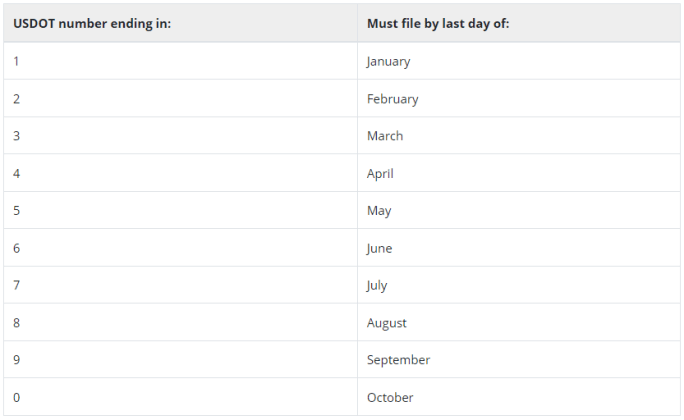
The tricky part can be figuring out when to update the form. The deadline for when a carrier must submit an updated MCS-150 form is based on the last two digits of its USDOT number. The last digit in the USDOT number indicates what month a carrier should update their form (see chart). The next-to-last digit of the USDOT number indicates which year they must update the form (either every even year, or every odd year).
In order to find out the deadline for your MCS-150 biennial update, take a look at the last two digits of your USDOT number. The last digit indicates which month you must file in, and the next-to-last digit indicates whether you must file the form every even or every odd year.
Source: FMCSA
For example, let’s say a USDOT number ends in 34. The three (being an odd number) would indicate that the form is due every odd year. And the four would indicate that the carrier is due in the month of April. So, if your USDOT number ends in 34, you should have filed your MCS-150 form in April 2021.
Although carriers are required to update their MCS-150 every other year, they may want to update it sooner. According to DeBruyne, it is recommended that companies update their information whenever there are changes to the company’s record.
One reason to update it more frequently if operations change is that the information on the MCS-150, such as the number of power units and annualized vehicle miles traveled, are used in the Safety Measurement System in calculating a carrier’s safety performance under the CSA (Compliance, Safety, Accountability) program.
Ad Loading...
Keeping it updated can improve scores, according to an FMCSA FAQ. An out-of-date MCS-150 form could hurt scores if it’s underreporting the number of power units, if the number of tractor units vs. straight trucks is incorrect, or if the VMT is under- or over-reported.
“It is strongly recommended to update the company records as soon as there is a change,” DeBruyne recommends. “Also, file upon receipt of the Biennial Update letter.”
To fill out a MCS-150 form and to view instructions for submitting the form, visit fmcsa.dot.gov.
Did you know?
Before the Federal Motor Carrier Safety Administration was created in 2000, motor carriers only had to file an MCS-150 form once – when they began operations.
At the time, it was the report that all motor carriers subject to federal safety regulations had to complete before they started operations in interstate commerce. FMCSA initiated an every-other-year update cycle to improve the quality of its database and its ability to target inspection and enforcement resources.
In 2015, the agency changed how carriers apply for new authority. First-time applicants had to start using the Unified Registration System (URS). This was part of a larger effort to raise the bar to entry into the business and help keep better track of “chameleon” carriers that evade enforcement by re-registering under a different identity.
MCS-150 today is only used to update information on carriers with existing operating authority.
Marijuana is getting stronger, laws are changing, and drug tests still can’t reliably establish impairment. What does that mean for truck drivers and the fleets that employ them?
The system will allow enforcement agencies to verify Enhanced Inspection information and decide whether Kodiak’s autonomous trucks can bypass roadside screening sites.
After three decades in trucking, Harold Perry shares what he's learned about driver safety, mentorship, and helping the next generation build confidence behind the wheel.
Carriers whose updates were due on or after June 1 have more time, while FMCSA works to stabilize its new registration system and warns of phishing sites impersonating its new carrier registration system, Motus.
ZF is expanding its North American commercial-vehicle presence with new transmission applications, electrification, trailer technology and autonomous-driving systems.
Fleets have more visibility into truck health, safety events, and driver activity than ever. The next challenge is turning all that information into useful guidance for the person who has to decide what to do next.
Could Tesla’s camera-only autonomous driving technology work on an 80,000-pound Semi? In this commentary, HDT's Deborah Lockridge takes a look at Tesla, Cybercab, and how autonomous trucks see the road.
The U.S. Department of Transportation issued a new automated-vehicle strategy that outlines plans for driverless-truck regulations, cross-state freight corridors, and federal safety standards.
New York City is expanding intelligent speed assistance and pedestrian-alert systems across its municipal fleet, moving the technologies from pilot programs into vehicle procurement and retrofit requirements.