





Read more from Jeff Kauffman's Behind the Numbers column.
What Q2 Earnings Tells Trucking About Market Trends
Transport companies delivered largely better-than expected second-quarter earnings, but we are starting to see weaker trends developing in consumer-facing industries.
September 27, 2022

Graphic: HDT
3 min to read
In the second quarter of 2022, less-than-truckload improved 4.7 percentage points in year-over-year margins, followed by intermodal with a 3.9 percentage point improvement. Railroads were the underperforming segment, down 2.6 percentage points.
Source: Company Reports, Tahoe Ventures LLC
Transport companies delivered largely better-than expected second-quarter earnings, but we are starting to see weaker trends developing in consumer-facing industries.
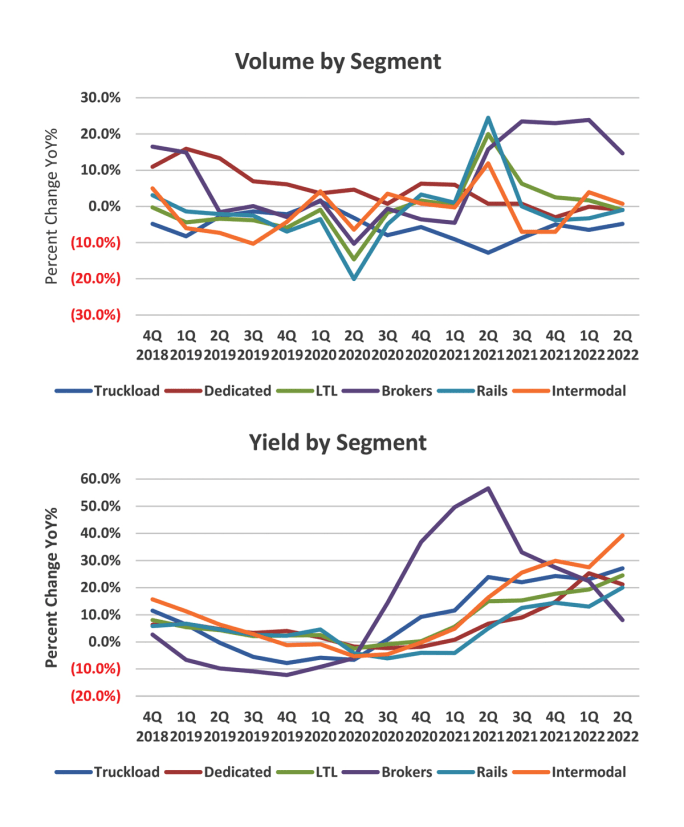
Overall, earnings-per-share outlooks remained flat for 2022, a deceleration from the 3% rate in the first quarter. In less-than-truckload and dedicated, yields (pricing + fuel surcharge + mix) largely came in ahead of expectations and volumes were stronger, but brokerage, intermodal and truckload showed decelerating growth.
Labor costs are rising, but at a slower rate, and purchased transportation costs are now declining. Customers are not yet pushing back hard on rate increases, and demand appears to be weaker in housing and large-ticket furnishings/DIY retailers. While retailers have struggled from stocking up on the wrong kind of inventory, the right inventory continues to be tight. Supply chain bottlenecks are easing, and ocean and air rates globally are moderating, but supply chain challenges are not yet over and rates still remain at elevated levels.
The big winners this quarter were less-than-truckload, with a 4.7 percentage point improvement in year-over-year margins, followed by intermodal with a 3.9 percentage point improvement.
The big underperformer this quarter was railroads, down 2.6 percentage points. Service problems caused rail carriers to scramble for extra people, equipment, and in some cases, revive closed rail yards.
Truckload and dedicated showed similar margin improvement but are headed in different directions. Dedicated margins improved 0.4 percentage points, much improved from declines of 2.5 points in the fourth quarter of 2021. Truckload operating margins improved by 0.3 percentage points, but that is down meaningfully from a 2.4-point improvement at the end of last year.
In the pure truckload segment, miles declined by 5% on flat fleet growth, but yields (including fuel) increased by about 27%, resulting in 20% revenue growth. Operating expenses were led by a 70% increase in fuel costs, resulting in margins being 0.3% better at 12%. Knight-Swift’s 17.4% operating margin edged out Heartland’s 17%.
More companies are breaking out dedicated truckload, although the data is not robust. The dedicated fleets saw 1% fewer miles on 4.9% fleet growth, and yields improved to about 21%, resulting in 27% revenue growth. Dedicated’s net fleet adds were among the largest we have seen in two years, as margins improved 0.4 percentage points to about 7.7%, still well below the 13% range in 2020.
The less-than-truckload space showed impressive margin improvement, despite a still-slow industrial marketplace. Tonnage and shipment growth were largely below expectations with a decline of 1% on more difficult comparisons, and weight/shipment was flat. Old Dominion Freight Line warned that July tonnage growth was negative, which bears watching. LTL yields continued to improve, up 24.5%, resulting in 23.3% revenue growth. The overall LTL margin hit a record high of 17.4%, up 4.7 points from a year ago. There were two notable firsts — Old Dominion broke a 70% operating ratio at 69.5%, and FedEx Freight broke 80% at 78.2%.
The brokerage and logistics group showed the largest revenue and volume deceleration but benefitted from margin expansion as spot rates fell more quickly than contract rates. Volumes dropped from 24% growth rates to 15% and yields fell from 22% to 8%, resulting in revenue growth of 26%. We believe this growth could trend toward negative in the second half of the year. Margins are expanding about 2.8 percentage points versus the prior year, but we expect this to moderate toward year-end as contracts are repriced.
This column first appeared in the September 2022 issue of Heavy Duty Trucking.
Subscribe to Our Newsletter
More Fleet Management

Sponsored•September 16, 2026
Color Match Smarter: Tools That Restore & Perform
For fleet managers and collision repair professionals keeping heavy-duty trucks on the road, getting the color right the first time isn't just about appearance — it's about efficiency, turnaround time, and bottom-line results. Discover how today's digital color tools are transforming the repair process from guesswork to precision.
Read More →
FMCSA Pauses Biennial-Update Enforcement Amid Motus Transition
Carriers whose updates were due on or after June 1 have more time, while FMCSA works to stabilize its new registration system and warns of phishing sites impersonating its new carrier registration system, Motus.
Read More →
Sponsored•September 14, 2026
2026 Blueprint for Countering Smarter Supply Chain Theft
Cargo theft is no longer just the cost of doing business. It's a multi-billion-dollar criminal enterprise exploiting vulnerabilities across your fleet, drivers, and supply chain.
Read More →


Sponsored•September 1, 2026
How Telematics Improves Visibility, Control, and Performance in Refrigerated Fleets
Explore how telematics help refrigerated fleets improve visibility, uptime, efficiency, compliance, and cargo protection across connected cold chain operations.
Read More →
What the U.S.-Canada Trade War Means for Trucking
Escalating U.S.-Canada tariffs could disrupt cross-border freight, reduce truck volumes, raise costs, and create new uncertainty for carriers on both sides of the border.
Read More →
What Are Trucking’s Top Concerns for 2026?
The American Transportation Research Institute wants to know what's worrying trucking fleet managers, drivers, and other stakeholders in its annual Industry Issues survey.
Read More →
American Trucking Associations Looks for a New Leader
ATA President and CEO Chris Spear abruptly left his job at the association on August 21, at a pivotal time for the trucking industry.
Read More →
Public Wi-Fi Cybersecurity Risks: How Truck Drivers and Fleets Can Protect Their Data
Public Wi-Fi can expose truck drivers and fleets to credential theft, malware, and other cyber threats. Here’s how to reduce the risk on the road.
Read More →
For Nicky Cupp, Fleet Innovation Starts With Frustration
HDT Truck Fleet Innovator Nicky Cupp turns everyday pain points at Fraley & Schilling into opportunities for better technology and smarter processes.
Read More →
Adam Buttgenbach’s Approach to Electric Trucks: Start With Where They Fit
HDT Truck Fleet Innovator Adam Buttgenbach helped PepsiCo build one of North America’s largest EV fleets by focusing on where electric trucks make operational sense.
Read More →