





More from Jeff Kauffman's Behind the Numbers: What Can Trucking Expect from Inflation and Interest-Rate Numbers? [Analysis]
What Do Q1 Freight Volumes Tell Us?
Given the uncertainty in the larger economy, what do the various volume lead indicators for trucking telling us? HDT's Contributing Economic Analyst explores the numbers.
March 26, 2023
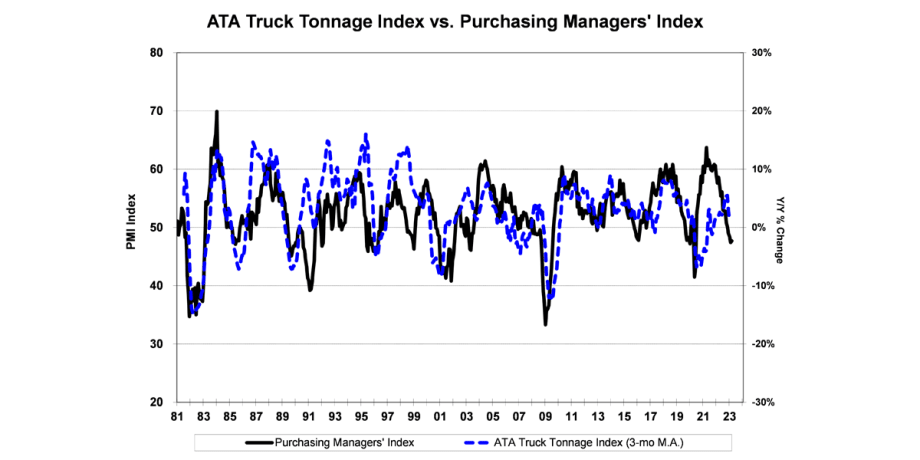
When you compare the Purchasing Managers’ Index with the American Trucking Associations’ tonnage numbers, you can see the PMI tends to lead truck tonnage in a fairly accurate direction.
Source: American Trucking Associations, Institute of Supply Management
3 min to read
In mid-March, many less-than-truckload carriers reported quarter-to-date tonnage and yield results that had volumes down about 6.2%, below expectations.
While the gross of fuel yields are up about 6.2%, roughly in line with our view, we thought it would be helpful to discuss various volume lead indicators for trucking as a whole. Given the uncertainty in the larger economy, what are these numbers telling us?
Freight Volumes
Volumes were slightly above expectations in January and below expectations in February, which we attribute to better-than-expected winter weather across much of the country in January. Cass shipments declined 3.2% in January from the previous month, but normal December-to-January drops are about 8% — so shipments improved versus normal seasonality.
Meanwhile, spot truck rates were relatively stable, even as winter came back with a fury on the West Coast and the northern states.
Rail volumes have been a tale of two cities, with commodity volumes (excluding coal, grain and intermodal) showing surprising strength (up 2.3% through February). But intermodal volumes were down about 8.2% year-to-date, owing largely to the inventory-reduction efforts going on with retailers. We also have seen weakness in chemical volumes on inventory destocking (although that is improving in recent weeks), lumber (on housing), corrugated boxes (destocking) and coal (warmer winter).
We believe much of what we have seen so far is not the weakening economy, but a meaningful inventory destocking of the large inventory builds a year ago.
Looking Forward
So, what should the go-forward view be? Normally, March makes the first quarter. This year, the drop in inbound container shipments (down 25% in February) is likely to leave that push lacking.
Nonetheless, many retailers have been reporting that their inventory adjustments are close to complete, and some of the retail-facing trucking companies we speak with believe more normal seasonality will begin to kick in sometime during the second quarter.
In our view, we haven’t really seen a meaningful slowdown in the economy yet related to the Fed’s interest rate increases. Is that still ahead of us?
The Purchasing Managers’ Index from the Institute of Supply Management, while not a perfect correlation, tends to lead truck tonnage in a fairly accurate direction. We get a similar graph if looking at the leading economic indicator index or the Cass Shipment Index. However, the PMI tends to lead truck tonnage with the greatest predictive value. The continued weakening of this index suggests that we could be in for slower truck tonnage in the quarters ahead.
Meanwhile, although the retail destocking may be nearing an equilibrium, manufacturing inventories overall remain bloated. We are starting to see layoff announcements beginning in industries other than technology.
Lower Demand, Lower Rates
Along with this, we expect to see a further weakening in used-vehicle prices as truck OEMs ramp up new-truck production. ACT Research says used Class 8 vehicle prices could weaken another 40% this year. This means buyers of truck equipment won’t have as much in collateral to trade, in addition to facing rising interest rates.
The point is, despite retail reports that we could be getting closer to the end of the big inventory destocking, these lead indicators for truck volumes continue to predict lower demand. And lower freight rates indicate that demand has not yet recovered.
In our view, growth risk remains to the downside, as the Federal Reserve continues to raise rates to battle inflation and the cost of equipment continues to rise. We expect comparisons to improve from destocking-related weak levels, but perhaps the weaker economy remains ahead of us.
This analysis appears in the April 2023 issue of Heavy Duty Trucking.
Topics:Fleet Management
Subscribe to Our Newsletter
More Fleet Management

Sponsored•September 16, 2026
Color Match Smarter: Tools That Restore & Perform
For fleet managers and collision repair professionals keeping heavy-duty trucks on the road, getting the color right the first time isn't just about appearance — it's about efficiency, turnaround time, and bottom-line results. Discover how today's digital color tools are transforming the repair process from guesswork to precision.
Read More →
FMCSA Pauses Biennial-Update Enforcement Amid Motus Transition
Carriers whose updates were due on or after June 1 have more time, while FMCSA works to stabilize its new registration system and warns of phishing sites impersonating its new carrier registration system, Motus.
Read More →
Sponsored•September 14, 2026
2026 Blueprint for Countering Smarter Supply Chain Theft
Cargo theft is no longer just the cost of doing business. It's a multi-billion-dollar criminal enterprise exploiting vulnerabilities across your fleet, drivers, and supply chain.
Read More →


Sponsored•September 1, 2026
How Telematics Improves Visibility, Control, and Performance in Refrigerated Fleets
Explore how telematics help refrigerated fleets improve visibility, uptime, efficiency, compliance, and cargo protection across connected cold chain operations.
Read More →
What the U.S.-Canada Trade War Means for Trucking
Escalating U.S.-Canada tariffs could disrupt cross-border freight, reduce truck volumes, raise costs, and create new uncertainty for carriers on both sides of the border.
Read More →
What Are Trucking’s Top Concerns for 2026?
The American Transportation Research Institute wants to know what's worrying trucking fleet managers, drivers, and other stakeholders in its annual Industry Issues survey.
Read More →
American Trucking Associations Looks for a New Leader
ATA President and CEO Chris Spear abruptly left his job at the association on August 21, at a pivotal time for the trucking industry.
Read More →
Public Wi-Fi Cybersecurity Risks: How Truck Drivers and Fleets Can Protect Their Data
Public Wi-Fi can expose truck drivers and fleets to credential theft, malware, and other cyber threats. Here’s how to reduce the risk on the road.
Read More →
For Nicky Cupp, Fleet Innovation Starts With Frustration
HDT Truck Fleet Innovator Nicky Cupp turns everyday pain points at Fraley & Schilling into opportunities for better technology and smarter processes.
Read More →
Adam Buttgenbach’s Approach to Electric Trucks: Start With Where They Fit
HDT Truck Fleet Innovator Adam Buttgenbach helped PepsiCo build one of North America’s largest EV fleets by focusing on where electric trucks make operational sense.
Read More →