




Volvo Goes With Gas in Diesel Engines
Which fuels will replace oil? Nobody yet knows the answer. However, in order for the manufacturers to be able to offer vehicles that the market will want in the future, strategic decisions have to be made today
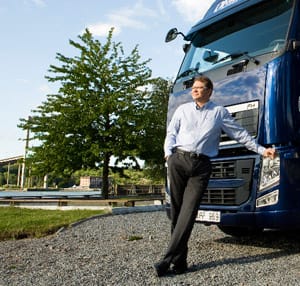
Mats Franzen at Volvo Trucks looks ahead.
Which fuels will replace oil? Nobody yet knows the answer. However, in order for the manufacturers to be able to offer vehicles that the market will want in the future, strategic decisions have to be made today.
Volvo Trucks is investing in a solution that is financially sustainable and that may form a bridge between fossil and renewable fuels: diesel engines running on methane gas.
"We have chosen a route where we combine the diesel engine's superior efficiency rating with the benefits of gas," says Mats Franzen, manager of engine strategy and planning, Volvo Trucks. "This gives us a truck that is significantly more energy-efficient than traditional gas trucks."
This approach is bound to attract attention in the transport sector, where the gas-powered trucks currently in use have spark plug internal combustion engines adapted for gas operation.
There is a simple logic behind Volvo Trucks' decision to slightly modify its proven diesel engines, says Franzen.
"A diesel engine has a 30 to 40 percent better efficiency rating than an ordinary spark plug engine running on petrol or an internal combustion engine. Whatever fuels either engine type runs on, the diesel engine is always far more energy-efficient. That's why all heavy vehicles have diesel engines," he explains.
One example: With compressed methane gas in the tanks, a gas-powered truck with an internal combustion engine can drive 150-200 kilometers (about 93 to 124 miles) without refueling. With the same amount of gas in a truck with a methane diesel engine, the range is twice as long.
Volvo Trucks' aim is for its trucks to operate on a combination of 75 percent methane gas and 25 percent diesel in the initial stage.
Optimum efficiency is achieved if the methane gas is chilled to negative 160 degrees Celsius. At that temperature, the gas becomes liquid, the volume is reduced and you get twice the amount of fuel. With liquid methane gas in the tank and a fuel consumption of 75 percent methane gas and 25 percent diesel, it is now possible to drive more than 500 kilometers (about 311 miles) before refueling.
This means that for transport companies performing long daily transport jobs and returning to the same filling station, Volvo Trucks' methane diesel technology is already an attractive, environmentally compatible fuel option.
"The technology is constantly developing. We'll be able to drive 1,000 kilometers on a tank of liquid gas in the near future," says Franzen.
At present, the network of filling stations that distribute liquid methane gas is unevenly developed in Europe. There are plenty of filling stations in the United Kingdom, while some countries, such as Sweden, have none at all. However, filling stations will soon be built in Sweden's three largest cities, partly as a result of Volvo Trucks' drive, which is taking place in close cooperation with gas suppliers in Sweden.
"We're currently in a transition stage," says Lars Martensson, Volvo Trucks' environmental director. "We're moving from decades of dependence of oil to a society based on renewable fuels. During this transition period, gas trucks with a methane diesel engine have an obvious advantage. They can run on only diesel, which is practical and safe when filling stations are few and far between."
A common argument against methane gas is that natural gas has to be used because not enough biogas is produced. Critics argue that replacing one fossil fuel with another is unsatisfactory.
"Using natural gas is one way of getting through this transition period until biogas production has been fully developed. We'd prefer our engines to run on both biodiesel and biogas. That would reduce carbon emissions by almost 80 percent compared to traditional diesel operation," says Martensson.
Field testing of methane diesel engines will start in Sweden and the UK in 2010. Potential customers are showing high interest, not least in the public sector, which already makes strict environmental requirements during procurement and plays a key role in driving development forward.
"Our focus on a combination of methane gas and diesel makes it possible to capitalize on all the benefits of a diesel engine, while lowering both costs and emission levels by using methane gas as our main energy source," says Franzen.
Facts - Methane-diesel engines
In a diesel engine, methane gas is sprayed into the cylinder along with the air flow through injectors located immediately above the valve openings. The diesel is injected as usual and ignited by the compression in the cylinder, along with the methane gas. However, a certain amount of diesel is necessary in order for the combination of methane gas and diesel to ignite.
Computers monitor the driving and control the proportion of methane gas and diesel. The best - i.e. the highest - proportion of gas is achieved during smooth, stable driving with few fast accelerations.
Facts - Renewable fuels
In August 2007, Volvo Trucks presented seven driveable demo trucks adapted for different biofuels. The company is now focusing primarily on dimethyl ether and methane gas. Dimethyl ether (DME) can for instance be produced from black liquor, a by-product of pulp production. Methane gas exists in the form of fossil natural gas. It can be produced in treatment plants and on rubbish dumps, or developed from biomass.
Natural gas is readily available, and in many countries is over 30 percent cheaper than diesel. Biogas production is constantly increasing, with Sweden at the forefront of development.
More Fuel Smarts

How Volvo Updated Its D13 for EPA 2027 [Watch]
Volvo’s updated D13 promises lower emissions without sacrificing performance or fuel economy. Take a closer look at what changed inside the engine in this HDT Spotlight video.
Read More →
Diesel Price Spike Shortens Payback for Natural Gas Trucks, Report Says
Energy Vision estimates fleets could recover the higher purchase price of an RNG-fueled Class 8 tractor in 1.3 to 2.8 years under current fuel-price scenarios.
Read More →
Calstart Becomes Catalyst Mobility, Reflecting Broader Focus
Calstart is now Catalyst Mobility, reflecting the nonprofit’s growing national role in clean transportation, including zero-emission trucks, infrastructure and incentive programs.
Read More →

Record Diesel Prices Squeeze Trucking Fleets
Average U.S. diesel prices have climbed to nearly $6 a gallon, surpassing the 2022 record as tight refinery capacity and Middle East disruptions keep fuel costs elevated.
Read More →
How Fuel Delivery Shapes Engine Performance
Fuel delivery depends on more than what happens at the injector. For fleet, maintenance and technical professionals, looking at the full path from pump to injector can provide useful context for understanding engine performance.
Read More →
East Coast Port Launches $45M Electric Truck Push
The Port Authority of New York and New Jersey announced millions in incentives for zero-emission drayage trucks, yard tractors, and new charging hubs near the port.
Read More →
California Bill Could Shed Light on Electric Truck Prices
Why do battery-electric Class 8 trucks remain so expensive? A California bill headed to Gov. Gavin Newsom would give fleets and state agencies more visibility into what manufacturers charge.
Read More →
Detroit Opens Orders for EPA 2027 Engines
Detroit isn’t starting from scratch to meet EPA 2027 diesel emissions standards. Its Gen 6 DD13 and DD15 engines keep much of today’s platform while updating the fuel and aftertreatment systems.
Read More →
Zero-Emission Truck Corridor Planned for West Coast
California, Oregon, Washington, British Columbia and Baja California are coordinating plans for truck charging and hydrogen fueling from Canada to Mexico.
Read More →
A Closer Look at Kenworth’s Electric T880E Vocational Truck [Video]
Learn more about Kenworth's T880E battery-electric vocational truck at the Paccar Technical Center, including its range, applications, upfitting considerations, and PTO options, in this HDT Spotlight video.
Read More →