For some fleets, the warning signs came with the disruption to the container-shipping business from China. For others, it was cancelled concerts and basketball championships. The hoarding of toilet paper. The first statewide shelter-in-place order. The declaration of a national emergency by President Trump.
Ad Loading...
However and whenever they first realized the COVID-19 pandemic would cause unprecedented disruption to their business, trucking fleets of all sizes and types have been affected in many ways.
For some, business initially picked up as the supply chain struggled to restock stores with toilet paper, hand sanitizer, and groceries, before tapering off near the end of March. For others, business dried up almost overnight. Some have parked trucks and furloughed workers; others have been scrambling to hire more drivers to meet demand.
Ad Loading...
Protecting Employees
As medical advice shifted rapidly in the early weeks of the pandemic, fleets grappled with what to tell employees, especially drivers out on the road — and how to get them supplies such as hand sanitizer, disinfecting wipes, and face masks.
The latter became even more urgent in the second half of April after the CDC did an about-face on its guidance on face coverings for the healthy public and several states made them mandatory.
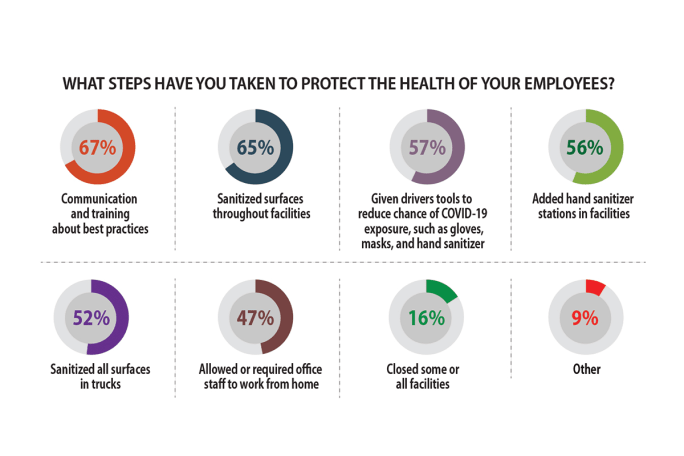
In an HDT survey conducted March 27 through April 11, the most common steps companies had taken to protect the health of their employees were:
Communication and training about best practices, 67%
Sanitized surfaces throughout facilities, 65%
Provided drivers tools to reduce chances of exposure, such as gloves, masks, and hand sanitizer, 57%
Added hand sanitizer stations in facilities, 56%
Sanitized all surfaces in trucks, 52%
Allowed or required office staff to work from home, 47%
Closed some or all facilities, 16%.
Some other tactics fleets mentioned included closing facilities to the public, no slip-seating at this time, daily screening questionnaires, and using technology for communication to minimize in-person contacts.
Ad Loading...
Drivers on the Front Lines
Many truck drivers faced long waits at shippers and receivers, as well as temperature checks, health questionnaires, mask requirements, and being banned from using restrooms.
With more and more states and localities shuttering sit-down restaurants, long-haul drivers were faced with few options other than prepackaged meals and some fast-food locations that offered curbside pickup. Some drivers turned to ordering food delivered to their trucks through apps such as DoorDash. Some franchise restaurants with truck-parking access started offering curbside options for truckers who couldn’t go through drive-throughs. Companies, local groups, associations, law enforcement, and individuals organized free-meals-for-truckers handouts.
There were also many questions about how to deal with drivers who might come down with COVID-19 while on the road.
While many fleets implemented what most of us are doing to reduce the spread of COVID-19 — like sanitize, sanitize, sanitize — a handful (16%) had to close some or all of their facilities.
Source: HDT
In our survey, when asked if someone at their company had tested positive: only 3% answered yes; 7% said they couldn’t get tested to know for sure; 10% either didn’t know, preferred not to answer, or said the company does not publicize the information; and 82% said they had not had anyone at their company test positive.
Fleets we spoke with told us that there was no one-size-fits-all plan that could accommodate every driver’s situation. They did their best to plan for all eventualities they could think of, then worked closely with each driver who contacted them with symptoms to help them get tested, find medical care, get home or quarantine on the road.
Ad Loading...
A number of fleets also announced they were offering additional financial benefits for any drivers who did come down sick with COVID-19.
At the same time, drivers faced far less congestion on the roads — a little eerie, but welcome, especially in normally crowded urban areas. A number of fleets announced special “hazard pay” for drivers. And drivers have been treated as some of the front-line heroes of the pandemic, with national and local media coverage alike detailing the challenges they face on the road and their vital role in the supply chain. In a photo-op on the White House Lawn, President Trump said, “Thank God for truckers.”
Non-Driving Employees
Carriers also have had to address how to protect their non-driving employees.
Many fleets sent a large percentage of their office employees home to work remotely — a tactic that has been so successful, some fleets now say that they will rethink their work-from-home policies in the long term.
Like drivers, shop employees can’t work from home. From shift scheduling and technician isolation to not letting preventive maintenance intervals slide, the virus tested the mettle of maintenance managers everywhere.
Ad Loading...
Changes in equipment utilization has meant trucks and trailers sometimes aren’t getting into the shops when they should for preventive maintenance and inspections. Shop efficiency has dropped in some cases, as technicians need to spend more time doing things like sanitizing the equipment, washing their hands, changing gloves, and so on.
There were questions about the best ways to disinfect trucks, especially for slip-seating operations (which many carriers suspended if possible) or where a truck was being reassigned to a new driver, especially if the former driver had been diagnosed with or suspected of having COVID-19.
Business Affected
Freight and rates have seen a rollercoaster ride caused by the pandemic’s effects on supply chains, routes, networks, and more.
Data from the American Transportation Research Institute gave a snapshot of how commercial fleet activity was affected by the outbreak, using real-time truck GPS data to evaluate truck activity across six states between Feb. 9 and April 18.
The data showed a spike in initial truck activity from early February into March, a result of high demand for items such as non-perishable food and paper products, as well as emergency medical supplies. The effects of stay-at-home orders shutting down major segments of the economy were also analyzed, which resulted in an April decline in trucking operations.
Ad Loading...
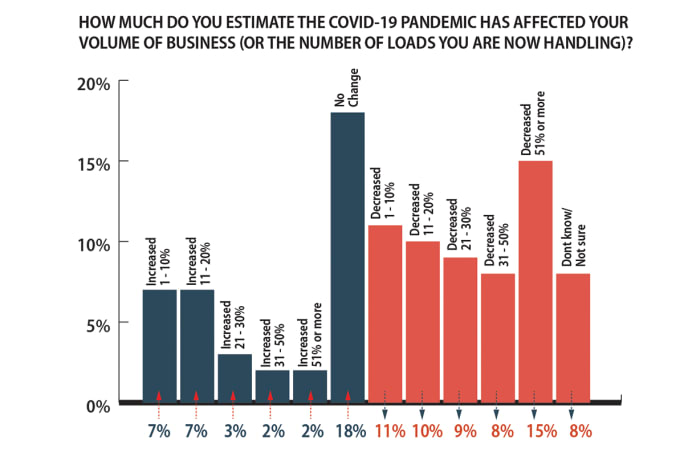
More than 60% of the fleets surveyed between March 27 and April 11 had seen a decrease in the volume of business since the outbreak hit in March, with 15% seeing a drop of 51% or more in the number of loads they handle.
Source: HDT
More than half of the fleets surveyed by HDT in late March/early April reported their level of business had been negatively affected by the COVID-19 pandemic.
In that survey, 53% of respondents said their volume of business/the number of loads had decreased, and 15% said it had fallen by more than 50%. Conversely, 21% said their business had increased, with the majority of those reporting an increase of 20% or less. Nearly one in five, 18%, said the pandemic had not affected the number of loads they were handling. Another 8% didn’t know or weren’t sure.
As the amount of available freight plummeted as stay-at-home orders took hold and supermarket shelves were staying somewhat better stocked, available truck capacity rose and freight rates dropped.
‘Drastic Declines in Rates’
By the end of the month, spot market rates had dropped so much that some loads would cost more in operating costs to haul than truckers would be paid. This led to demonstrations by independent truckers in Texas and California, who largely blamed brokers for the problem and called for more broker regulation.
“Trucking companies are still reeling from drastic declines in rates, as large swaths of the economy remain closed in response to COVID-19,” said DAT Solutions in its report on spot rates for the week of April 20-26. “That’s hurt demand for truckload shipments, and prices continue to fall on most major lanes.”
Ad Loading...
As we went to press, there were some indications that things might be looking up, as some states cautiously began re-opening some business activity. Spot load-posting volume increased 6.2% the week ending April 26, ahead of Texas, Ohio, Georgia, Tennessee, and other states easing lockdown orders on their economies, said DAT Solutions.
However, “truckload volumes remained well below seasonal levels, both in terms of loads offered and loads moved, and did little to prevent spot rates from sliding further into dangerously low territory for owner-operators and small carriers,” DAT said.
Larger carriers that rely more on less-volatile contract freight were less affected, and many were still hiring drivers (while changing orientation practices to encompass social distancing and other preventive measures.)
However, many contract carriers saw the number of loads tendered from their committed shippers drop significantly, forcing some into the spot market, especially to fill empty backhauls. A willingness to accept low rates to get the truck back to where they could pick up a committed contract load put more downward pressure on spot rates.
Depending on where their business lies, some fleets have furloughed employees or temporarily shut down. Fleets serving industries such as events, food service, automotive manufacturing, or the increasingly beleaguered oil production industry, saw business dry up. Even larger fleets that have been able to keep busy announced pay cuts for executives. Some fleets were able to take advantage of the federal government’s small-business loan and payroll protection program. There’s little doubt that some fleets won’t make it out the other side of this crisis.
Ad Loading...
Still, trucking fleets of all sizes and types have been doing their best to keep trucking through this pandemic. Below are links to examples of how some fleets are dealing with the pandemic's effect on their employees and their buisness, and some of the ways they’ve been navigating this crisis.
Carriers whose updates were due on or after June 1 have more time, while FMCSA works to stabilize its new registration system and warns of phishing sites impersonating its new carrier registration system, Motus.
ZF is expanding its North American commercial-vehicle presence with new transmission applications, electrification, trailer technology and autonomous-driving systems.
Fleets have more visibility into truck health, safety events, and driver activity than ever. The next challenge is turning all that information into useful guidance for the person who has to decide what to do next.
Could Tesla’s camera-only autonomous driving technology work on an 80,000-pound Semi? In this commentary, HDT's Deborah Lockridge takes a look at Tesla, Cybercab, and how autonomous trucks see the road.
The U.S. Department of Transportation issued a new automated-vehicle strategy that outlines plans for driverless-truck regulations, cross-state freight corridors, and federal safety standards.
New York City is expanding intelligent speed assistance and pedestrian-alert systems across its municipal fleet, moving the technologies from pilot programs into vehicle procurement and retrofit requirements.
Federal regulators also are targeting more than 160 additional training providers and launching a nationwide audit of third-party CDL skills testers as part of a broader crackdown on trucking fraud.
Two pilot programs could eventually reshape hours-of-service rules, giving truck drivers options to pause their 14-hour clock or use longer split sleeper rest periods.
Hundreds of thousands of pets travel in truck cabs. A new safety guide from Volvo Trucks and the Center for Pet Safety offers practical advice for truck drivers who bring dogs and cats along for the ride.