





Related: Spec'ing Trailer Doors and Floors
Today’s Trailer Landing Gear
Landing gear can make a driver’s job that much easier at the beginning and end of a haul, depending on how well the components are protected and how well they work together.
December 22, 2015
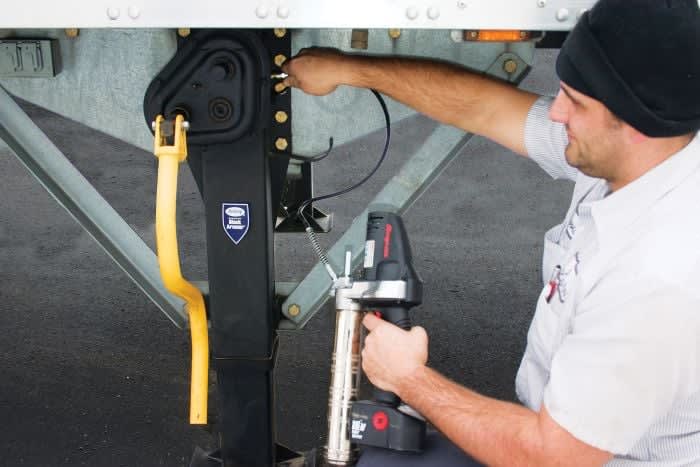
Rust and corrosion are not just a problem for the exterior, it can also creep into the interior parts, which is why it’s important to ensure that all components are kept greased and free of moisture and corrosive chlorides. Photo: Jost International
3 min to read
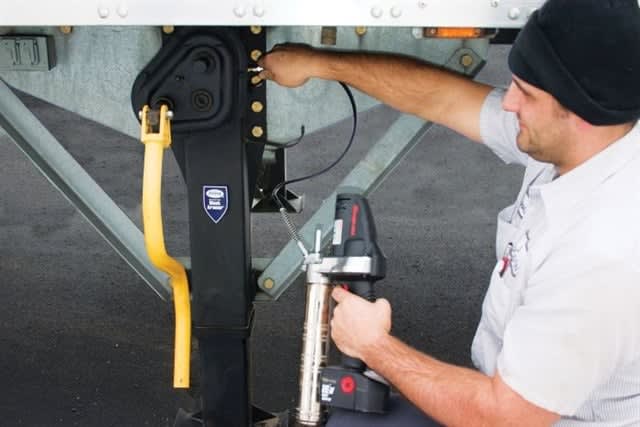
Rust and corrosion are not just a problem for the exterior, it can also creep into the interior parts, which is why it’s important to ensure that all components are kept greased and free of moisture and corrosive chlorides. Photo: Jost International
Landing gear can make a driver’s job that much easier at the beginning and end of a haul, depending on how well the components are protected and how well they work together to take some of the effort off the hands of the driver.
When it comes time to hook up or unhook your trailer, it’s not always about what you see, but what you don’t see. While the water and wash from winter roads can cause corrosion that slowly eats away at external landing gear hardware, the internal parts also need to be looked at.
“Landing gear continues to be one of the areas of the trailer that is susceptible to corrosion created by the use of chlorides for snow and ice control,” says Brian Moynihan, vice president of trailer product sales and development at Jost International. “Internal corrosion will cause the nut and elevating screw inside of the landing gear to corrode and cause the landing gear to fail prematurely.”
Jost helps combat this with an internal grease tube that encapsulates the elevating screw. Every time the legs are cranked up and down, a fresh coating of grease is applied to the screw. In addition, the physical presence of the grease tube helps keep the corrosive chlorides off of the nut and elevating screw.
That’s not to say the outside doesn’t need to be protected from corrosion as well.
“We are concerned about ensuring the ‘chipping resistance’ of the top treated surfaces and slowing down the progress of corrosion propagation, or what’s commonly known as rust creep,” says Zoran Tomic, director of global landing gear product planning and market development, trailers system for SAF-Holland.
The company’s corrosion and rust prevention includes Black Armour, a chemical that bonds with metal to form a protective skin that’s resistant to water and anti-icing chemicals; hot dip galvanizing; and the use of aluminum for the most exposed landing gear parts.
Driver ergonomics
Landing gear manufacturers also focus on drivers in terms of ergonomics and safety. Jost provides a low gear lifting ratio of 32 turns per inch of travel, which translates into landing gear that can lift a loaded trailer without excessive force. When there is no load on the landing gear, it also offers a fast high gear at 3.5 turns per inch of travel, giving the driver the ability to quickly get the legs to the ground or fully retracted.
“In 2016 Jost will be introducing a new landing gear model with a new gear train and shifting system that will allow the landing gear to shift from high gear to low gear automatically,” Moynihan says. “As soon as this new landing gear model detects a load on the legs, it will shift automatically into low gear. When the load is removed from the legs it will automatically shift into high gear.”
While automated landing gear can improve ergonomics, it can also be cost prohibitive, according to Holland’s Tomic. Other applications require the landing gear to lift a fully loaded trailer so the efficiency of the lifting capabilities — lifting the heaviest load with minimal input torque at the crank handle — are still important.
“Because of the need for increased driver uptime, landing gear manufacturers have been concentrating on reducing the time spent to lower the landing gear,” says Tomic, who explained how the Holland Atlas FastGear’s cranking speed of 1.8 turns per inch of travel in high gear has increased efficiency by minutes, not seconds. “This means fewer minutes spent lowering the landing gear, significantly increasing driver uptime.”
Subscribe to Our Newsletter
More Equipment

How Volvo Updated Its D13 for EPA 2027 [Watch]
Volvo’s updated D13 promises lower emissions without sacrificing performance or fuel economy. Take a closer look at what changed inside the engine in this HDT Spotlight video.
Read More →
Michelin Tire Improves Efficiency and Durability for Regional Fleets
The Michelin X Multi Energy D2 is a regional haul drive tire engineered to help fleets improve fuel efficiency, durability and traction in demanding stop-and-go operations.
Read More →
ZF Expands Commercial Vehicle Push in North America
ZF is expanding its North American commercial-vehicle presence with new transmission applications, electrification, trailer technology and autonomous-driving systems.
Read More →
Tesla Wants a Self-Driving Semi. Are Cameras Enough?
Could Tesla’s camera-only autonomous driving technology work on an 80,000-pound Semi? In this commentary, HDT's Deborah Lockridge takes a look at Tesla, Cybercab, and how autonomous trucks see the road.
Read More →
Kodiak: Driverless Long-Haul Truck Launch on Track for 2026
Kodiak AI says its driverless long-haul safety case is 93% complete and it remains on track to begin commercial operations by year-end 2026.
Read More →
What DOT’s Automated Vehicle Strategy Means for Trucking
The U.S. Department of Transportation issued a new automated-vehicle strategy that outlines plans for driverless-truck regulations, cross-state freight corridors, and federal safety standards.
Read More →
East Coast Port Launches $45M Electric Truck Push
The Port Authority of New York and New Jersey announced millions in incentives for zero-emission drayage trucks, yard tractors, and new charging hubs near the port.
Read More →
PlusAI Going Public to Fund Autonomous Truck Launch
A SPAC deal could provide PlusAI with up to $300 million as it works toward a 2027 commercial launch of factory-built autonomous trucks.
Read More →
NHTSA Moves to Rewrite Truck Fuel-Economy Rules
The National Highway Traffic Safety Administration says it lacks authority to regulate medium- and heavy-duty truck engines separately from complete vehicles, but the existing standards have not yet been eliminated.
Read More →
Detroit Opens Orders for EPA 2027 Engines
Detroit isn’t starting from scratch to meet EPA 2027 diesel emissions standards. Its Gen 6 DD13 and DD15 engines keep much of today’s platform while updating the fuel and aftertreatment systems.
Read More →