





Related: State of the Commercial Truck Tire Market Present & Future
Tire Makers Are Thinking Ahead to GHG Phase 2 Standards
EPA’s GHG Phase 2 rules are still a couple of years off, but tire makers are already designing and testing new ultra-low-rolling-resistance tires.
November 16, 2018
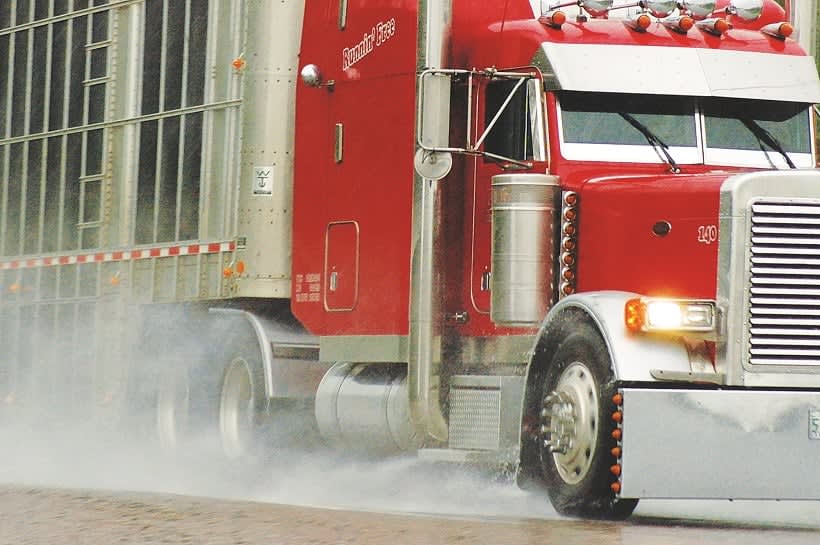
Tires built for trucks after 2021, when GHG Phase 2 kicks in, will have to be more efficient, with less rolling resistance, but they will still have to meet fleets’ expectations for tread wear and tire life.
Photos: Jim Park
6 min to read
Tire makers will have their hands full over the next few years getting ready to meet Phase 2 of the EPA’s greenhouse gas emissions/fuel economy requirements. GHG Phase 1 required the rolling resistance coefficient to be 7.7, but GHG Phase 2 demands the RRC be lowered to a 6, depending on the type of truck.
“Phase 1 was 7.7 for all vehicles, period,” explains Mahesh Kavaturu, Goodyear commercial tires marketing manager. “Phase 2 has ratcheted down to 6.0 — a 25% reduction. Meeting those challenges will drive a lot of new technology.”
Those rolling resistance numbers are actual measurements of a tire’s fuel efficiency, but are not intended to be a tool fleets would use when spec’ing tires. The number represents only one of a tire’s many design criteria. The numbers are derived from actual testing that EPA uses to rank tires as SmartWay verified or not. The numbers are also used by truck makers in their Greenhouse Gas Emissions Model (GEM) certification to quantify the efficiency of the tires they plan to use on a truck. In that context, the drop from 7.7 to 6.0 is a very real 25% reduction in rolling resistance, and something the tire makers will have to contend with.
Each vehicle classification comes with its own rolling resistance target. Sleeper cabs are 6.0, for example, while the target for vocational trucks is 7.5.
Faced with an overnight change, tire makers could probably build a tire with much lower rolling resistance today, but such a tire would come with unsatisfactory miles to removal, tearing and chipping risks, and even traction losses. No fleet or driver would tolerate that, so the process of developing future tires that not only meet the GHG Phase 2 requirements but also satisfy fleet expectations are well underway. We have only a couple of years before the first tier of reductions hits in 2021.
The traditional pathways to lower rolling resistance have involved tinkering with the tread and sidewall rubber compounds and reducing the depth of the tread. These approaches achieve the goals, but sometimes there are undesirable side effects.
“When some tire makers formulate tread compounds to achieve the lower rolling-resistance performance required by SmartWay, the tires may wear faster or be more susceptible to cutting and tearing than tires designed with more traditional tread compounds that maximize wear performance,” says Gary Schroeder, executive director of Cooper Truck and Bus Tire. “The other option is to reduce tread depth, particularly on drive tires, which have less tread ‘squirm.’ But the disadvantage with shallower tread can be fewer overall miles to removal.”
Those older approaches won’t work for GHG Phase 2. The requirement for ever lower rolling resistance numbers on tires that fleets will be happy with will take more than tinkering with tread depth.
Not just a new tread
Goodyear sees the way forward into GHG Phase 2 as breaking the tire into separate components during the design phase and optimizing the construction of that part of the tire for what it can deliver to the fuel economy equation.
Starting with the tread, Kavaturu says Goodyear is using a two-layer tread. The top layer is designed and compounded for tread wear and traction, while the bottom layer is designed to maximize fuel economy.
“The tread is what meets the road, so it has to be long-wearing and provide adequate traction,” he says. “Typically, the tread can have four or five different components using several different rubber compounds. We get the long tread wear from compounds we use and the traction from a combination of compounds and tread design. The bottom layer of the tread, the part that sits closest to the casing, is designed for firmness and stability, and that’s what helps reduce rolling resistance in the tread.”
Tread designs could include features such as open-design tread blocks, blades and sipes to create a biting tread that grips the pavement surface but can still evacuate water to prevent traction loss.
It’s the same approach with the casing and sidewall areas. Engineers use extensive computer modeling to see where improvements can be made, and then the structural elements are designed around stiffening the sidewall, for example. Compounds play a part here, too. The rubber used in the sidewall might be quite different from the tread rubber, because they are used for different purposes.
Improvements in computing capacity in recent years have made the modeling process much more efficient. Rubber, with its inherent flexibility, is very difficult to model, and even more so when you put a soft piece of rubber next to a rigid steel belt. But engineers can now successfully predict how these designs will perform, right down to modeling the tire’s contact patch at different inflation pressures.
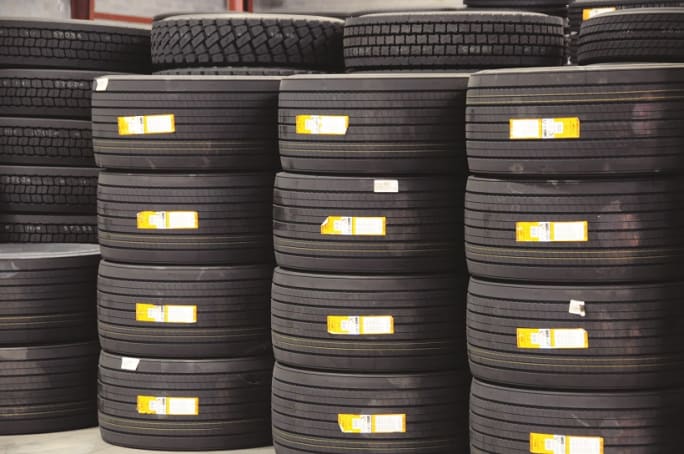
New tread designs and rubber compounding may change our expectation of what a low-rolling-resistance tire should look like and how it will perform.
New rubber compounds
New recipes for rubber compounding are emerging that will contribute greatly to tire life and fuel efficiency. New blends of synthetic rubber, such as polybutadiene with its high resistance to wear, are finding their way into commercial tires and helping engineers get closer to the GHG Phase 2 goal line.
Engineers first must blend all the material in proportions that meet the design targets, such as low rolling resistance or long tread life, and develop them in the lab. Once they have the material, they do physical property testing on it and then pull that data into mathematical models where the compounds can be subjected to simulated operating conditions, explains Goodyear’s Kavaturu.
“Finite element modeling on the computer can predict tire wear, traction and things of that nature, all before a prototype is built and tested at the proving grounds.
“It’s one thing to predict tire performance in a computer, but it still has to be tested on the proving grounds to verify its performance against the design parameters and then with fleets in real-world applications,” he adds. “If all goes well, we’ll bring that new tire to market. Typically, this design cycle takes two to three years depending on the product.”
Trailer tires, too
The GHG Phase 2 reg for trailers remain in legal limbo, but Michelin says fleets should not overlook the impact of using low-rolling-resistance tires on trailers.
“Trailer tires account for approximately 42% of the vehicle’s tire rolling resistance contribution by axle, according to the EPA’s greenhouse gas model,” says Bill Walmsley, product category manager for Michelin North America. “This makes trailer axles a prime wheel position for low-rolling-resistance tires. Trailer tires are typically ribbed tread designs that are lower in tread depth, which positively contribute to lower rolling resistance in this free rolling position.”
For long-haul fleets, fuel costs represent the single highest non-payroll operating expense. Rolling resistance accounts for approximately a third of fuel costs, Walmsley notes. The lower the rolling resistance, the less fuel consumed.
“A 3% reduction in rolling resistance translates into a 1% fuel savings or an increase of .05 mpg,” he says.
And that’s why tire makers are busy developing tires that not only meet the demands of GHG Phase 2, but also save their customers money.
Subscribe to Our Newsletter
More Fuel Smarts

How Volvo Updated Its D13 for EPA 2027 [Watch]
Volvo’s updated D13 promises lower emissions without sacrificing performance or fuel economy. Take a closer look at what changed inside the engine in this HDT Spotlight video.
Read More →
Diesel Price Spike Shortens Payback for Natural Gas Trucks, Report Says
Energy Vision estimates fleets could recover the higher purchase price of an RNG-fueled Class 8 tractor in 1.3 to 2.8 years under current fuel-price scenarios.
Read More →
Calstart Becomes Catalyst Mobility, Reflecting Broader Focus
Calstart is now Catalyst Mobility, reflecting the nonprofit’s growing national role in clean transportation, including zero-emission trucks, infrastructure and incentive programs.
Read More →

Record Diesel Prices Squeeze Trucking Fleets
Average U.S. diesel prices have climbed to nearly $6 a gallon, surpassing the 2022 record as tight refinery capacity and Middle East disruptions keep fuel costs elevated.
Read More →
Sponsored•September 9, 2026
How Fuel Delivery Shapes Engine Performance
Fuel delivery depends on more than what happens at the injector. For fleet, maintenance and technical professionals, looking at the full path from pump to injector can provide useful context for understanding engine performance.
Read More →
East Coast Port Launches $45M Electric Truck Push
The Port Authority of New York and New Jersey announced millions in incentives for zero-emission drayage trucks, yard tractors, and new charging hubs near the port.
Read More →
California Bill Could Shed Light on Electric Truck Prices
Why do battery-electric Class 8 trucks remain so expensive? A California bill headed to Gov. Gavin Newsom would give fleets and state agencies more visibility into what manufacturers charge.
Read More →
Detroit Opens Orders for EPA 2027 Engines
Detroit isn’t starting from scratch to meet EPA 2027 diesel emissions standards. Its Gen 6 DD13 and DD15 engines keep much of today’s platform while updating the fuel and aftertreatment systems.
Read More →
Zero-Emission Truck Corridor Planned for West Coast
California, Oregon, Washington, British Columbia and Baja California are coordinating plans for truck charging and hydrogen fueling from Canada to Mexico.
Read More →
A Closer Look at Kenworth’s Electric T880E Vocational Truck [Video]
Learn more about Kenworth's T880E battery-electric vocational truck at the Paccar Technical Center, including its range, applications, upfitting considerations, and PTO options, in this HDT Spotlight video.
Read More →