




The True Costs of Congestion
Truckload carrier Jet Express hauls dedicated, closed-loop freight, and has to give customers updates on delivery times every two hours
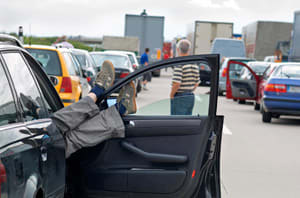
Congestion will cost trucking and the nation big bucks as the economy comes back -- but solutions are unclear.
Truckload carrier Jet Express hauls dedicated, closed-loop freight, and has to give customers updates on delivery times every two hours.
If Jet Express doesn't communicate with customers on a late shipment, the company has to shell out $15,000 for every 15 minutes of lateness - or $60,000 per hour, says President Kevin Burch.
The kind of speed, reliability and predictability Jet Express gives customers is a big reason the trucking industry can expect its share of total tonnage to increase from 68 percent in 2009 to 70.7 percent by 2021. Other modes of transportation simply can't compete, says Brandon Borgna, spokesman for the American Trucking Associations.
But highway congestion gets in the way of that, preventing trucking companies from providing the level of service customers expect.
As the U.S. Department of Transportation looks at multimodal solutions and an overdue highway reauthorization bill is stalled in Congress, congestion - and its costs for trucking and for the nation as a whole - is only expected to get worse as the economy recovers.
The costs
In addition to the costs associated with a late delivery, a truck stuck in a congested bottleneck or an urban area can take a toll in other ways.
For one, fleets have to deal with the additional fuel costs that add up from trucks idling in traffic. The Texas Transportation Institute estimated that in 2007, passenger cars and trucks wasted about 2.8 billion gallons of fuel, enough to fill 56 super-tankers.
Carriers also lose out on productive labor time, as drivers are also sitting idle on the road waiting for traffic to clear up. TTI says overall, congestion costs the country 4.2 billion hours of work time, or nearly one full work week for every traveler per year.
Add up all wasted fuel and lost productivity, and congestion cost the nation $87.2 billion in 2007 alone.
Darrin Roth, director of highway operations for ATA, says the trucking industry alone loses about $19 billion a year in fuel, equipment expenses and labor efficiency related to congestion.
According to ATA's research arm, the American Transportation Research Institute, the total cost of running a truck is $83.68 per hour, or $1.73 per mile. Top costs include diesel fuel/oil, driver wages and truck/trailer lease or purchase payments. When a truck is stuck in traffic, these costs can add up.
"There's only so much that [trucking companies] can absorb," ATA's Borgna says.
Congestion also takes a toll on driver satisfaction and well-being, according to Steve Williams, chairman and CEO of Maverick USA. Sitting in traffic is not a pleasant experience for drivers; in fact, traffic can create a heightened, tense environment, he says. Traffic directly impacts driver turnover, an issue that will become even more important as driver demographics change, he says.
In addition, as congestion increases, the risk of slow-maneuver crashes goes up pretty significantly, says Don Osterberg, senior vice president of safety, driver training and security at Schneider National.
Traffic also affects safety beyond the congested area, Osterberg adds. As drivers are delayed, they tend to feel rushed to make the delivery on time once they get out of the congestion. Time pressure can lead to poor decision-making. As the economy improves, we'll likely see an increase in high-severity crashes as congestion worsens, he predicts.
Where congestion is headed
Trucking tonnage is expected to grow 30 percent by 2021, says Bob Costello, chief economist for the ATA. We'll start seeing that growth pretty soon as we come out of the recession.
Schneider's Osterberg says there's a direct correlation between vehicle miles traveled and the state of the economy. As the economy improves, demand for freight transportation will also improve.
"If there's more freight to move, there's going to be more trucks to move it," says Pat Quinn, co-chairman of U.S. Xpress Enterprises and treasurer of the ATA.
When the economy was good in 2005, 2006 and early 2007, congestion was at its worst in recorded history, says Dan Murray, vice president of research at the American Transportation Research Institute, which assists with the Federal Highway Administration's Bottleneck Analysis. By late 2009, congestion had decreased significantly, while highway speeds went up dramatically, based on ATRI's research. However, as the economy picks back up this year, congestion will no doubt become an issue yet again, Murray says.
"It doesn't take a rocket scientist to figure out that congestion is going to get much worse," says Maverick's Williams. "It's going to be an inefficient mess."
According to the American Association of State Highway and Transportation Officials' report "Unlocking Gridlock," travel on the U.S. highway system increased five-fold over the past 60 years, to almost 3 trillion miles in 2009. By 2050, annual travel is expected to climb to nearly 4.5 trillion miles, even with aggressive strategies to cut the rate of growth to only 1 percent per year.
As consumers continue to concentrate in large urban areas, it will create a "perfect storm" for the trucking industry, ATRI's Murray says. Trucks will be targeted for idle and emissions reduction while at the same time congestion makes it harder for trucks to move around. The result: Freight and jobs may move to less densely populated areas.
"Today, drivers with a 30-minute commute still lose 22 hours (nearly three full work days) annually sitting in traffic," AASHTO says. "As the economy rebounds, congestion levels will also rebound, unless the nation builds the capacity needed."
Fighting back
If we can only expect congestion to get worse, what can we do to mitigate the effects? While there are a few simple things carriers can do, many believe the answer lies in increased infrastructure funding, an area that has not seen a lot of traction lately.
In 2006, former Senate Majority Leader Bill Frist asked U.S. Xpress' Quinn to join the National Surface Transportation Policy and Revenue Study Commission, which was formed to discuss the future of our nation's infrastructure. In January 2008, the commission presented its report to Congress, which was supposed to be the basis for the next highway reauthorization bill. Now, Congress says the funding is just not there to get the bill off the ground this year.
The report found we need to focus on remote bottlenecks around the country, and that we need to look at infrastructure spending on a national level, not simply a state level, Quinn says.
Recently, ATRI and the Federal Highway Administration released the findings of their 2009 Bottleneck Analysis of 100 Freight Significant Highway Locations. The analysis, aimed at identifying impediments to truck mobility, was conducted with the hope that these bottlenecks can be fixed, mainly through investments in infrastructure, according to Jeff Short, senior research associate at ATRI.
Maverick's Williams says this list of bottlenecks will only get bigger, and the current bottlenecks will get worse over time. He calls for a national transportation strategy that expands across administrations and provides economic security for our country. "This country has done such a pitiful job in investing in highway infrastructure."
The ATA supports an increase in fuel taxes, as long as the proceeds go toward infrastructure needs and are not diverted to other projects.
Aside from transportation funding, Schneider's Osterberg says fleets need to do a better job of trip planning based on their knowledge of problem areas and of problem times of day. "We have to do a better job of communicating situations as they arise," he says.
Over the long term, the industry requires a more robust way to communicate near real-time to drivers, Osterberg says. He envisions a next-generation system where a driver can simply push a button to view local weather and t
More Fleet Management

Color Match Smarter: Tools That Restore & Perform
For fleet managers and collision repair professionals keeping heavy-duty trucks on the road, getting the color right the first time isn't just about appearance — it's about efficiency, turnaround time, and bottom-line results. Discover how today's digital color tools are transforming the repair process from guesswork to precision.
Read More →
FMCSA Pauses Biennial-Update Enforcement Amid Motus Transition
Carriers whose updates were due on or after June 1 have more time, while FMCSA works to stabilize its new registration system and warns of phishing sites impersonating its new carrier registration system, Motus.
Read More →
2026 Blueprint for Countering Smarter Supply Chain Theft
Cargo theft is no longer just the cost of doing business. It's a multi-billion-dollar criminal enterprise exploiting vulnerabilities across your fleet, drivers, and supply chain.
Read More →


How Telematics Improves Visibility, Control, and Performance in Refrigerated Fleets
Explore how telematics help refrigerated fleets improve visibility, uptime, efficiency, compliance, and cargo protection across connected cold chain operations.
Read More →
What the U.S.-Canada Trade War Means for Trucking
Escalating U.S.-Canada tariffs could disrupt cross-border freight, reduce truck volumes, raise costs, and create new uncertainty for carriers on both sides of the border.
Read More →
What Are Trucking’s Top Concerns for 2026?
The American Transportation Research Institute wants to know what's worrying trucking fleet managers, drivers, and other stakeholders in its annual Industry Issues survey.
Read More →
American Trucking Associations Looks for a New Leader
ATA President and CEO Chris Spear abruptly left his job at the association on August 21, at a pivotal time for the trucking industry.
Read More →
Public Wi-Fi Cybersecurity Risks: How Truck Drivers and Fleets Can Protect Their Data
Public Wi-Fi can expose truck drivers and fleets to credential theft, malware, and other cyber threats. Here’s how to reduce the risk on the road.
Read More →
For Nicky Cupp, Fleet Innovation Starts With Frustration
HDT Truck Fleet Innovator Nicky Cupp turns everyday pain points at Fraley & Schilling into opportunities for better technology and smarter processes.
Read More →
Adam Buttgenbach’s Approach to Electric Trucks: Start With Where They Fit
HDT Truck Fleet Innovator Adam Buttgenbach helped PepsiCo build one of North America’s largest EV fleets by focusing on where electric trucks make operational sense.
Read More →