




The Solyndra Redemption: Clean Diesel Technology
Billions of taxpayer 'stimulus' dollars have been directed toward the perceived savior of our environment and the economy -- anything "green," i.e., green jobs, green energy etc
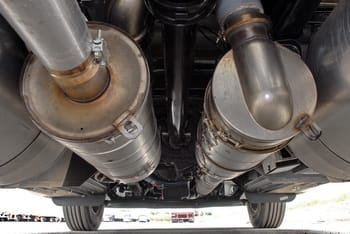
DPF-equipped 2010-generation engines have cut particulate matter emissions by an estimated 96%. The health-related benefits are substantial. Photo by Jim Park.
Billions of taxpayer 'stimulus' dollars have been directed toward the perceived savior of our environment and the economy -- anything "green," i.e., green jobs, green energy etc.
But the recent Solyndra solar scam, where $535 million of American taxpayer dollars evaporated into "green" air, is evidence that these investments aren't always the answer.
There is, I think, a solution that would have an immediate and profound impact on the lives of every American, and it comes from an unlikely source -- clean diesel engines.
After 20 years in the truck leasing business, I earned the designation of Fleet Sustainability Specialist after intense research on fuel economy, fleet maintenance costs and the effects of diesel exhaust emissions on human health. Sadly, this research was ignited by the loss of two family members (a 20-year non-smoker and a never-smoker) from the same household to an aggressive form of lung cancer within a two-month time frame.
Although not proven, I firmly believe that these deaths are traceable to the dirty diesel exhaust emissions spewed out by America's aging distribution fleets.
Breathing Easier: Reducing Health Costs
According to the Clean Air Task Force, 21,000 Americans die prematurely every year due directly to diesel exhaust emissions. Diesel exhaust also contributes to myriad respiratory and other ailments including asthma, bronchitis, cardiac arrest, stroke and lung and bladder cancers. Recently, diesel exhaust has also been linked to the growing epidemic of autism.
Diesel exhaust is made up of microscopic carbon soot particles that absorb metals and other toxic substances. The tiny particles are inhaled and absorbed into the bloodstream, delivering toxins to vital internal organs, contributing to a runaway epidemic of respiratory disease, costing billions of dollars annually in medical expenses, lost wages and lost productivity.
Diesel engines power over 95% of our commercial trucks and 90% of the world's global trade.
Since 2003, government regulations have been credited for reducing emissions of carbon dioxide, nitrogen oxides, and particulate matter of 20%, 94% and 96% respectively. Just as removing lead from gasoline in the 1970s enabled automobiles to operate 95% cleaner, so too has ultra-low sulfur diesel reduced emissions of America's diesel engines.
Today, a 2011 model-year tractor equipped with clean diesel technology and powered by ultra-low sulfur diesel is a virtual clean air machine; the exhaust emitted is cleaner than the engine intake air. The most harmful emissions are equivalent to, and in some cases less than, engines powered by natural gas, ethanol or biodiesel.
In 2005, Congress passed the Diesel Emissions Reduction Act (DERA) and it is now supported by more than 500 environmental, health, industry, labor, and government organizations.
Clean Diesel Technology: Encouraging the Domino Effect
The new clean diesel technology can save lives, save our environment, reduce health care costs, create jobs, encourage business, improve infrastructure and help reduce our dependence on foreign oil -- all without costing taxpayers one cent. In the process, it will reduce the cost of all goods distributed by transportation fleets and ultimately save Americans billions of dollars at the checkout line.
Suppose that the $535 million in stimulus funds appropriated to solar panel company Solyndra were redirected to a corporate fleet upgrade fund to replace tractors with model year 2008 engines or older. The fund would issue a tax credit in the amount of $10,000 for each tractor upgraded to clean diesel technology. In a very short period, we could replace 53,500 higher-polluting dirty diesels with new clean diesel tractors.
A domino effect would follow:
Domino 1: Tax Revenue Growth The first domino to fall is the immediate recapture of the entire investment in the form of a Federal Excise Tax (FET). Transportation equipment is taxed at 12% FET. Revenue raised on an average tractor (depending on specification) cost of $110,000 is $13,200, which would net a surplus of FET revenues to the tune of $3,200 for each of the 53,500 tractors. This would result in a net return of more than $171 million. Nice money to direct towards "shovel-ready road projects" and "structurally deficient" bridge repairs.
The next domino to fall would produce immediate benefits at state and local levels in the form of sales tax, titling tax and registration tax revenues.
Local markets would benefit from the dealer prep fees. Decal companies would acquire business identifying the new "clean" vehicles, which would equate to even more business revenue and additional state sales tax.
Domino 2: Job Creation: It takes approximately 2,000 man-hours to build a Class 8 tractor. This equates to approximately one job per tractor. These are not jobs at the assembly plants but on the local level where the component suppliers and manufacturers fabricate the parts for the tractors.
In my home state of Florida, for example, there are a minimum of 40 manufacturers that sell components to Freightliner for its Cascadia model tractor. These are the small businesses that are the backbone of our society. They supply the hoses, belts, relays, fans, pumps, air filters, gauges, steering systems and information systems for the transportation equipment that make America operate.
When Americans are working they have pride and self-respect. They become contributing members of society, paying income tax, and social security and Medicare taxes. Did someone say domino effect? It doesn't stop there.
Domino 3: Younger Fleets, Lower Costs: The useful life of a diesel tractor is approximately 30 years. It is common practice for many companies to run tractors as long as 10 years and 1 million miles. Companies will invest tens of thousands of dollars to rebuild engines in order to avoid the cost increases brought on by diesel emissions regulations -- the unintended consequence and absolute reverse effect of the enacted regulation. Increasing equipment costs and antiquated fleet practices are responsible for the America's aging fleet problem.
To alleviate growing concerns about the safety of aging tractors, even more regulations in the form of the U.S. Department of Transportation's Compliance, Safety and Accountability (CSA) program have been implemented, costing billions of dollars to the transportation industry and raising prices at the checkout line.
A $10,000 tax credit for companies to implement what I call a Transportation Revolving Upgrade Concept (TRUC) will divulge the monumental savings of this truly sustainability fleet strategy. Companies that capitalize on the continuous improvements in technology, safety, aerodynamics, and fuel economy would gain a competitive advantage and pass lower costs along to consumers.
Domino 4: The $5 Million, One-Mile-per-Gallon Savings Plan: In October 2010, President Obama signed regulation into the federal register for the first-ever fuel economy standards for tractor equipment. Tractor manufacturers are mandated to improve fuel economy by 4% annually. The return on investment from a revolving equipment upgrade tactic is immediate in terms of corporate responsibility and public perception.
Consider the fuel savings on a 500-tractor fleet, each logging 100,000 miles per year, averaging 5.5 miles per gallon with a fuel cost of $4 per gallon. A 1-mpg fuel efficiency gain would mean a cost savings of $5.6 million annually. This equates to a reduced dependence on foreign oil and reduced greenhouse gas emissions. It would also reach federal emissions reduction goals decades early. There would be other irrefutable benefits to a revolving equipment upgrade strategy, but they are too numerous to mention here.
Emissions: The Big Green Domino
According to the Environmental Prot
More Fuel Smarts

Why Diesel Price Relief Efforts May Fall Short
Diesel prices have eased from September’s record high, but doubts about additional Russian supply and limits on dyed-diesel tax relief mean trucking fleets still face expensive fuel. And prices could go higher.
Read More →
Why Small Fuel Savings Matter in Trucking
Can better fuel economy help pay for driver raises? In this podcast, GP Transco explains how small efficiency gains create room to reinvest in its people.
Read More →
How GP Transco Cuts Trucking Fuel Costs, a Tenth of a Gallon at a Time
What’s another tenth of a mile per gallon worth? GP Transco shares how equipment upgrades and driver coaching turn small gains into meaningful fuel savings.
Read More →
Electric Yard Tractors Move Beyond Pilots
Operating-cost savings have overtaken sustainability goals as the leading reason surveyed fleets are adopting battery-electric terminal tractors, according to new NACFE research.
Read More →
Geotab Links Fleet Card to Vehicle Data
The new card combines fuel discounts with telematics-based purchase controls. Geotab’s analysis also points to potential savings from choosing lower-priced fuel stops.
Read More →
Fleet Economics Shape Electric Truck Outlook
ACT Research expects costs, charging infrastructure, and technology improvements to drive zero-emission commercial vehicle adoption as federal regulations and incentives retreat.
Read More →
Wex Adds Cardless Fuel Payments for Over-the-Road Customers
A new fuel card feature for Wex customers offers convenience and security.
Read More →
New California Law Could Shed Light on Electric Truck Prices
Why do battery-electric Class 8 trucks remain so expensive? A California bill signed by Gov. Gavin Newsom would give fleets and state agencies more visibility into what manufacturers charge.
Read More →
How Volvo Updated Its D13 for EPA 2027 [Watch]
Volvo’s updated D13 promises lower emissions without sacrificing performance or fuel economy. Take a closer look at what changed inside the engine in this HDT Spotlight video.
Read More →
Diesel Price Spike Shortens Payback for Natural Gas Trucks, Report Says
Energy Vision estimates fleets could recover the higher purchase price of an RNG-fueled Class 8 tractor in 1.3 to 2.8 years under current fuel-price scenarios.
Read More →