




The Changing Face of Trucking Part 2: Riding the Rails
In late 1989, truckload pioneer J.B. Hunt ventured into the intermodal business, moving truck trailers "piggyback" on flatbed railcars. The company moved 20 loads that first year. In 2009, it moved more than 900,000

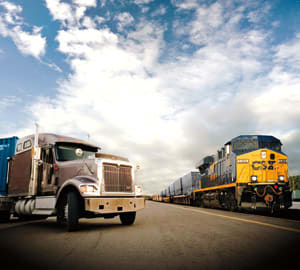
Rail intermodal gives trucking companies another option to sell to customers interested in saving money and being 'green.'
In late 1989, truckload pioneer J.B. Hunt ventured into the intermodal business, moving truck trailers "piggyback" on flatbed railcars. The company moved 20 loads that first year. In 2009, it moved more than 900,000.
In fact, today more than half of J.B. Hunt's revenues come from its intermodal operations and nearly three-fourths of the carrier's total operating income, according to Thom Williams, a former transportation executive and now an analyst as the principal of Amherst Alpha Advisors.
Schneider National followed Hunt's example and entered the intermodal market in 1991. Today Schneider owns about 12,000 intermodal containers. More and more motor carriers are getting into the act: Swift Transportation, Knight Transportation, U.S. Xpress, Marten Transport, Con-way, Averitt the list goes on.
At the same time, the major railroads have been investing heavily in intermodal infrastructure, have shaved transit times, and have developed programs and products to make it easier for trucking companies to get into intermodal.
Intermodal's growth
Rail intermodal is predicted to grow by more than 80 percent over the next decade, according to the recently released American Trucking Associations' U.S. Freight Transportation Forecast to 2021. The forecast predicts average yearly growth of 6.5 percent between 2010 and 2015 and 5.2 percent a year from 2016 through 2021.
Current numbers already indicate the trend. Intermodal volumes jumped 8.4 percent year-over-year in the first quarter, according to the Intermodal Association of North America. Intermodal transport's share of U.S. long-haul truck traffic reached record highs during the first quarter, according to FTR Associates - 13.5 percent.
"Active truck capacity is coming into balance with demand, and even a modest increase in freight demand could lead to shortages of truck drivers and hence, truck capacity, resulting in more opportunity for intermodal," says Larry Gross, senior consultant for FTR.
Still, ATA's chief economist, Bob Costello, emphasizes that even with this tremendous growth, rail intermodal will still have a very small piece of the overall freight transportation pie. In 2009, trucking had 68 percent market share by tonnage, rail carload had 13.6 percent, 6.4 percent went by water - and rail intermodal was 1.1 percent. By 2021, that piece of the pie is forecast to be less than 2 percent.
"In some areas, at some companies, in some lanes, we may see more of a shift to rail intermodal," Costello says. But in the big picture, he says, "It is my opinion that trucks and trains compete on a very limited basis."
That's largely because railroads are really only an option for long-haul freight - although where exactly the line is may be changing. In the past, notes John Larkin with Stifel Nicolaus' Transportation and Logistics Research Group, intermodal wasn't worth considering for hauls under 750-1,000 miles. Now, he says, that's down to 500 miles. If fuel prices rise, Larkin predicts, we could see that point drop further in the next five to 10 years. J.B. Hunt projections shared by Thom Williams indicate they expect the intermodal share of the market to expand significantly in the 500- to 1,000-mile segment.
Why the growth?
Getting into intermodal lets trucking companies offer customers additional, lower-cost, one-stop-shopping options. As Schneider touts on its intermodal web site, "Door-to-door, truck-like service, at a fraction of the cost of traditional trucking methods."
There are several reasons shippers today are interested in intermodal options.
One, as railroads have cut transit times and improved reliability, trains can now handle freight that at one time would have had to go on truck in order to get there by a certain day. Two, it is typically less expensive for the shipper than equivalent truck transport.
Three, an increased emphasis on "sustainability" and "green" initiatives has led many shippers to increase their use of rail transport. Rail fuel efficiency is higher than truck fuel efficiency in terms of ton-miles per gallon, also meaning fewer greenhouse gas emissions and less dependence on foreign oil.
BNSF provides its customers a yearly estimate of how much greenhouse gas emissions they've saved by shipping on the railway. A trucking company partnered with BNSF could use this information to help sell intermodal services to customers.
"Historically, people always said from a service standpoint intermodal would never be able to compete, and from a complexity standpoint it was too difficult and too fragmented," says Val Noel, president of Pacer Cartage, which has about a thousand owner-operators hauling intermodal containers to and from rail ramps and marine facilities and doing regional truck moves. "Over the past two or three years, I think our industry, especially on the underlying rail carrier side, has done an excellent job of improving service, and our industry has done a good job of reducing the fragmentation and complexity and making it easier for shippers to utilize our service. I think in the long run, intermodal will provide shippers a high-quality product that can fulfill their supply chain needs and do it in a way that's sustainable for our environment."
It's an area trucking companies should not ignore, says Andrew Gagnon, logistics manager at Menlo Logistics. "For trucking companies, it's essential in today's market to at least check their own base of operations to see if offering intermodal fits for them as well," he says. "It's as simple as if you can offer more, you can get more business."
In 2006, New Jersey-based NFI started noticing that a lot of bids from shippers also had a section for intermodal. "We didn't have that service offering, so we felt we were missing out on some of the opportunities," says Ike Brown, NFI vice chairman and president of NFI Intermodal. "We also felt that in the long term, because of [changing] demographics, hiring truck drivers was going to become more difficult, and that the long-haul freight was eventually going to go toward rail as opposed to over the road. So we decided to get into the intermodal business."
Phil Pierce, executive vice president of sales and marketing for Averitt Express, says the rail service is just another mode they're offering customers, in addition to their truckload and LTL services.
"Probably the hottest-growing segment of our industry is intermodal," Pierce says. "If you're in the truckload arena - and we have 1,500 power units in truckload - then it blends well, adding more capacity up and beyond those 1,500 power units. It's just another option for our customer to utilize and keep it in the Averitt family."
In addition to being able to get more business, trucking companies could experience other benefits.
"Whether to drive out costs or reduce their carbon footprint, shippers are more determined than ever to develop a stronger intermodal presence in the supply chain," says Michael Rutherford, spokesman for CSX Intermodal. "Many [trucking companies] equally realize the efficiencies can also apply to their own organization, through better equipment utilization, lower operating costs, and less time away from home for drivers."
At NFI, for instance, trucking operations have become more regionalized, explains Brown. They've shifted freight moves of 600 miles or more primarily to intermodal. The average truck length of haul is now just under 300 miles.
"As we're converting our over-the-road operations from the road to the intermodal, we hope to improve our driver turnover, give the drivers a better standard of living, more home time and more predictable routes," he says.
As the transportation industry moves forward, activities on the part of the federal government also could push the adoption of intermodal.
Containers vs. trailers
Many see a move within intermodal toward containers and away from tra
More Fleet Management

Color Match Smarter: Tools That Restore & Perform
For fleet managers and collision repair professionals keeping heavy-duty trucks on the road, getting the color right the first time isn't just about appearance — it's about efficiency, turnaround time, and bottom-line results. Discover how today's digital color tools are transforming the repair process from guesswork to precision.
Read More →
FMCSA Pauses Biennial-Update Enforcement Amid Motus Transition
Carriers whose updates were due on or after June 1 have more time, while FMCSA works to stabilize its new registration system and warns of phishing sites impersonating its new carrier registration system, Motus.
Read More →
2026 Blueprint for Countering Smarter Supply Chain Theft
Cargo theft is no longer just the cost of doing business. It's a multi-billion-dollar criminal enterprise exploiting vulnerabilities across your fleet, drivers, and supply chain.
Read More →


How Telematics Improves Visibility, Control, and Performance in Refrigerated Fleets
Explore how telematics help refrigerated fleets improve visibility, uptime, efficiency, compliance, and cargo protection across connected cold chain operations.
Read More →
What the U.S.-Canada Trade War Means for Trucking
Escalating U.S.-Canada tariffs could disrupt cross-border freight, reduce truck volumes, raise costs, and create new uncertainty for carriers on both sides of the border.
Read More →
What Are Trucking’s Top Concerns for 2026?
The American Transportation Research Institute wants to know what's worrying trucking fleet managers, drivers, and other stakeholders in its annual Industry Issues survey.
Read More →
American Trucking Associations Looks for a New Leader
ATA President and CEO Chris Spear abruptly left his job at the association on August 21, at a pivotal time for the trucking industry.
Read More →
Public Wi-Fi Cybersecurity Risks: How Truck Drivers and Fleets Can Protect Their Data
Public Wi-Fi can expose truck drivers and fleets to credential theft, malware, and other cyber threats. Here’s how to reduce the risk on the road.
Read More →
For Nicky Cupp, Fleet Innovation Starts With Frustration
HDT Truck Fleet Innovator Nicky Cupp turns everyday pain points at Fraley & Schilling into opportunities for better technology and smarter processes.
Read More →
Adam Buttgenbach’s Approach to Electric Trucks: Start With Where They Fit
HDT Truck Fleet Innovator Adam Buttgenbach helped PepsiCo build one of North America’s largest EV fleets by focusing on where electric trucks make operational sense.
Read More →