




Test Drive: Sprinter 4x4s Traverse Rough Terrain
Most customers won't need a full-size van with this kind of off road capability, but for those who do, the Sprinter proves it can handle rough terrain.

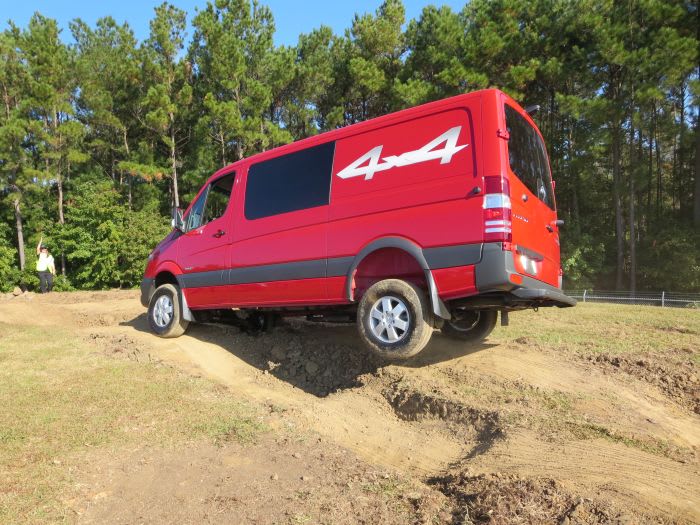
Wheel in the air is no problem because the 4x4 system, based on M-B’s 4Matic all-wheel drive, automatically directs power to wheels with traction. Photo: Tom Berg
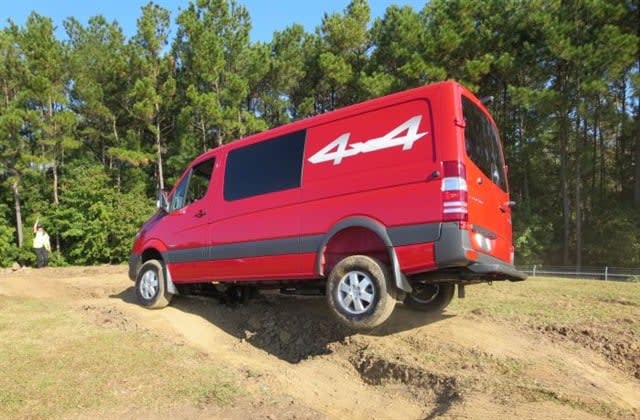
Wheel in the air is no problem because the 4x4 system, based on M-B’s 4Matic all-wheel drive, automatically directs power to wheels with traction. Photo: Tom Berg
Recent advertising for the redesigned 2015 Sprinter shows a tall, Euro-style van chugging across a desert sand dune. C’mon – is that possible? It is if the van has the new four-wheel drive option.
Claus Tritt, general manager, Sprinter operations, for Mercedes-Benz of North America, says he’s argued for this feature for years. Tritt and a dedicated crew demonstrated the 4x4’s capability during an event last fall at the assembly plant near Charleston, S.C. They had carved a short off-road course into a lawn, and I was surprised how well the van got through it.
A supervisor prudently assumed that none of us writers had ever done anything like this before. He peered into the open driver’s-door window and gave strict instructions starting with, “Buckled up? OK, put your left foot down there” – he pointed to the dead-pedal area on the upper-left corner of the floor – “and keep it there. Make sure you’re in low range. Put it in gear, and now you’re ready to go.” He waved me onto the course, and I goosed the gas pedal.
Pushing the limit
Soon a flag lady, seeing my brisk pace, signaled me to stop. I did, and she waved me forward again, gesturing for me to proceed slowly. She walked and trotted ahead, again signaling stops and go-slow orders as I came upon steep slopes and narrow cuts; obviously, she didn’t want me to bang up the truck. Still, I enjoyed the ride and was impressed with the van’s ability to traverse abrupt obstacles with one wheel in the air.
The system is based on the 4Matic mechanical and electronic equipment used in Mercedes cars, and automatically sends power to wheels with the best traction. However, while 4Matic is full-time all-wheel drive, the Sprinter’s 4x4 is part-time and must be manually engaged with a dash-mounted switch at speeds of 6 mph or less, and low range will click in only during a stand-still, like most 4x4 systems. It will automatically disengage if the driver speeds up without switching back to 2-wheel drive.
For good ground clearance, a 4x4 Sprinter sits about 4 inches higher than a 4x2. Although I sat higher than I would in a pickup truck, I was not conscious of any excess side-to-side motion. The chassis was quite stable and able while traversing the undulating trail.
I found the experience fun enough to take a second trip. And, while climbing in and out of the tall van, I appreciated the grab handle on the front of the door. Handles for driver and passenger are standard on the 4x4, and they're optional on 4x2 vans.
Most customers will never need all the capability the system has, Tritt says, but those who need extra traction will appreciate the option. It’s an exclusive in the Euro-van segment, and costs $6,400 for the single-speed transfer case and $6,800 for the 2-speed TC. He expects up to 5% of Sprinter sales to include it. That might include customers in the construction trades, cargo delivery and passenger conveyance in snowy and mountainous areas, and off-road enthusiasts who are likely to equip it for camping.
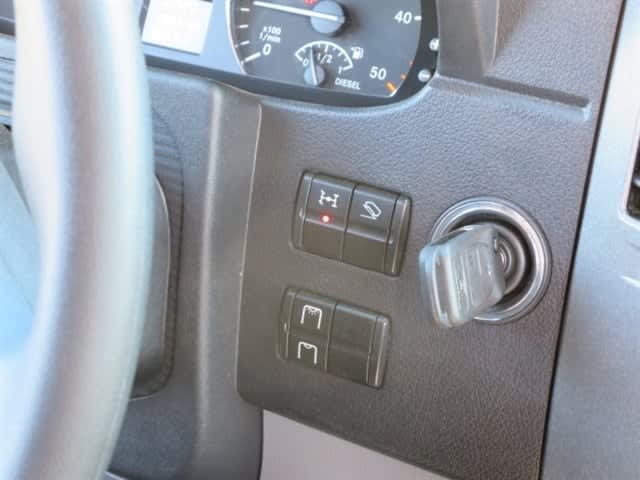
Symbols, not labels, mark rocker switches that engage 4x4 and low-range. Photo: Tom Berg
Economical engine options
Earlier I said “gas pedal.” Of course, Sprinters come only with diesels. The new standard powertrain is a 2.1-liter inline 4-cylinder diesel running through a 7-speed automatic transmission, with the current 3-liter V-6 diesel and 5-speed automatic available as an option.
Twin counter-rotating balance shafts in the I-4 contribute to smooth operation, while the extra two ratios in the 7-speed allow the smaller engine to perform about as well as the larger diesel while delivering slightly better economy, Tritt said.
I drove about 50 miles in a cab-chassis model on city streets and an interstate highway, and was convinced that the little I-4 is quite snappy whether accelerating or cruising. Tritt thinks about half of all buyers will take the I-4, which makes 161 hp and 266 lb-ft. Those needing more cargo-carrying and towing ability will choose the 188-hp, 325-lb-ft V-6.
Another new feature for the ’15 Sprinter is “cross-wind assist.” It uses chassis instruments to sense sideways motion and applies brakes in wheels on the upwind side to compensate. The action is automatic and instantaneous, and a driver can take his hands off the wheel with the van staying in line, said a technician after a demonstration where he plowed through a 90-mph crosswind generated by three trailered air boats whose hopped-up V-8s roared at full power.
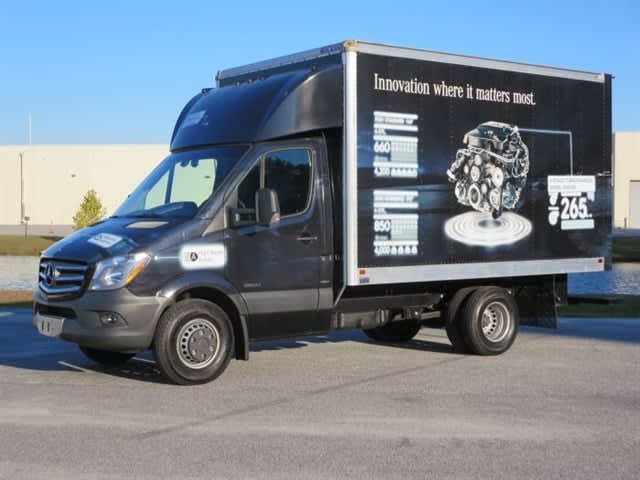
Van body has graphics advertising the new standard 2.1-liter I-4 diesel.Photo: Tom Berg
The Mercedes-Benz look
The third generation van’s swept-back styling is concentrated in the nose with sculpturing extending through side panels. It gives the vans a more assertive and contemporary appearance. The nose is higher to lessen the severity of injuries if the van hits a pedestrian.
Name badges front and rear and slightly different grilles separate Freightliner and Mercedes-Benz versions, as the vehicles are otherwise identical. Sprinters are sold by 57 Freightliner and 200 M-B dealers.
Sprinter will never try to achieve the volume anticipated for the new Ford Transit van or the Ram Promaster, he said. Instead, it will concentrate on quality of the product and service. But Sprinter “leveled the way for them” when it came to the U.S. in 2001 and showed the viability of larger but lighter full-size vans that use smaller and more economical powertrains.
More Equipment

How Volvo Updated Its D13 for EPA 2027 [Watch]
Volvo’s updated D13 promises lower emissions without sacrificing performance or fuel economy. Take a closer look at what changed inside the engine in this HDT Spotlight video.
Read More →
Michelin Tire Improves Efficiency and Durability for Regional Fleets
The Michelin X Multi Energy D2 is a regional haul drive tire engineered to help fleets improve fuel efficiency, durability and traction in demanding stop-and-go operations.
Read More →
ZF Expands Commercial Vehicle Push in North America
ZF is expanding its North American commercial-vehicle presence with new transmission applications, electrification, trailer technology and autonomous-driving systems.
Read More →
Tesla Wants a Self-Driving Semi. Are Cameras Enough?
Could Tesla’s camera-only autonomous driving technology work on an 80,000-pound Semi? In this commentary, HDT's Deborah Lockridge takes a look at Tesla, Cybercab, and how autonomous trucks see the road.
Read More →
Kodiak: Driverless Long-Haul Truck Launch on Track for 2026
Kodiak AI says its driverless long-haul safety case is 93% complete and it remains on track to begin commercial operations by year-end 2026.
Read More →
What DOT’s Automated Vehicle Strategy Means for Trucking
The U.S. Department of Transportation issued a new automated-vehicle strategy that outlines plans for driverless-truck regulations, cross-state freight corridors, and federal safety standards.
Read More →
East Coast Port Launches $45M Electric Truck Push
The Port Authority of New York and New Jersey announced millions in incentives for zero-emission drayage trucks, yard tractors, and new charging hubs near the port.
Read More →
PlusAI Going Public to Fund Autonomous Truck Launch
A SPAC deal could provide PlusAI with up to $300 million as it works toward a 2027 commercial launch of factory-built autonomous trucks.
Read More →
NHTSA Moves to Rewrite Truck Fuel-Economy Rules
The National Highway Traffic Safety Administration says it lacks authority to regulate medium- and heavy-duty truck engines separately from complete vehicles, but the existing standards have not yet been eliminated.
Read More →
Detroit Opens Orders for EPA 2027 Engines
Detroit isn’t starting from scratch to meet EPA 2027 diesel emissions standards. Its Gen 6 DD13 and DD15 engines keep much of today’s platform while updating the fuel and aftertreatment systems.
Read More →