




Test Drive: Driving the FTR, Isuzu's Biggest Truck
It's Isuzu's biggest truck in North America. But does that mean it's a departure from the OEM's tried-and-true design philosophy? HDT's Senior Editor, Jack Roberts, climbed behind the wheel to find out.

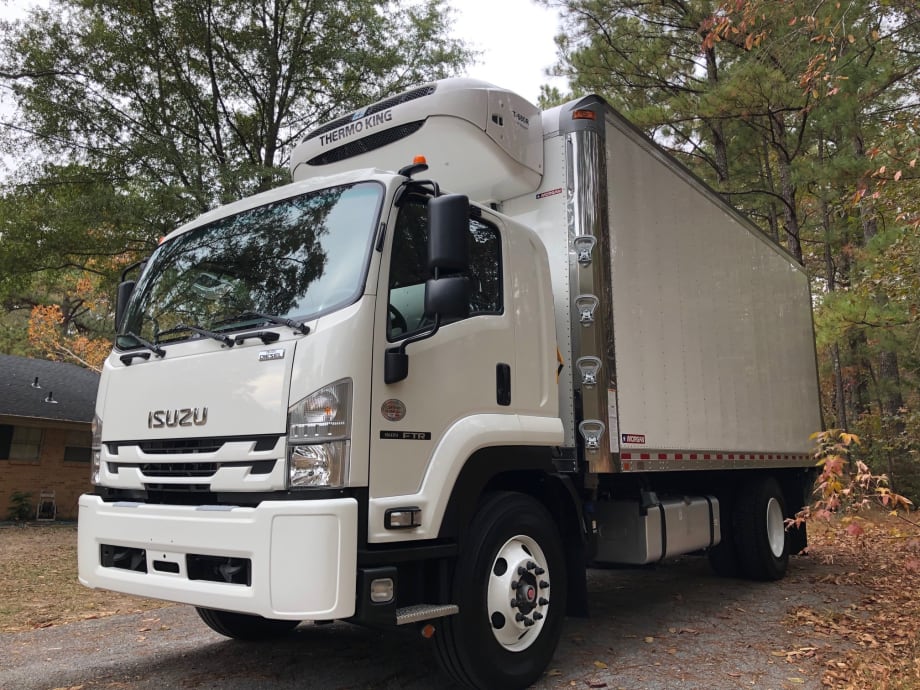
The Isuzu FTR holds true to the company's vehicle design philosophy with an emphasis on safety, maneuverability and fuel economy.
Photo: Jack Roberts
Around the world, Isuzu Motors sells a range of commercial trucks, ranging from light- to heavy-duty models. In North America, however, the Japanese OEM focused for many years exclusively on providing midrange Class 3 to 5 medium-duty trucks.
But in 2017, that dynamic changed when the company launched its Class 6 FTR model — a 25,950-pound GVWR cabover optimized for urban and regional applications — in the U.S. And on a clear day in mid-November, I got to climb up into the cab and take a shining new FTR out on the road to see for myself how Isuzu is approaching the heavier end of the medium-duty market here.
For starters, the FTR is by no means a departure from Isuzu’s long-standing and highly successful formula for short-wheelbase cabover trucks.
At first approach, the FTR appears massive compared to other Isuzu models I’ve driven in the past. But, scale aside, the truck also seems intimately familiar. All the design cues I’ve come to expect from Isuzu are present, from the panoramic front windshield, outstanding agility in tight surroundings, simple and intuitive switches, knobs and controls, crisp, easy-to-read instrumentation and gauges, and work-focused cab interior ergonomics.
More to the point, the FTR retains Isuzu’s proven low-cab-forward design developed for city driving, which boasts a combination of maneuverability and visibility. My demo model featured the standard, four-cylinder, Isuzu 5.2L 4HK1-TC turbocharged diesel engine. Mated to a North American-exclusive Allison automatic transmission, the powertrain puts out 215 hp and 520 lb.-ft. of torque at 1,600 rpm. The truck was fitted with an 18-foot Morgan refrigerated body and a Thermo King T680R-50 reefer unit, making the truck suitable for urban and short-haul refrigerated food transport.
The FTR’s COE design has inherent advantages in city driving. But that does come at something of a cost-- you have to pull a yellow lever behind the driver’s seat to unlock the truck cab and swing it forward to access the engine bay. Isuzu understands this is an impediment to performing daily and routine maintenance checks, so as a workaround to this essential design feature, it has placed as many of the big truck’s daily check points in easy-to-reach locations around the cab. Most of the daily checks are located directly behind the cab. A lever underneath the dash pops open a panel on the front of the truck, which allows access to the HVAC system, air filters, and washer fluid.
Climbing up into an Isuzu FTR is a lot like clambering up into an old school Class 8 cabover tractor. Luckily, Isuzu provides wide and deep, sure-grip steps and smartly positioned grab-handles as well as doors that swing wide open a full 90-degrees to provide minimal obstructions during your ascent.
Once you’re settled in behind the steering wheel in the standard air-ride seat, the first thing that strikes you is how much larger the FTR interior is compared to smaller Isuzu trucks. The most noticeable aspect here is the sheer width of the cab, which offers ample room for three-across seating. A folding jump seat in the middle of the cab, offset to the right of the floor-mounted Allison transmission shifter, does triple duty as a laptop desk and file storage locker.
There are other storage areas located throughout the cab as well, including nooks and crannies behind the sun visors, retractable cup holders, slots for phones and door-mounted pockets. It was cold enough to warrant a coat on the day of the drive. And this went behind the seats onto a conveniently placed shelf, where it could be retrieved when needed with minimal fuss.
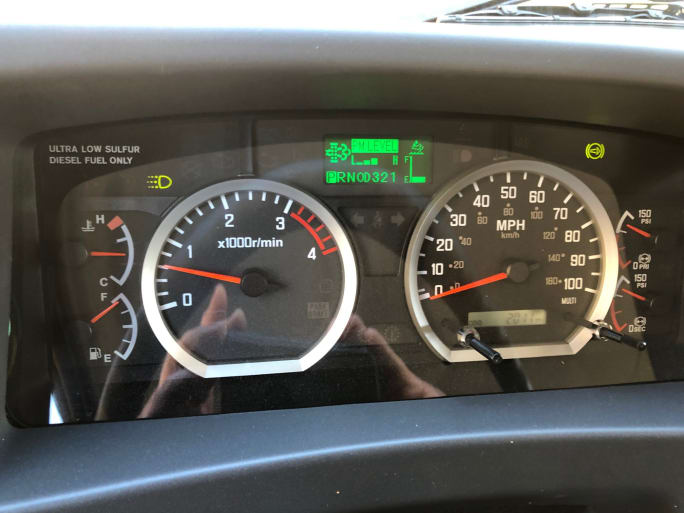
The dash and instrument cluster on the Isuzu FTR features, bright, crisply lit gauges and a driver information screen.
Photo: Jack Roberts
At Home on the Highway
Turning the key forward, the four-cylinder Isuzu diesel rumbles to life and quickly settles down to a muted idle. Despite the size of the cab, sound dampening inside the truck has done an outstanding job of keeping noise levels to a minimum – no mean feat when you’re sitting directly above a diesel engine. But at idle, and even at highway cruise speeds, the truck is quiet enough to allow normal conversation as both powertrain and road noise is held to minimal levels.
The Isuzu FTR features a deep, 50-degree wheel cut on the steer axle. According to the book, this gives the truck a curb-to-curb turning radius of from 43.7 to 65 feet, depending on the wheelbase specification. But when you’re behind the wheel of the truck, this capability is remarkable to experience. More than once, I chuckled out loud in appreciation of how nimble this truck is: It just doesn’t seem possible that a vehicle that big can turn so tightly and allow such great visibility to the sides and rear while doing so.
Once I was up and moving, I headed for my pre-chosen route, one I felt perfectly mirrored the application this truck was designed for: Long stretches of state highway mixed with urban driving in small, rural towns. Isuzu is constantly exploring new engine options for its low cab forward trucks. The FTR is engineered to fit in a sweet spot delivering both ample power for the applications it serves while delivering on the fuel economy front as well. Acceleration is crisp, with the Allison gearbox ticking through the steps quickly and efficiently. Shifts are consistently smooth without any lag time either before or afterward and no “searching” for the proper gear at all that I could discern.
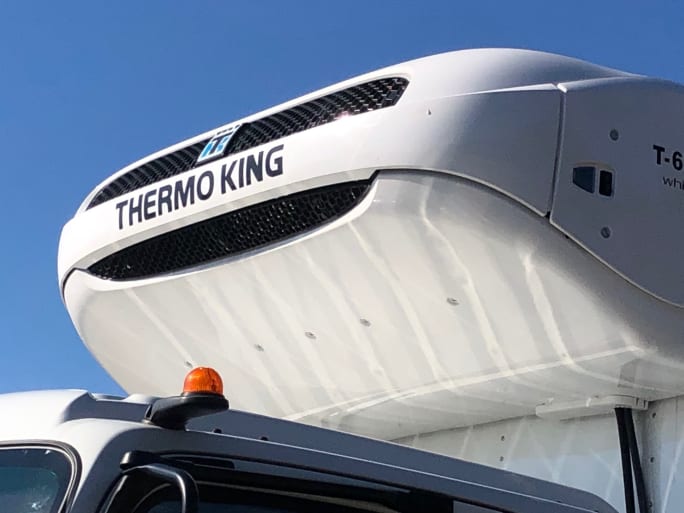
Our test model FTR was set up for short-haul food delivery, with an 18-foot Morgan box and a Thermoking T680R-50 reefer unit.
Photo: Jack Roberts
As noted, visibility to all quarters is excellent, including straight down in front of the truck. Isuzu amplifies this feature with both convex and concave mirrors on both sides of the cab, which give excellent fields of view everywhere, except immediately behind the box van itself.
Low-cab-forward trucks aren’t designed to be highway cruisers. Their forte is urban operation. And as such, the steering geometry that gives them such wonderful maneuverability at slow speeds can sometimes lead to a tendency to “wander” around in a lane at highway speeds. The FTR didn’t exhibit the slightest inclination to nose around in the lane during my drive. Most of my highway speeds were around 55 mph on two-lane state roads – although I did dial it up to 65 mph on a stretch of four-lane U.S. highway heading back into town at the end of my drive.
Taken as a whole, the FTR is simply a bigger, more capable version of what Isuzu does best: Design maneuverable trucks that allow urban and short-haul delivery fleets an economic way to move goods. These trucks have become the workhorses that keep cities all over the globe humming. And obviously, Isuzu isn’t about to mess with a winning formula.
But having a good design philosophy on your hands doesn’t justify stagnation. And it’s clear from many of the new little touches and features scattered throughout the FTR that Isuzu engineers remain committed to keeping their trucks competitive as the race to create faster, more agile, and more economical commercial vehicles to handle tough urban applications heats up.
More Equipment

How Volvo Updated Its D13 for EPA 2027 [Watch]
Volvo’s updated D13 promises lower emissions without sacrificing performance or fuel economy. Take a closer look at what changed inside the engine in this HDT Spotlight video.
Read More →
Michelin Tire Improves Efficiency and Durability for Regional Fleets
The Michelin X Multi Energy D2 is a regional haul drive tire engineered to help fleets improve fuel efficiency, durability and traction in demanding stop-and-go operations.
Read More →
ZF Expands Commercial Vehicle Push in North America
ZF is expanding its North American commercial-vehicle presence with new transmission applications, electrification, trailer technology and autonomous-driving systems.
Read More →
Tesla Wants a Self-Driving Semi. Are Cameras Enough?
Could Tesla’s camera-only autonomous driving technology work on an 80,000-pound Semi? In this commentary, HDT's Deborah Lockridge takes a look at Tesla, Cybercab, and how autonomous trucks see the road.
Read More →
Kodiak: Driverless Long-Haul Truck Launch on Track for 2026
Kodiak AI says its driverless long-haul safety case is 93% complete and it remains on track to begin commercial operations by year-end 2026.
Read More →
What DOT’s Automated Vehicle Strategy Means for Trucking
The U.S. Department of Transportation issued a new automated-vehicle strategy that outlines plans for driverless-truck regulations, cross-state freight corridors, and federal safety standards.
Read More →
East Coast Port Launches $45M Electric Truck Push
The Port Authority of New York and New Jersey announced millions in incentives for zero-emission drayage trucks, yard tractors, and new charging hubs near the port.
Read More →
PlusAI Going Public to Fund Autonomous Truck Launch
A SPAC deal could provide PlusAI with up to $300 million as it works toward a 2027 commercial launch of factory-built autonomous trucks.
Read More →
NHTSA Moves to Rewrite Truck Fuel-Economy Rules
The National Highway Traffic Safety Administration says it lacks authority to regulate medium- and heavy-duty truck engines separately from complete vehicles, but the existing standards have not yet been eliminated.
Read More →
Detroit Opens Orders for EPA 2027 Engines
Detroit isn’t starting from scratch to meet EPA 2027 diesel emissions standards. Its Gen 6 DD13 and DD15 engines keep much of today’s platform while updating the fuel and aftertreatment systems.
Read More →