




Talking Electric Truck Charging with Penske Leasing’s Paul Rosa
HDT Talks Trucking delves into Penske Truck Leasing's experience installing charging infrastructure for commercial vehicles in Southern California.
February 12, 2021

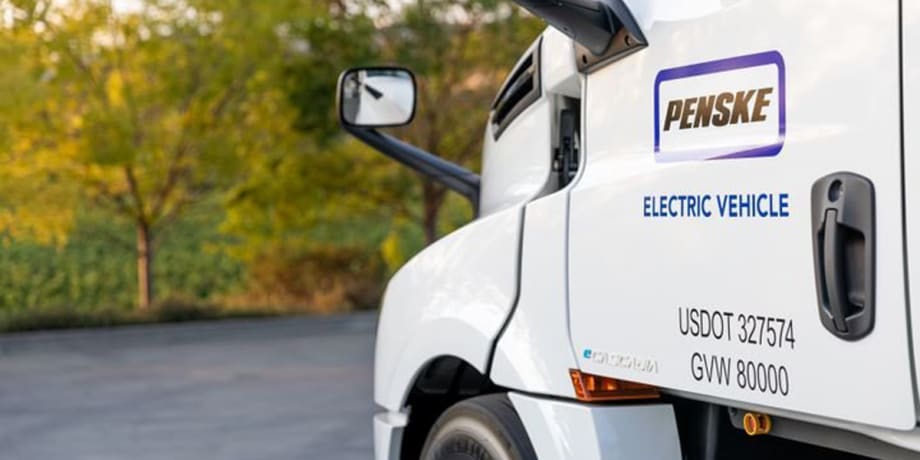
Penske Truck Leasing's project to install charging infrastructure for commercial vehicles has yielded “an awful lot of information and knowledge" to properly prepare their organization for the many electric vehicles that will be coming in the years to come.
Photo: Penske
3 min to read
As more and more news breaks about the developments pushing forward the coming tide of electric trucks, HDT Talks Trucking's host Jim Park spoke with Paul Rosa, senior vice president of procurement and fleet planning for Penske Truck Leasing, to hear about the lessor’s experience with installing charging infrastructure for commercial vehicles at a site in Southern California.
For starters, Rosa explained that setting up truck charging is not yet anything like a quick, in-and-out deal. “This project really goes back years, to when we were first talking about zero-emission or near-zero emission vehicles,” he told Park. “And then around 2017, it really started to get clear we needed to get closer to this. We needed to be out front and understand all that’s involved.”
Rosa said that, boiled down, this site project was “always about understanding everything that could go right and everything that would go wrong. And then properly preparing for that."
"As a company of our size, supporting the customer base that we do, we need to understand all the classes of equipment, Class 3 all the way on up to Class 8, [that customers operate]," he said.
The project has yielded “an awful lot of information and knowledge to properly prepare our customers, as well as our organization and our facilities, for the many, many electric vehicles that will be coming in the years to come,” he continued. “I'll use a sports analogy. I think we're past the pregame planning after lots of prep work. We've just finished up the first quarter with most of the game left to play, including a halftime to evaluate what's going on and making adjustments.”
According to Rosa, the many lessons learned start with the clock. On that, you want to get a running start. “We knew we had some lead time [for the install] before the electric trucks came to us. We were okay, but you’ve got a lot to figure out. ... There’s more to it than people realize. That’s why we're encouraging our customers to seek out information [on charging infrastructure as well as the vehicles]."
Lessons learned
Tune into the podcast to hear Rosa’s thorough account of the project and lessons learned, including delving into the topics of:
- Facility upgrades. “When you start talking to customers that have been in their facilities for many years, and you now need to put in charging infrastructure, that can pose some pretty dramatic challenges from an upgrade perspective.”
- Installation costs. “You have to go back to what does a customer need. How many vehicles are they going to operate? What kind of vehicles? Are they all going to be the same kind of vehicle? What's their duty cycle? Do they require fast charging? Or can they charge over a seven to ten hour period?
- Driver Training. “We start with a safety orientation, that's first and foremost. Then we get into the drivability of the vehicle. And there's orientation about how you can get greater range. That means don't be driving fast right out of the gate. And don't go fast and don't stop fast. Where there are different drivers that get in the vehicle on different days, it can become a little bit of a competition on who can get more range. You can see who has more kilowatts left in the battery when they come back.”
Subscribe to Our Newsletter
More Fuel Smarts

How Volvo Updated Its D13 for EPA 2027 [Watch]
Volvo’s updated D13 promises lower emissions without sacrificing performance or fuel economy. Take a closer look at what changed inside the engine in this HDT Spotlight video.
Read More →
Diesel Price Spike Shortens Payback for Natural Gas Trucks, Report Says
Energy Vision estimates fleets could recover the higher purchase price of an RNG-fueled Class 8 tractor in 1.3 to 2.8 years under current fuel-price scenarios.
Read More →
Calstart Becomes Catalyst Mobility, Reflecting Broader Focus
Calstart is now Catalyst Mobility, reflecting the nonprofit’s growing national role in clean transportation, including zero-emission trucks, infrastructure and incentive programs.
Read More →

Record Diesel Prices Squeeze Trucking Fleets
Average U.S. diesel prices have climbed to nearly $6 a gallon, surpassing the 2022 record as tight refinery capacity and Middle East disruptions keep fuel costs elevated.
Read More →
Sponsored•September 9, 2026
How Fuel Delivery Shapes Engine Performance
Fuel delivery depends on more than what happens at the injector. For fleet, maintenance and technical professionals, looking at the full path from pump to injector can provide useful context for understanding engine performance.
Read More →
East Coast Port Launches $45M Electric Truck Push
The Port Authority of New York and New Jersey announced millions in incentives for zero-emission drayage trucks, yard tractors, and new charging hubs near the port.
Read More →
California Bill Could Shed Light on Electric Truck Prices
Why do battery-electric Class 8 trucks remain so expensive? A California bill headed to Gov. Gavin Newsom would give fleets and state agencies more visibility into what manufacturers charge.
Read More →
Detroit Opens Orders for EPA 2027 Engines
Detroit isn’t starting from scratch to meet EPA 2027 diesel emissions standards. Its Gen 6 DD13 and DD15 engines keep much of today’s platform while updating the fuel and aftertreatment systems.
Read More →
Zero-Emission Truck Corridor Planned for West Coast
California, Oregon, Washington, British Columbia and Baja California are coordinating plans for truck charging and hydrogen fueling from Canada to Mexico.
Read More →
A Closer Look at Kenworth’s Electric T880E Vocational Truck [Video]
Learn more about Kenworth's T880E battery-electric vocational truck at the Paccar Technical Center, including its range, applications, upfitting considerations, and PTO options, in this HDT Spotlight video.
Read More →