




Stable Environment
The bendix anti-rollover system keeps mack mixer on its wheels.
Drivers of ready mix concrete trucks are usually pretty careful, but every once in a while a guy goes into a turn too fast and the truck rolls over. Mixers are uniquely unstable due to their high centers of gravity and the fact that their drums spin in a clockwise direction (as viewed from the truck's rear). Heavy concrete climbs up the left wall, further raising the center of gravity on that side and making right turns especially risky.
But a demonstration vehicle, shown off by Mack Trucks during the recent World of Concrete show in Las Vegas, refused to roll because its fast-acting anti-rollover system slowed it down every time it veered into turns too fast. It was when the electronic system was turned off that the Granite mixer heeled over, lifting the inside wheels and tires of its tandem axles right off the pavement. The truck fell onto a hefty wheeled outrigger on its opposite side, preventing a real-life rollover.
Most mixer rollovers result in serious damage to the expensive chassis and body. Often they're total losses. During the demo, damage to the Granite was limited to burned tires and an overworked frame and running gear. On another demo vehicle, a Mack Vision tractor pulling a water-filled tank trailer, the tires howled and generated clouds of rubber smoke. It was as compelling a spectacle as that of F-15 fighters roaring off into the evening sky from Nellis Air Force Base across the street.
But tractors like the Vision are relatively easy to equip with an electronic stability system, because most semitrailers they pull don't vary too much in mass and center of gravity, said Bendix engineers working on what Mack calls its Road Stability Advantage, or RSA. The inherent instability of loaded mixers makes them far harder to deal with. Engineers must study each vehicle type and program the stability system accordingly, explained Kevin Romanchok, director of electronics for Bendix Commercial Vehicle Systems.
Some truck builders already offer stability control on tractors. But Mack claims to be first with an anti-rollover system for vocational trucks, and its three-axle Granite mixer chassis with a setback front axle is the first to be fitted with RSA. Engineers are programming RSA for other mixer configurations, including multi-axle chassis with forward-set steer axles, Romanchok said. And they are preparing systems for dump and tank trucks, which also carry heavy, high-centered loads. The Bendix-made system will be available later on air-braked straight trucks from other builders.
For the demonstration, the Granite mixer's drum was loaded with 12 tons of pea gravel to simulate concrete. Bendix test driver Charlie Ross took it through the coned courses while explaining what he was doing. With RSA switched off, I was jostled a bit as the truck tried to roll over, then plopped back onto all its tires when he hit the brake pedal.
Ross flicked a switch on the dashboard to turn on the system and went through the coned courses again, first entering a tight-radius right turn and then a sudden double lane-change maneuver. As the truck barreled into the sharp turns at 25 to 30 mph, the brakes came on swiftly and slowed the vehicle to a safe speed. The truck's wheels stayed on the pavement and we finished each run at about 10 to 15 mph slower than when we began.
What I couldn't feel until I drove the truck is that although the accelerator was floored, the system told the engine to cut back on power, which also helped with deceleration. RSA cut power on me several times as I made sharp right turns at the other end of the parking lot; I was driving too slow for it to apply the brakes, but it knew that the truck was still moving too fast into the turns for its own good. In the sharp turn and lane-change maneuvers, the system simultaneously cut power and applied the brakes.
The system reacts in microseconds to a rollover situation and acts before a driver might be aware that he's in trouble, the Bendix people said. The start of a roll is apparent to the driver of a straight truck, but not to the driver of a semi or other combination vehicle. The trailer begins to roll first and there's no seat-of-the-pants feel; it's usually past the point of no return by the time the driver sees it in his mirrors, if he looks at all. Braking action seemed smoother on the tractor-trailer rig than on the truck, maybe because the semi's total wheelbase is far longer. But the truck's braking action was nowhere near the violence of a real rollover.
Electronic stability control is an enhancement to the anti-lock braking system now required on all air-braked trucks and tractors. The system shares a more powerful electronic brain with ABS; it reads inputs from sensors on wheel ends, plus more sensors on a truck's steering column, chassis and braking system, and compares the severity of the turn to road speed. The stability system and ABS then take appropriate action, cutting power and applying brakes. Brake applications vary at each wheel, depending on the direction of the turn and the dynamics being experienced.
On a tractor, the stability system sends signals that are read by the trailer's ABS, whether it's Bendix's or another manufacturer's. If the trailer is an older one without ABS, the system on the tractor sends pulsing pneumatic signals back to the trailer brakes, effectively turning them into ABS-controlled units, said Randy Howe, Bendix's northeast regional sales manager who works with Mack and its sister company, Volvo Trucks. Last August, Volvo showed off its version of the Bendix stability system for tractors during a truck show in Dallas.
Mack has not yet announced a price for the Road Stability Advantage system, but Tom Kelly, senior vice president for marketing, said it'll be a lot less than what some customers who previously saw the demo said they'd be willing to pay. The price might be somewhere between $2,000 and $3,000, which would pay for itself many times over if the system saved just one $150,000 mixer truck.
Not that the anti-rollover system will guarantee a truck's safety. I took the mixer into one turn faster than the demo's prescribed speed and the tandem's inside wheels left the ground. But the truck didn't fall onto the outrigger because the system sensed what was happening, and quickly cut power and applied the brakes. The truck settled back down on all wheels.
This illustrated what Charlie Ross had earlier said of the system: "It'll keep you out of trouble, but only up to a point," which I had about reached on that run. Any faster and it'd have "rolled."
More Fleet Management

How Telematics Improves Visibility, Control, and Performance in Refrigerated Fleets
Explore how telematics help refrigerated fleets improve visibility, uptime, efficiency, compliance, and cargo protection across connected cold chain operations.
Read More →
What the U.S.-Canada Trade War Means for Trucking
Escalating U.S.-Canada tariffs could disrupt cross-border freight, reduce truck volumes, raise costs, and create new uncertainty for carriers on both sides of the border.
Read More →
What Are Trucking’s Top Concerns for 2026?
The American Transportation Research Institute wants to know what's worrying trucking fleet managers, drivers, and other stakeholders in its annual Industry Issues survey.
Read More →

American Trucking Associations Looks for a New Leader
ATA President and CEO Chris Spear abruptly left his job at the association on August 21, at a pivotal time for the trucking industry.
Read More →
Public Wi-Fi Cybersecurity Risks: How Truck Drivers and Fleets Can Protect Their Data
Public Wi-Fi can expose truck drivers and fleets to credential theft, malware, and other cyber threats. Here’s how to reduce the risk on the road.
Read More →
For Nicky Cupp, Fleet Innovation Starts With Frustration
HDT Truck Fleet Innovator Nicky Cupp turns everyday pain points at Fraley & Schilling into opportunities for better technology and smarter processes.
Read More →
Adam Buttgenbach’s Approach to Electric Trucks: Start With Where They Fit
HDT Truck Fleet Innovator Adam Buttgenbach helped PepsiCo build one of North America’s largest EV fleets by focusing on where electric trucks make operational sense.
Read More →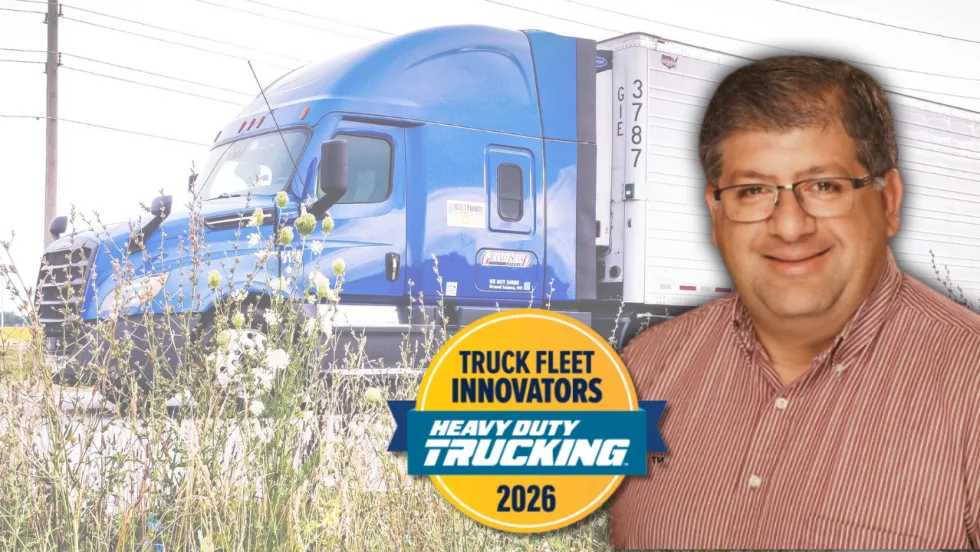
Deen Albert: Let Automation Do the Math, People Make the Decisions
HDT Truck Fleet Innovator Deen Albert makes sure people are still at the heart of operations at Grand Island Express, even while adopting artificial intelligence tools. AI-assisted dispatch helped boost revenue 25% with the same number of trucks.
Read More →
Trimble’s New AI Agent Takes Aim at Fleet Back-Office Busywork
Arc Agent works across Trimble TMS products to automate repetitive tasks such as freight orders, maintenance, invoices, fuel costs and more.
Read More →
How HDT’s 2026 Truck Fleet Innovators Are Rethinking Fleet Operations
Meet five trucking leaders who are challenging assumptions, solving operational problems, and putting innovative ideas to work.
Read More →