





Related: Spec’ing Last-Mile Truck Bodies with Drivers in Mind
Spec'ing Regional Trucks
A regional spec is a pretty broad term. How do you optimize efficiency and cost when a truck might be doing completely different work from one day to the next?
April 15, 2020
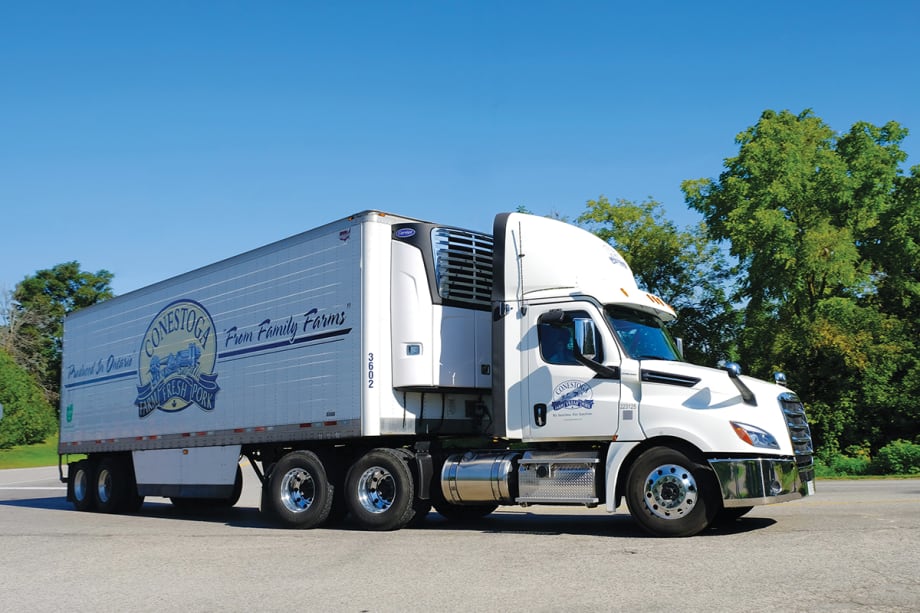
Regional trucks that spend a significant percentage of their time at highway speeds can benefit from some aero treatment. While side skirts and fairings can be easily damaged in urban operations, roof-mounted deflectors are up and out of the way.
Photo: Jim Park
4 min to read
You’ve seen the writing on the wall: regional trucking is the next frontier, a growth segment. There’s strong demand for regional service, and drivers seem to prefer it to long-haul. Can you simply reassign a bunch of aging highway tractors to regional routes and expect to prosper?
Before “regional” became a thing, local trucks were bare-bones workhorses, day-cabs without a spot of chrome, and often under-powered. They were the cheapest trucks a fleet could buy, but they were purpose-built. They had no sleepers, which improved visibility and maneuverability, and kept the price down. Tires were spec’d to resist curb damage and scrubbing, while providing ample traction. You didn’t need big power because the truck wasn’t going far. And drivers put up with them because they got to go home at night.
Today’s regional spec requires a bit more thought. For example, do you load the day cab up with aero if it will spend a high percentage of its time at highway speed — when its P&D exposure could inflict damage to the side skirts, fairings and air dams? Do you spec it with low-rolling-resistance tires to save fuel on the highway when the rocks and curbs at loading docks will chew those tires apart? Do you spec a low-rpm drivetrain for the highway when you need better gradeability and startability in the city?
“We’re starting to see greater emphasis on fuel economy in regional trucks, which didn’t seem to be a big priority in the past,” says Mike Roeth, executive director of the North American Council for Freight Efficiency, which last year organized Run on Less Regional to demonstrate fuel-saving strategies in regional operations. “Fleets realize that regional trucks will still spend considerable time at highway speed, where some aero treatment can be advantageous. Tires and powertrains are leaning in that direction too, though fleets sometimes have to compromise the spec for operational considerations.”
Highway Trucks in the City?
Advances in powertrain controls make it possible to get most of the advantages of a downsped driveline even in a P&D operation. Gradeability and startability need to be considered, but electronic torque limiting in lower gears can help prevent driveline damage from high-torque engines. Electronic actuation can help minimize clutch wear and damage. All this makes it possible to run a highway truck in a local operation in many cases, enabling fleets to run P&D on the day shift and linehaul at night.
Adding a sleeper to a regional truck is a question of practicality. Sleepers add weight and cost but can provide some aero benefit. They also limit the truck’s maneuverability on city streets and loading docks, virtually precluding blind-side backing, where there’s a safety consideration too. Some routes within a 300-mile region can put a driver out overnight, or sometimes for two or three nights, so a sleeper might be considered mandatory rather than an accessory. However, some fleets are warming to the idea of putting drivers into hotels rather than sleepers.
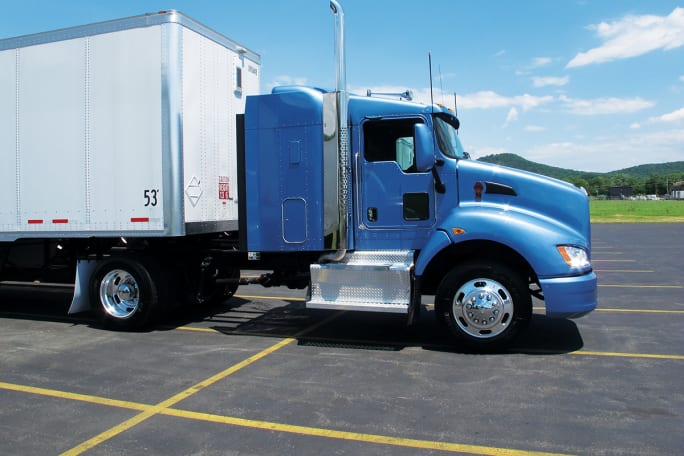
Most OEMs offer short 28- to 36-inch sleepers for overnight operations. They are useful for hours-of-service compliance in applications where trip plans can be compromised by delays. Some fleets choose hotels over small sleepers to improve driver satisfaction and retention.
Photo: Jim Park
“All of our trucks are day cabs,” says Steve Rush, president of Carbon Express, a tank fleet based in Wharton, New Jersey. “We run all the way to Alaska in day-cabs. There’s no need for a sleeper if you’re on regular routes and you can plan stops.”
Rush spoke of a fleet-owner friend who was having difficulty keeping drivers on a three-day peddle run. “I suggested he try putting them into a hotel rather than using the sleeper, and his recruiting problems disappeared,” he says. “He soon had a waiting list for the peddle runs. It seems drivers didn’t object so much to the overnight trips, but to living in a sleeper. Hotels solved all his problems.”
Balancing Pros and Cons
How do you decide which approach to take, a highway spec or a city spec? Collect data on tractor usage, including miles run, time at certain speeds, fuel consumed, loaded weight, etc. That can help determine upon which side of caution you decide to err.
If city P&D trucks are to be used in linehaul overnight, does the fuel saved with a highway spec — lower gear ratios, rib tires, etc. — cover the potential shortcomings in startability (driveline wear and damage) or tire wear/damage from operating a highway tire in a high-scrub environment? Do you need a full 6x4 for either or both applications? Would a 4x2 or a 6x2 do the job?
“Fleets like flexibility,” admits Roeth. “But do they really need it? There are always those just-in-case examples, or a few routes that need a 6x4 once in a while, but the 6x4 are heavier, require more maintenance, suffer greater tire wear under light loads and get poorer fuel economy. If they weren’t trying to make one truck all things to everyone, maybe those fleets could save fuel and some money if the specs were a little more targeted.”
Of course, nobody is going to buy two trucks just to avoid premature tire wear in a situation where one truck can serve two functions. Chances are one truck can easily serve two masters if the pros and cons are carefully considered.
Subscribe to Our Newsletter
More Equipment

How Volvo Updated Its D13 for EPA 2027 [Watch]
Volvo’s updated D13 promises lower emissions without sacrificing performance or fuel economy. Take a closer look at what changed inside the engine in this HDT Spotlight video.
Read More →
Michelin Tire Improves Efficiency and Durability for Regional Fleets
The Michelin X Multi Energy D2 is a regional haul drive tire engineered to help fleets improve fuel efficiency, durability and traction in demanding stop-and-go operations.
Read More →
ZF Expands Commercial Vehicle Push in North America
ZF is expanding its North American commercial-vehicle presence with new transmission applications, electrification, trailer technology and autonomous-driving systems.
Read More →
Tesla Wants a Self-Driving Semi. Are Cameras Enough?
Could Tesla’s camera-only autonomous driving technology work on an 80,000-pound Semi? In this commentary, HDT's Deborah Lockridge takes a look at Tesla, Cybercab, and how autonomous trucks see the road.
Read More →
Kodiak: Driverless Long-Haul Truck Launch on Track for 2026
Kodiak AI says its driverless long-haul safety case is 93% complete and it remains on track to begin commercial operations by year-end 2026.
Read More →
What DOT’s Automated Vehicle Strategy Means for Trucking
The U.S. Department of Transportation issued a new automated-vehicle strategy that outlines plans for driverless-truck regulations, cross-state freight corridors, and federal safety standards.
Read More →
East Coast Port Launches $45M Electric Truck Push
The Port Authority of New York and New Jersey announced millions in incentives for zero-emission drayage trucks, yard tractors, and new charging hubs near the port.
Read More →
PlusAI Going Public to Fund Autonomous Truck Launch
A SPAC deal could provide PlusAI with up to $300 million as it works toward a 2027 commercial launch of factory-built autonomous trucks.
Read More →
NHTSA Moves to Rewrite Truck Fuel-Economy Rules
The National Highway Traffic Safety Administration says it lacks authority to regulate medium- and heavy-duty truck engines separately from complete vehicles, but the existing standards have not yet been eliminated.
Read More →
Detroit Opens Orders for EPA 2027 Engines
Detroit isn’t starting from scratch to meet EPA 2027 diesel emissions standards. Its Gen 6 DD13 and DD15 engines keep much of today’s platform while updating the fuel and aftertreatment systems.
Read More →