




Smart Roads, Smart Vehicles
Intelligent highways, smart vehicles, connected transportation systems – sounds like the stuff of the future. In reality, though, many technologies currently found on our roadways reflect that future. In many cases they will be integral components of an intelligent transportation system. And the most important piece of technology might be the one most everyone now carries in their pocket, purse or backpack.

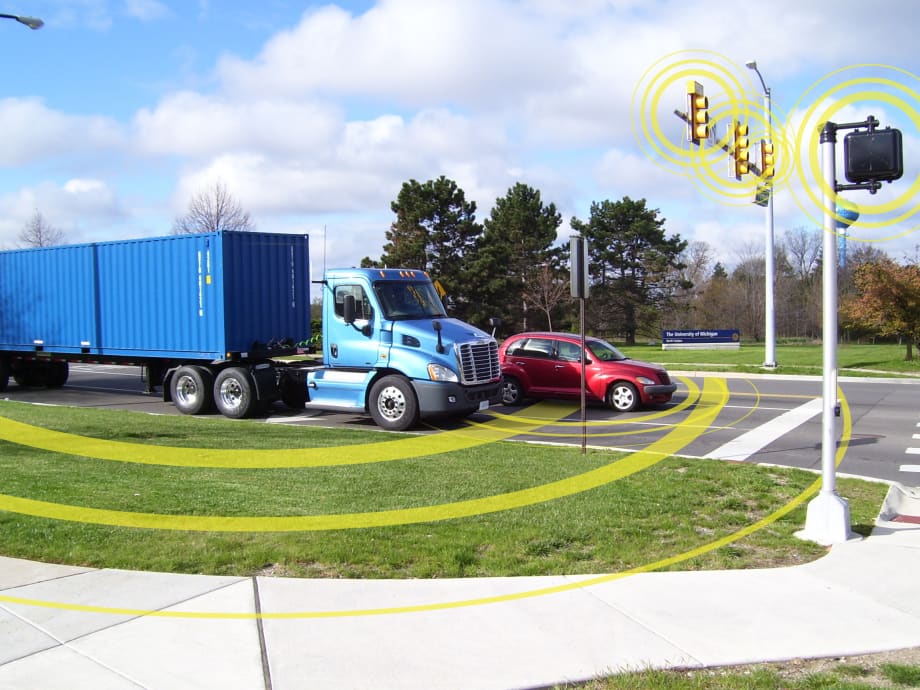
Intelligent highways, smart vehicles, connected transportation systems – sounds like the stuff of the future. In reality, though, many technologies currently found on our roadways reflect that future. In many cases they will be integral components of an intelligent transportation system. And the most important piece of technology might be the one most everyone now carries in their pocket, purse or backpack.
The U.S. Department of Transportation, via its Intelligent Transportation System Program, has funded numerous research projects on vehicle-to-vehicle and vehicle-to-infrastructure communications. The goal: a national, multimodal system featuring connected vehicles, infrastructure and driver/passenger mobile devices – even pedestrian mobile devices (cell phones).
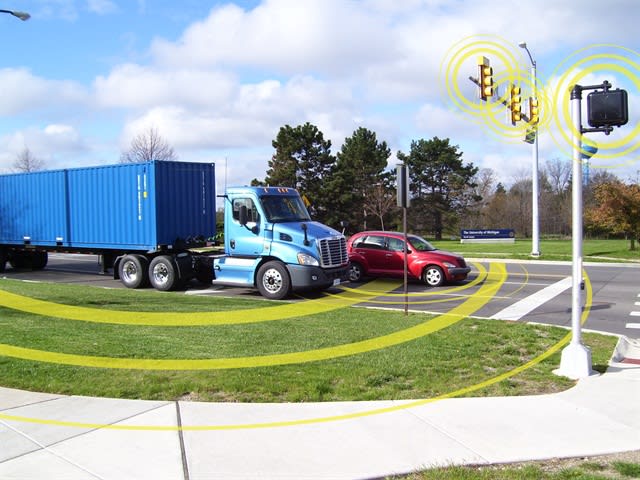
DOT believes a “connected” transportation system will mean a safer and more efficient system, with vehicles communicating with each other as well as with traffic signals, toll booths and other parts of the infrastructure.
Among the short-term research programs are projects focusing on commercial vehicle information systems and technologies. This would involve using information systems and communications networks to improve safety and productivity and reduce regulatory costs. These programs would rely on data sharing, electronic registration and automated roadside screening/enforcement activities.
The ITS Strategic Plan through 2014 includes a section on truck vehicle-to-vehicle research. The goal is to help reduce crashes by alerting drivers via in-cab alarms of vehicles in their vicinity that might represent a threat, such as one that is speeding or merging into the roadway from a blind spot.
Overcoming the issues
A number of challenges must be overcome to get to the ITS programs vision, according to a U.S. Government Accountability Office report released earlier this year. Those challenges include:
• Finalizing a technical framework for vehicle-to-vehicle security;
• Ensuring the performance of the radio-frequency spectrum used by vehicle-to-vehicle communications;
• Ensuring drivers respond appropriately to warning alerts;
• Liability issues that may be created by the technologies; and
• Privacy – something that’s been much in the news since the release of the GAO report.
The GAO report said that a vehicle-to-vehicle communication system would need a way to ensure the integrity of the data shared between vehicles by being able to detect, report and revoke the credentials of vehicles sharing inaccurate information.
What DOT envisions for the future is similar to what current commercial vehicle collision-avoidance systems, vehicle tracking or vehicle performance monitoring devices accomplish, with the exception of communicating with other vehicles.
Is tomorrow’s technology here today?
Only a small percentage of commercial vehicles are currently equipped with on-board telematics/fleet management systems. (That may change if the Federal Motor Carrier Safety Administration adopts a rule mandating electronic logging devices for recording drivers hours-of-service.)
However, virtually all drivers carry mobile devices such as a smartphone, tablet or both. There are hundreds of trucking-centered applications available online for these devices, and a growing number of fleet management providers offer mobile products as well.
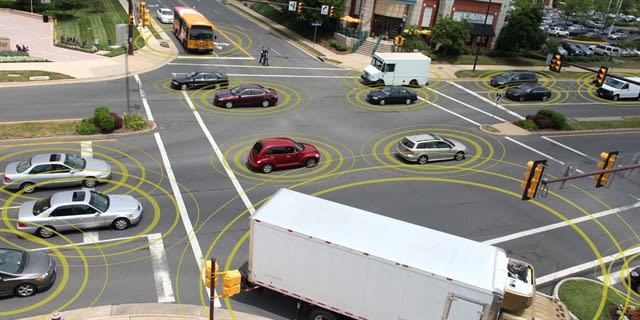
Either way, these systems tend to communicate with a fleet’s vehicle management system and with other systems that might be installed on a vehicle. While DOT’s ITS program foresees a nationwide network, many commercial vehicle fleets already run in what might be termed local networks. One of the benefits of such a network, according to the ITS vision, is the ability for vehicles ahead to alert other vehicles of adverse weather conditions – icy roads, heavy fog, snow or traffic congestion.
For a number of commercial vehicle networks, this is already a reality. For instance, Telogis operates a “feedback loop” for drivers with its navigation product. Termed “community-based navigation,” drivers can send feedback regarding routes, low-bridges, construction, weather or other things. The feedback is validated and then shared with other drivers. The network includes 120,000 drivers, according to Rick Turek, vice president navigation with Telogis. Noting that often infrastructure data “was out-of-date as soon we get it,” he said that “the only way we found to stay current (on road and weather conditions) was to use the whole community.”
Among the “couple hundred” messages they get from drivers each day, there is often some traffic or weather information that allows them to send out revised navigation instructions.
Turek sees the potential of extending local networks to encompass entire transportation systems.
He sees less promise in so-called smart infrastructure.
“The most expensive thing can do would be to insert probes into the roadway” to monitor traffic and weather. “The more you can take advantage of the mobile unit inside the vehicle and cloud-based applications,” the easier the job will be, he says. “The probes won’t be on the roadway but in the vehicles. If you are looking at smart vehicles, you are looking at a network connecting the vehicles through a localized cloud.”
When onboard systems talk to each other
For the most part, however, the systems fleets deploy are closed networks and not the open, data-sharing network the ITS plan envisions. There are perfectly good reasons for that. But even here, cooperation is expanding. Some mobile communications providers, for example, allow other services to piggyback on their network.
Adam Kahn, director of fleet services with Omnitracs, says an interesting trend is for several technology vendors to come together and have their systems “converse to serve the fleets in a more dynamic method.”
As an example, he mentioned a truck OEM’s recent introduction of on-board sensors that can identify maintenance issues and then send that data to a nearby dealer locations via whatever type of mobile communications system that particular fleet deploys. The information is routed to the fleet’s maintenance director, and the nearest service location is identified via geo information from the telematics unit. “We are starting to see a lot of cooperation.”
Currently, Kahn says, “connected” trucks feature a number of systems communicating with each other. For instance, critical-events reporting applications and lane departure warning systems are coupled with other activities.
“If we see a hard-braking event (from the critical events reporting application) it starts other things,” Kahn says. If the vehicle is equipped with an in-cab camera system, such as SmartDrive for instance, a hard-braking event will turn on its cameras.
Another trend, Kahn notes, is that “truck sensors are moving almost into the ‘always on’ environment – they always know what is happening. And in that way, the trucks themselves are becoming part of the smart roadway.”
Talking to infrastructure
At least one application allowing fleets to bypass weigh and inspection stations uses a fleet’s existing mobile communications platform to request and receive bypass authorizations.
The traditional service requires a transponder installed on the truck, a receiver mounted some distance from the weigh station to receive the by-pass request, and a transmitter a little further on to relay the authorization.
The mobile applications, on the other hand, do not require any of those and allow fleets to “leverage the devices they have already purchased,” says Brian Heath, president and CEO of Drivewyze. The company’s app can be downloaded to iPhone, iPads or Android phones and tablet. Its PreClear subscription service allows fleets to get bypass clearances either through the driver’s mobile device or in-cab mobile communication’s unit or electronic logging device.
Omnitrac’s Kahn agrees that such services make sense for both the carrier and the enforcement agencies involved. “It’s like a frequent traveler who gets a TSA pass,” he says. “I can’t imagine why a fleet wouldn’t find that attractive.”
And while the reality of a nationwide connected transportation system still lies somewhere in the future, the reality, as Kahn notes, is “a lot of this stuff is happening now.”
More Fleet Management

Color Match Smarter: Tools That Restore & Perform
For fleet managers and collision repair professionals keeping heavy-duty trucks on the road, getting the color right the first time isn't just about appearance — it's about efficiency, turnaround time, and bottom-line results. Discover how today's digital color tools are transforming the repair process from guesswork to precision.
Read More →
FMCSA Pauses Biennial-Update Enforcement Amid Motus Transition
Carriers whose updates were due on or after June 1 have more time, while FMCSA works to stabilize its new registration system and warns of phishing sites impersonating its new carrier registration system, Motus.
Read More →
2026 Blueprint for Countering Smarter Supply Chain Theft
Cargo theft is no longer just the cost of doing business. It's a multi-billion-dollar criminal enterprise exploiting vulnerabilities across your fleet, drivers, and supply chain.
Read More →


How Telematics Improves Visibility, Control, and Performance in Refrigerated Fleets
Explore how telematics help refrigerated fleets improve visibility, uptime, efficiency, compliance, and cargo protection across connected cold chain operations.
Read More →
What the U.S.-Canada Trade War Means for Trucking
Escalating U.S.-Canada tariffs could disrupt cross-border freight, reduce truck volumes, raise costs, and create new uncertainty for carriers on both sides of the border.
Read More →
What Are Trucking’s Top Concerns for 2026?
The American Transportation Research Institute wants to know what's worrying trucking fleet managers, drivers, and other stakeholders in its annual Industry Issues survey.
Read More →
American Trucking Associations Looks for a New Leader
ATA President and CEO Chris Spear abruptly left his job at the association on August 21, at a pivotal time for the trucking industry.
Read More →
Public Wi-Fi Cybersecurity Risks: How Truck Drivers and Fleets Can Protect Their Data
Public Wi-Fi can expose truck drivers and fleets to credential theft, malware, and other cyber threats. Here’s how to reduce the risk on the road.
Read More →
For Nicky Cupp, Fleet Innovation Starts With Frustration
HDT Truck Fleet Innovator Nicky Cupp turns everyday pain points at Fraley & Schilling into opportunities for better technology and smarter processes.
Read More →
Adam Buttgenbach’s Approach to Electric Trucks: Start With Where They Fit
HDT Truck Fleet Innovator Adam Buttgenbach helped PepsiCo build one of North America’s largest EV fleets by focusing on where electric trucks make operational sense.
Read More →