




Shell Explores the Limits of Fuel Efficiency at Eco-Marathon
On a weekend where Shell Lubricants hosted an eco-marathon challenge, the company showed off its Starship concept truck, aiming to push the limits of fuel efficiency with current technology.

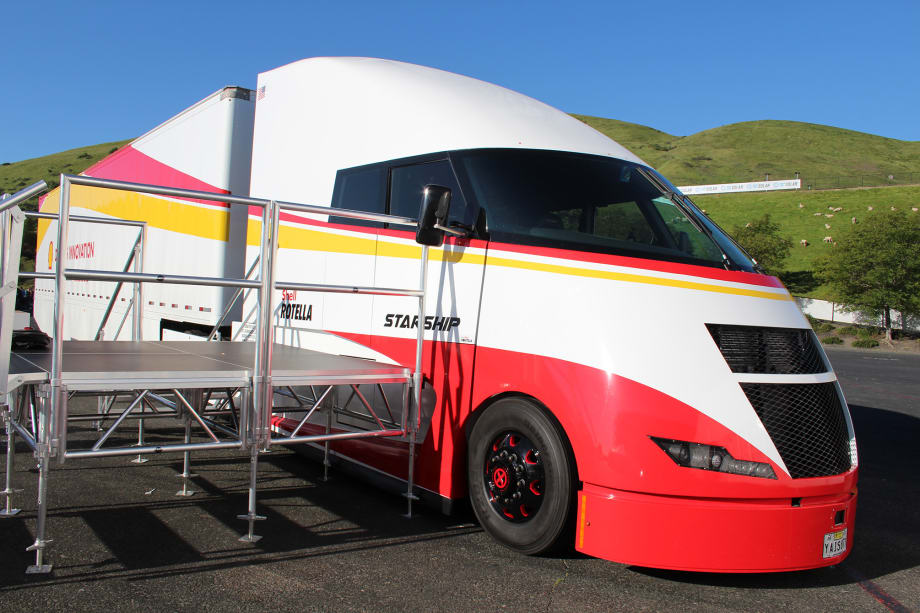
The Starship is a highly aerodynamic demonstration truck developed by Shell and Airflow to test how existing technologies and innovative design can improve trucking efficiency. Photos: Jim Beach
How efficient can a Class 8 truck be? That’s the question Shell Lubricants is asking with its new concept truck project, the Starship Initiative. A collaboration with Airflow Truck Company, the Starship truck makes use of existing and customized technologies, along with a one-of-a-kind cab to push the limits on fuel efficiency.
The Starship was on display at the Sonoma Raceway, Sonoma, California, April 19-22 as part of Shell’s Make the Future California and Eco-marathon Americas 2018 festival. In addition to the Starship, displays included low-emissions automobiles using technologies such as fuel cells, hybrid drivetrains and electric engines. Toyota’s hydrogen cell Class 8 truck, put in service in October at the Ports of LA and Long Beach by Southern Counties Express, was also on display. A number of interactive and informational displays were also featured.
The key event of the festival was the Eco-marathon mileage challenge, with 99 high school teams vying to set a new mileage mark while piloting their class-constructed vehicles around the Sonoma Raceway track.
Starship's Energy-Efficient Technologies
The Starship truck will hit the highways in May, for a cross-country trip to test how efficient it can be. Energy-efficient technologies include a bespoke aerodynamic design made of 100% carbon fiber, active grille shutters that open and close based on based on temperature (when open, air can flow through the radiator and engine compartment; when not needed, the shutters close automatically, allowing air to move around the vehicle, which eliminates a drag), an aerodynamic boat tail, and super long side skirts.
Several technologies are put to work improving the truck’s 6-cylinder, 400-hp engine that was calibrated with the automated manual transmission to run at low speeds – down to 800 rpm.
The truck will also have a hybrid axle system installed, with an electric motor and axle replacing the rear tractor non-driven axle to supply extra power when climbing grades.
Topping off the truck, literally, is a solar array on the trailer roof that charges and stores power in a 48-volt battery bank to power normal loads such as lights, wipers and blower motors, plus power for other electrical components and equipment.
The truck was built by Airflow Truck Company, the third high-efficiency truck built by company owner Bob Sliwa. He built his first in 1983 after buying a Class 8 tractor and setting out on the road where he said he was “amazed” at the inefficiency of heavy trucks. He was getting 4-5 mpg of fuel. So, he started tinkering. Having a racing background, that was something he was used to doing. Little by little, modification by modification, he was able to improve his fuel efficiency to 10 mpg.
In 2012, he bought a new truck from an OEM, spent two years modifying it and ended up getting 13.4 mpg while hauling a full load.
The Starship was built “from scratch” he said, with an aerodynamic design. While much of the technology used is now currently available, there were still several modifications that had to be made, Sliwa said, citing the window defroster as an example. The windshield on the Starship is much bigger than a normal Class 8 truck windshield, and required larger tubing and adding four blower motors to deliver the airflow necessary.
Why Shell's Involved With a Concept Truck
Bob Mainwaring, technology manager for innovation, Shell Lubricants, said the goal of projects such as the Starship is to find ways of using existing technologies to “carry goods with as little energy as possible.”
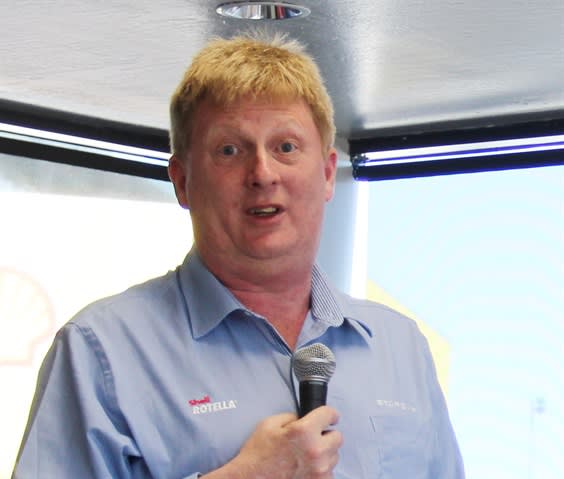
Bob Mainwaring, technology manager for innovation, Shell Lubricants, explained the goals of the Starship Initiative at the Sonoma Raceway.
Ways to do that include decreasing things such a drag, cross-sectional surfaces, velocity, acceleration and the overall mass of the truck while maximizing the mass of the load being hauled, which yields greater ton-mile efficiency. “You can do all of those things through engineering and careful driving,” he said.
Mainwaring stressed the importance of co-engineering – working with various component suppliers to decrease friction and improve efficiency of each part of the truck. “All OEMs are interested in the ‘low-hanging’ fruit to get more efficiency,” he said. Shell and other lubricant manufacturers contribute by reducing friction in engines, transmissions and axles. “Lubricants matter.” Taking that message into the heavy-duty space, Shell wanted to engage OEMs to co-design lubricants and drivetrains “that work together at the highest efficiency.”
As for the road trip, Sliwa said that while driving cross country, he’ll be focused on the gauges. He likened his driving style to being a kinetic energy manager. “We’ll be coasting a lot,” he said. On a recent 2,000-mile trip, he said, “we coasted 500 miles and used gravity to go down hills."
More Fuel Smarts

How Volvo Updated Its D13 for EPA 2027 [Watch]
Volvo’s updated D13 promises lower emissions without sacrificing performance or fuel economy. Take a closer look at what changed inside the engine in this HDT Spotlight video.
Read More →
Diesel Price Spike Shortens Payback for Natural Gas Trucks, Report Says
Energy Vision estimates fleets could recover the higher purchase price of an RNG-fueled Class 8 tractor in 1.3 to 2.8 years under current fuel-price scenarios.
Read More →
Calstart Becomes Catalyst Mobility, Reflecting Broader Focus
Calstart is now Catalyst Mobility, reflecting the nonprofit’s growing national role in clean transportation, including zero-emission trucks, infrastructure and incentive programs.
Read More →

Record Diesel Prices Squeeze Trucking Fleets
Average U.S. diesel prices have climbed to nearly $6 a gallon, surpassing the 2022 record as tight refinery capacity and Middle East disruptions keep fuel costs elevated.
Read More →
How Fuel Delivery Shapes Engine Performance
Fuel delivery depends on more than what happens at the injector. For fleet, maintenance and technical professionals, looking at the full path from pump to injector can provide useful context for understanding engine performance.
Read More →
East Coast Port Launches $45M Electric Truck Push
The Port Authority of New York and New Jersey announced millions in incentives for zero-emission drayage trucks, yard tractors, and new charging hubs near the port.
Read More →
California Bill Could Shed Light on Electric Truck Prices
Why do battery-electric Class 8 trucks remain so expensive? A California bill headed to Gov. Gavin Newsom would give fleets and state agencies more visibility into what manufacturers charge.
Read More →
Detroit Opens Orders for EPA 2027 Engines
Detroit isn’t starting from scratch to meet EPA 2027 diesel emissions standards. Its Gen 6 DD13 and DD15 engines keep much of today’s platform while updating the fuel and aftertreatment systems.
Read More →
Zero-Emission Truck Corridor Planned for West Coast
California, Oregon, Washington, British Columbia and Baja California are coordinating plans for truck charging and hydrogen fueling from Canada to Mexico.
Read More →
A Closer Look at Kenworth’s Electric T880E Vocational Truck [Video]
Learn more about Kenworth's T880E battery-electric vocational truck at the Paccar Technical Center, including its range, applications, upfitting considerations, and PTO options, in this HDT Spotlight video.
Read More →