




Russia’s Comtrans Show Reflects Improving Truck Market
Russia’s Comtrans, the largest truck and transportation exhibition in Europe this year, showed off nearly everything offered on the Russian market for five days earlier this month in Moscow.

Daimler, which has a 15% stake in and a 50/50 joint venture with the Russian truck maker Kamaz, is aiming for higher market share in Russia.
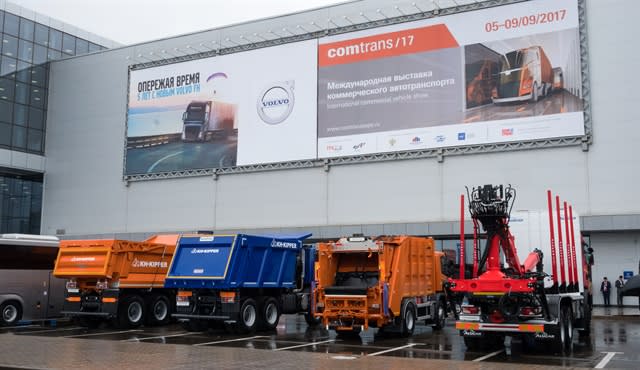
Russia's Comtrans exhibition is held every other year.
Russia’s Comtrans, the largest truck and transportation exhibition in Europe this year, showed nearly everything offered on the Russian market for five days earlier this month in Moscow.
The event took place at Moscow's most modern exhibition place, the Crocus Exhibition Center, which was completed just 10 years ago.
The Russian truck market fully follows the economy of the country. Much depends on world market prices for oil and gas, which is the country's most important source of export and revenue. After two weak years, the truck market has now stabilized, and the Russian market is making a comeback this year with increased volumes.
This was clearly evident at the Comtrans exhibition, which is held every other year. This was the 14th time the exhibition was organized. The exhibition space of 40,000 square meters was 5% more than the last show in 2015.
The Russian Truck Market at a Glance
There are just over 8 million commercial vehicles registered in Russia. Since 2009, the number has increased by over 13%, or almost 1 million vehicles. Over half of these were manufactured before 2002. Thus, every other commercial vehicle in Russia is over 15 years old. Of these 8 million vehicles, about 50% are light trucks, about 45% are medium-heavy and heavy trucks and about 5% are tourist and city buses. After all-time high sales in 2012, the market fell dramatically and reached its bottom in 2015, which was as low as the crisis year 2009.
In January to July 2017, 31,100 trucks were manufactured in Russia, which is 47% more than in the same period last year.
The heavy truck market in Russia consists of 70% domestic brands such as Kamaz, Ural and GAZ. This also includes the Belarusian MAZ from Minsk. 10% consists of the Asian block, with trucks from Japan, China and Korea, carrying nameplates such as Hino, Isuzu, FAW, Foton, and Hyundai. The remaining 20% are the European manufacturers, called the "Big Seven.” A majority of the Western manufacturers have local production in Russia, due to high custom duties on imported new trucks.
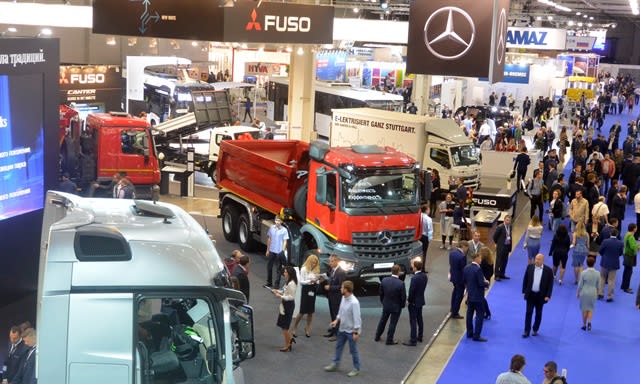
Daimler, which has a 15% stake in and a 50/50 joint venture with the Russian truck maker Kamaz, is aiming for higher market share in Russia.
Daimler on the Move in Russia
In 2008, Daimler acquired a 10% stake in Kamaz, the dominant domestic manufacturer. Thus, Mercedes and Fuso gained access to a large dealer network with many service points. In 2014, the Daimler ownership increased to 15%.
Together, the two companies own a 50-50 joint venture named Daimler Kamaz Rus. This company manufactures the Actros, Atego, Axor and Unimog models as well as the Fuso Canter. Since 2000, the company's factory in Naberezhnye Chelny has built a total of 20,000 trucks, of which 12,000 were Mercedes-Benz and 8,000 Fuso. Daimler supplies Kamaz with Mercedes cabs, and this year Kamaz introduced the new 54901-K5 tractor unit with the most recent Actros cab.
Heiko Schulze, CEO of Daimler Kamaz Rus, has a clearly stated the goal to become number one among the import brands.
Mercedes offers the previous Actros and Axor models with V-engines, and from this year also the latest Actros model, the one introduced in Europe in 2011 with the Strategic Future Truck Platform. It was developed to accommodate the current straight six-cylinder HDEP engine.
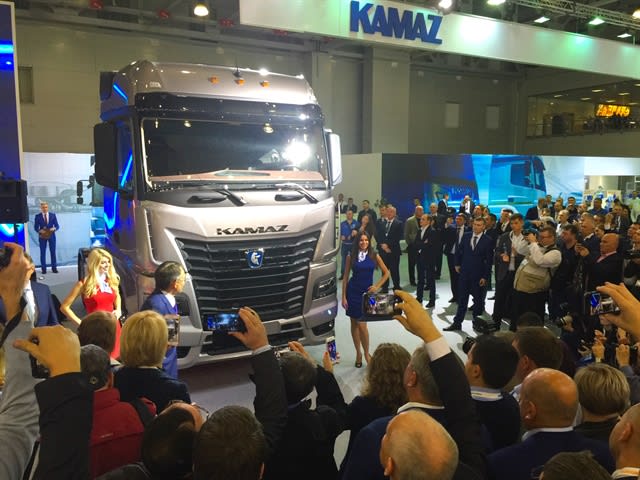
Russian truck maker Kamaz introduced the new 54901-K5 tractor unit, featuring Mercedes' most recent Actros cab.
Other Truck Importers
Daimler has to catch up with Volvo Trucks, the largest among the Russian commercial vehicle importers, which has been in the country for 44 years. In 1973 the company got its first major order from the then-Soviet Union of 100 Volvo F89 tractor units intended for international traffic by the Russian governmental transport company Sovtransavto. It was the first more comprehensive delivery of a western truck model. The Volvo F12 was also sold in large numbers to the Soviet Union.
At Comtrans, Volvo showed seven trucks, include the “Swedish Flag” Performance Edition, which in Russia is named the FH Viking.
Racing driver Boije Ovebrink signed autographs and posed for photos with the Volvo Iron Knight speed-record-breaking race truck with 2400 hp.
Scania shares the number-two market share spot for the Western truck makers in Russia with Mercedes. The Södertälje brand is a veteran in Russia, with an over 100-year history in the country. Scania vehicles started to be delivered back in the time of the czars. Scania this year introduced its new generation, named Truck of the Year in Russia. Scania has its Russian truck plant in Saint Petersburg, formerly Leningrad.
Also premiering at the show was the new DAF XF 480 FT Super Space Cab, which starts selling in Russia in early 2018. DAF is the European leg of Paccar.
Renault Trucks is presently the smallest among the Big Seven, but is working heavily to push its new product line in order to get back to the 10% it used to have with the previous Magnum and Premier models.
From China, new trucks from FAW (First Auto Works) and Foton appeared. Dong Feng, in which Volvo has a major stake, was absent. Korean Hyundai launched its Mighty model.
Euro 4 applies
Until January 1, 2012, new trucks could be sold with Euro 3 engines in Russia. Today, the Euro 4 exhaust gas standard applies as the lowest standard, while most import brands offer Euro 5. The reason for waiting for Euro 6 is that the fuel quality can not be guaranteed in this area. Too often, sulfur levels are too high. However, for customers with trucks running in international transportation, Euro 6 is often offered.
The next Comtrans show will take place in September 2019.
More Equipment

How Volvo Updated Its D13 for EPA 2027 [Watch]
Volvo’s updated D13 promises lower emissions without sacrificing performance or fuel economy. Take a closer look at what changed inside the engine in this HDT Spotlight video.
Read More →
Michelin Tire Improves Efficiency and Durability for Regional Fleets
The Michelin X Multi Energy D2 is a regional haul drive tire engineered to help fleets improve fuel efficiency, durability and traction in demanding stop-and-go operations.
Read More →
ZF Expands Commercial Vehicle Push in North America
ZF is expanding its North American commercial-vehicle presence with new transmission applications, electrification, trailer technology and autonomous-driving systems.
Read More →
Tesla Wants a Self-Driving Semi. Are Cameras Enough?
Could Tesla’s camera-only autonomous driving technology work on an 80,000-pound Semi? In this commentary, HDT's Deborah Lockridge takes a look at Tesla, Cybercab, and how autonomous trucks see the road.
Read More →
Kodiak: Driverless Long-Haul Truck Launch on Track for 2026
Kodiak AI says its driverless long-haul safety case is 93% complete and it remains on track to begin commercial operations by year-end 2026.
Read More →
What DOT’s Automated Vehicle Strategy Means for Trucking
The U.S. Department of Transportation issued a new automated-vehicle strategy that outlines plans for driverless-truck regulations, cross-state freight corridors, and federal safety standards.
Read More →
East Coast Port Launches $45M Electric Truck Push
The Port Authority of New York and New Jersey announced millions in incentives for zero-emission drayage trucks, yard tractors, and new charging hubs near the port.
Read More →
PlusAI Going Public to Fund Autonomous Truck Launch
A SPAC deal could provide PlusAI with up to $300 million as it works toward a 2027 commercial launch of factory-built autonomous trucks.
Read More →
NHTSA Moves to Rewrite Truck Fuel-Economy Rules
The National Highway Traffic Safety Administration says it lacks authority to regulate medium- and heavy-duty truck engines separately from complete vehicles, but the existing standards have not yet been eliminated.
Read More →
Detroit Opens Orders for EPA 2027 Engines
Detroit isn’t starting from scratch to meet EPA 2027 diesel emissions standards. Its Gen 6 DD13 and DD15 engines keep much of today’s platform while updating the fuel and aftertreatment systems.
Read More →