





Related: 11 Things to Know to Stay Out of Trouble with Final ELD Deadline
Running Pre-2000 Engines, Paper Logs Calls for Right Documentation
The electronic logging device mandate that went into full effect last December had a number of exemptions, and one of them was for older engines that might not have the level of electronics needed.
February 24, 2020
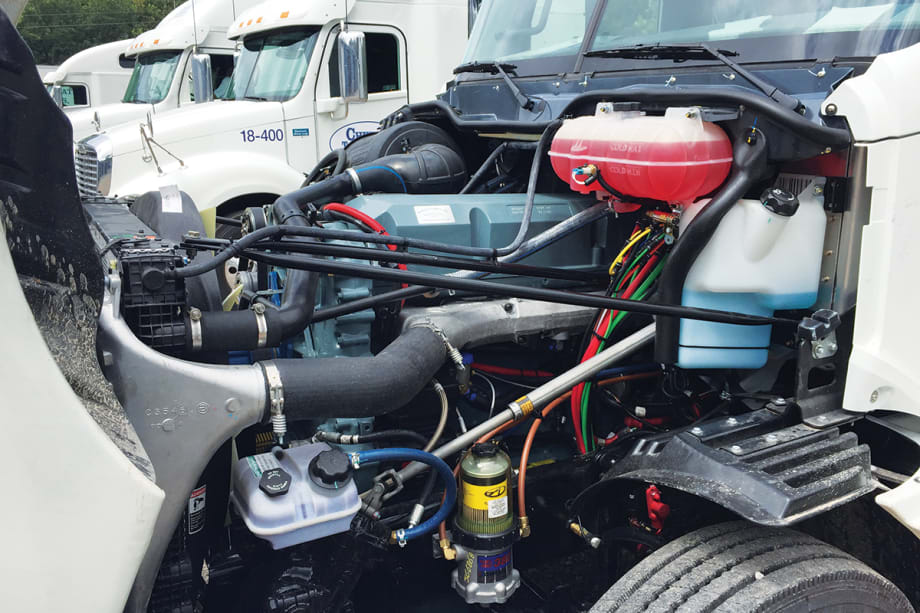
Make sure if you’re using a pre-2000 engine in a newer truck that you have plenty of documentation.
Photo: Deborah Lockridge
3 min to read
The electronic logging device mandate that went into full effect last December had a number of exemptions, and one of them was for older engines that might not have the level of electronics needed.
But just because you’re exempt doesn’t mean you’ll automatically sail through roadside inspections or back-office compliance reviews – especially if you’re running an older engine in a glider kit that has allowed you to update the cab while keeping the older engine.Originally, the ELD rule said it offered an exemption for “Drivers of vehicles manufactured before model year 2000,” and in fact you’ll still find that wording on certain government sites.
The reason was that older engines did not have the same level of sophisticated electronics that could feed the needed data to the ELD. But the original wording didn’t take into account that some truckers like to install older engines out of wrecked trucks into newer cabs via glider kits, so FMCSA clarified that exemption to reflect that it refers to the engine model year, not the model year in the truck’s VIN number.
So whether you’re driving a 1998 truck with the original engine or you have a 2018 glider kit with a 1998 engine, you aren’t required to use an ELD.
According to an FMCSA FAQ, “While the driver is not required to possess documentation that confirms the vehicle engine model year, 49 CFR Part 379 Appendix A requires motor carriers to maintain all documentation on motor and engine changes at the principal place of business.”
However, just what that documentation should consist of may be subject to interpretation by the particular investigator doing a compliance review, says John Seidl, who provides DOT transportation consulting to motor carriers as vice president of risk services for insurance provider Reliance Partners.
One of Seidl’s clients last year received a conditional safety rating and a $15,000 fine for “failing to require a driver to prepare a record of duty status using the appropriate method.” Their crime? Drivers were using paper logbooks because their trucks’ engines were built prior to 2000. The compliance review said the drivers were using paper logs but had “no documentation to show engine is manufactured prior to 2000.”
“He had a glider kit, but nothing to tie the engine to the paperwork,” Seidl says. “FMCSA didn’t like that there was just a piece of paper saying it was a glider with a pre-2000 engine. They wanted a physical tie to the engine to support the paperwork,” he said, although there’s nothing in the law spelling out that requirement. That 49 CFR Part 279 Appendix A simply says, “records of motor and engine changes.”
So Seidl worked with the small fleet to gather documentation for all its trucks with pre-2000 engines, such as:
Printed paperwork from glider kit manufacturers and engine rebuilders showing the pre-2000 original engine build dates.
ECM download from the trucks showing the engine serial number and the truck VIN, linking that engine build date to the VIN
Registration cards showing the corresponding VIN for the truck
“If you’re running a glider, you’d better not only have paperwork, but try to tie that pre-2000 engine to the paperwork you have,” Seidl advises. “Get pictures of the engine serial numbers that match the paperwork, ECM downloads that match the paperwork. If you’re running a 1996 truck, a registration card will usually do. But if the registration card says it’s a 2015 Freightliner and you’re trying to say you have a ’99 engine, this particular investigator in this state would not accept mere paperwork.”
Subscribe to Our Newsletter
More Safety & Compliance

From One Generation to the Next: How Mentorship Builds Safer Truck Drivers
After three decades in trucking, Harold Perry shares what he's learned about driver safety, mentorship, and helping the next generation build confidence behind the wheel.
Read More →
FMCSA Pauses Biennial-Update Enforcement Amid Motus Transition
Carriers whose updates were due on or after June 1 have more time, while FMCSA works to stabilize its new registration system and warns of phishing sites impersonating its new carrier registration system, Motus.
Read More →
ZF Expands Commercial Vehicle Push in North America
ZF is expanding its North American commercial-vehicle presence with new transmission applications, electrification, trailer technology and autonomous-driving systems.
Read More →
Truck Drivers Need More Than Another Alert
Fleets have more visibility into truck health, safety events, and driver activity than ever. The next challenge is turning all that information into useful guidance for the person who has to decide what to do next.
Read More →
Tesla Wants a Self-Driving Semi. Are Cameras Enough?
Could Tesla’s camera-only autonomous driving technology work on an 80,000-pound Semi? In this commentary, HDT's Deborah Lockridge takes a look at Tesla, Cybercab, and how autonomous trucks see the road.
Read More →
What DOT’s Automated Vehicle Strategy Means for Trucking
The U.S. Department of Transportation issued a new automated-vehicle strategy that outlines plans for driverless-truck regulations, cross-state freight corridors, and federal safety standards.
Read More →
NYC Expands Speed, Pedestrian Safety Tech Across Fleet
New York City is expanding intelligent speed assistance and pedestrian-alert systems across its municipal fleet, moving the technologies from pilot programs into vehicle procurement and retrofit requirements.
Read More →
FMCSA Removes 110 Truck Driver Training Schools from Certified ELDT List
Federal regulators also are targeting more than 160 additional training providers and launching a nationwide audit of third-party CDL skills testers as part of a broader crackdown on trucking fraud.
Read More →
Beyond DOT Compliance: What Makes a Trucking Fleet Truly Safe?
A trucking fleet can follow every rule and still make unsafe decisions. The real test comes when safety conflicts with freight, productivity, or cost.
Read More →
Hours of Service Pilot Programs: FMCSA Readies for 2027 Rollout
Two pilot programs could eventually reshape hours-of-service rules, giving truck drivers options to pause their 14-hour clock or use longer split sleeper rest periods.
Read More →