





Related: Nitrogen Cooling System Offers Alternative to Traditional Reefer Trailers
Reefer Technology's Becoming More Important
Maintenance and monitoring of temps, real-time tracking of trailers and loads, and clean-burning diesels are already here. More new refrigerants are next.
May 3, 2016
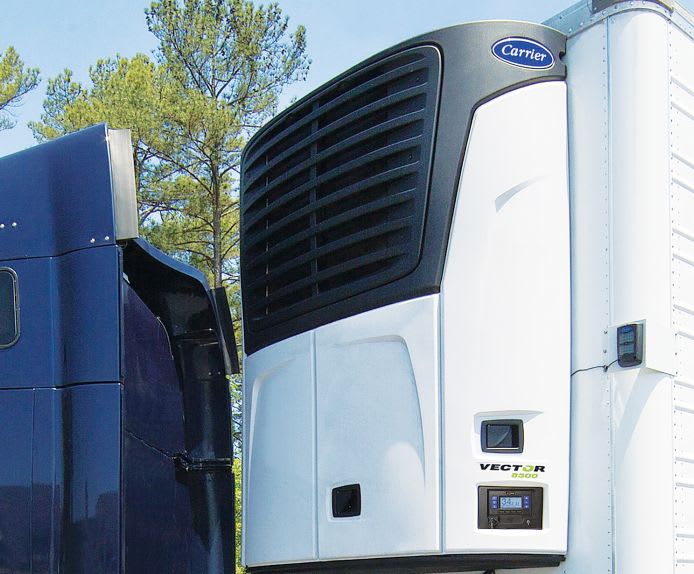
Carrier’s next refrigerant will be carbon dioxide, which is very safe as a cooling compound even if environmental authorities blame CO2 for helping cause Climate Change. Photo: Carrier Transicold
5 min to read
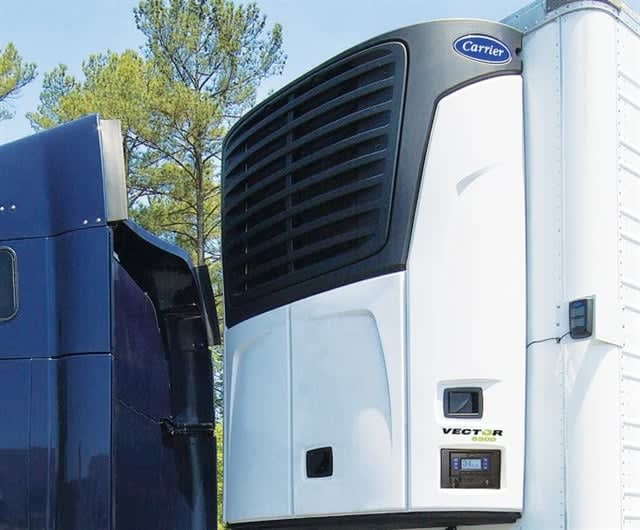
Carrier’s next refrigerant will be carbon dioxide, which is very safe as a cooling compound even if environmental authorities blame CO2 for helping cause Climate Change.Photo: Carrier Transicold
Sophistication is an integral part of today’s transport refrigeration units. Development over the years has stemmed from creative competition and concern for cargo safety from fleets, shippers and receivers, and more recently from the federal government.
Products from Carrier Transicold and Thermo King, which make most of the TRUs for North America and elsewhere, not only keep perishable commodities at proper temperatures in transit, but also let managers continually record those temps and track the whereabouts of the reefers, and their loads, in real time.
Those abilities are vital to delivering cargoes in the conditions specified by customers, and for adherence to food safety regulations which are becoming a larger part of refrigerated trucking. The recorded data help truck operators answer any questions that might come from people at either end of a shipment and thus settle any issues.
Meanwhile, Carrier and Thermo King say they have steadily updated their equipment to meet federal and California limits on diesel exhaust emissions and refrigerant compounds, and to operate more intelligently to save fuel and wear on components.
Diesel emissions on current units now meet Tier 4 Final standards, which are equivalent to the most recent EPA rules for truck engines. All TRU engines meet the limits with electronic controls, and advanced fuel system and combustion technology. Some use diesel particulate filters, while others can achieve clean-air goals without them. Pressure from California authorities to use all-electric “standby” power whenever possible has spurred development of diesel-electric “hybrid” TRUs and more buying of standby components by carriers.
The next refrigerants
Refrigerants have been changing as TRU makers meet rules that seek to control release of compounds damaging to Earth’s atmosphere. Freon — R12 — is long gone since the discovery of its harm to the protective ozone layer, and chemists have developed increasingly safe compounds that, if errantly vented, add fewer pollutants. One compound condemned as a greenhouse gas that’s said to be partly responsible for climate change is carbon dioxide.
Yet carbon dioxide is also a good thing, Carrier said last year when it announced that CO2 — R-744 — would be its next refrigerant. It’s already used in Europe and in ocean shipping and has proved efficient and effective. Because it’s a natural compound, its Global Warming Potential is a small fraction of currently used compounds like R-404A. Also, acquiring supplies of CO2 takes it out of circulation, and even if it is mistakenly released, it’ll be no worse than if it weren’t recycled as a transport refrigerant in the first place, the company says.
Thermo King, meanwhile, announced last summer that it has selected Chemours Opteon XP44 — R-452A — which has a Global Warming Potential about 45% percent lower than R-404A, its current refrigerant. Opteon, which is awaiting approval by the EPA, will be an alternative to R-404A until fleets are ready to transition to the new compound.
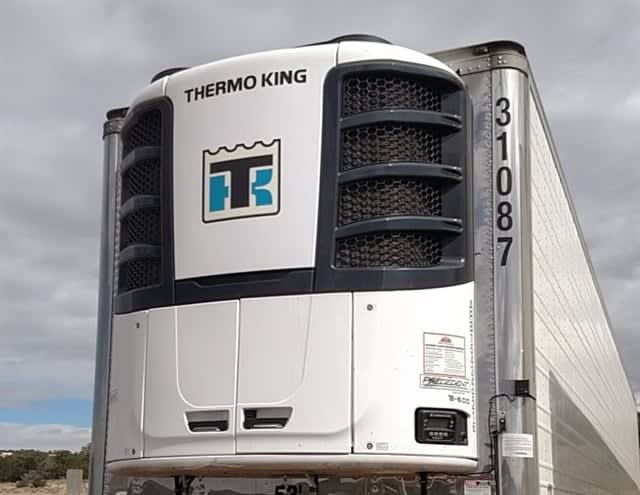
With tracking equipment, this untethered trailer’s reefer can be remotely monitored. Thermo King will switch to R-452A, which has half the Global Warming Potential of R-404A, its current refrigerant.Photo: Tom Berg
Array of sensors
Sensors are key to proper operation of a modern reefer’s components and to maintaining desired temperatures. A large array of sensors watches temps inside and outside the trailer, as well as humidity and many other conditions, says David Kiefer, Carrier’s director of marketing, sales and product management.
“Sensors today not only monitor trailer interior temperature, but other temperatures, pressures, electrical voltages and current draw,” he explains. “Some sensors, such as those for compressor discharge pressure or engine coolant temperature, make sure the unit operates safely and reliably. Others, such as those that monitor electrical voltage or current, help detect emerging operational issues or aid technicians in diagnostics and repair.”
Knowing ambient temps enables the reefer’s electronic controls to anticipate cooling and air circulation needs inside a trailer. So do door switches that signal when doors are opened, helping to confirm deliveries and warning of possible theft and inappropriate or unauthorized operation of the units, such as while parked empty in yards. Tank sensors warn if low fuel could shut down the engine, for “if it’s out of fuel, it’s out of cool,” Kiefer quips.
“When outside temperatures are within a predetermined range of the set point, the unit runs in start/stop mode, but when ambient temperatures heat up, the unit will automatically switch to continuous run,” Kiefer says. “The range at which the unit switches back and forth between modes, and thus the degree of fuel savings, can be easily adjusted by the user — a narrower stop/start range for more sensitive cargoes, and a wider range for less sensitive loads. By completely automating the function, the chance of operator error is also reduced.”
Fleet testing using collected data has shown that continuous-run demands by shippers can be unrealistic, says Bud Rodowick, manager, fleet performance for Thermo King. “Start/stop operation can keep sensitive commodities very close to the [temperature desired], and deviating from a specified temperature can protect them very well.”
Logging is becoming more important, as recent rules from the Food and Drug Administration demand careful treatment and monitoring of loads to keep them from spoiling and therefore harming consumers.
“It’s coming,” he has repeatedly warned reefer operators about implementation of the regs under the Sanitary Transportation of Food Act, the last of which will be published next month as a final rule. Among the requirements: accurate records of what’s occurred in transit, and careful cleaning of trailer and truck body interiors and areas in terminals where food products are handled. Another is documentation of shippers’ instructions regarding care of foodstuffs. Therefore, “Carriers, talk to your customers and shippers now,” Rodowick urged.
Subscribe to Our Newsletter
More Equipment

How Volvo Updated Its D13 for EPA 2027 [Watch]
Volvo’s updated D13 promises lower emissions without sacrificing performance or fuel economy. Take a closer look at what changed inside the engine in this HDT Spotlight video.
Read More →
Michelin Tire Improves Efficiency and Durability for Regional Fleets
The Michelin X Multi Energy D2 is a regional haul drive tire engineered to help fleets improve fuel efficiency, durability and traction in demanding stop-and-go operations.
Read More →
ZF Expands Commercial Vehicle Push in North America
ZF is expanding its North American commercial-vehicle presence with new transmission applications, electrification, trailer technology and autonomous-driving systems.
Read More →
Tesla Wants a Self-Driving Semi. Are Cameras Enough?
Could Tesla’s camera-only autonomous driving technology work on an 80,000-pound Semi? In this commentary, HDT's Deborah Lockridge takes a look at Tesla, Cybercab, and how autonomous trucks see the road.
Read More →
Kodiak: Driverless Long-Haul Truck Launch on Track for 2026
Kodiak AI says its driverless long-haul safety case is 93% complete and it remains on track to begin commercial operations by year-end 2026.
Read More →
What DOT’s Automated Vehicle Strategy Means for Trucking
The U.S. Department of Transportation issued a new automated-vehicle strategy that outlines plans for driverless-truck regulations, cross-state freight corridors, and federal safety standards.
Read More →
East Coast Port Launches $45M Electric Truck Push
The Port Authority of New York and New Jersey announced millions in incentives for zero-emission drayage trucks, yard tractors, and new charging hubs near the port.
Read More →
PlusAI Going Public to Fund Autonomous Truck Launch
A SPAC deal could provide PlusAI with up to $300 million as it works toward a 2027 commercial launch of factory-built autonomous trucks.
Read More →
NHTSA Moves to Rewrite Truck Fuel-Economy Rules
The National Highway Traffic Safety Administration says it lacks authority to regulate medium- and heavy-duty truck engines separately from complete vehicles, but the existing standards have not yet been eliminated.
Read More →
Detroit Opens Orders for EPA 2027 Engines
Detroit isn’t starting from scratch to meet EPA 2027 diesel emissions standards. Its Gen 6 DD13 and DD15 engines keep much of today’s platform while updating the fuel and aftertreatment systems.
Read More →