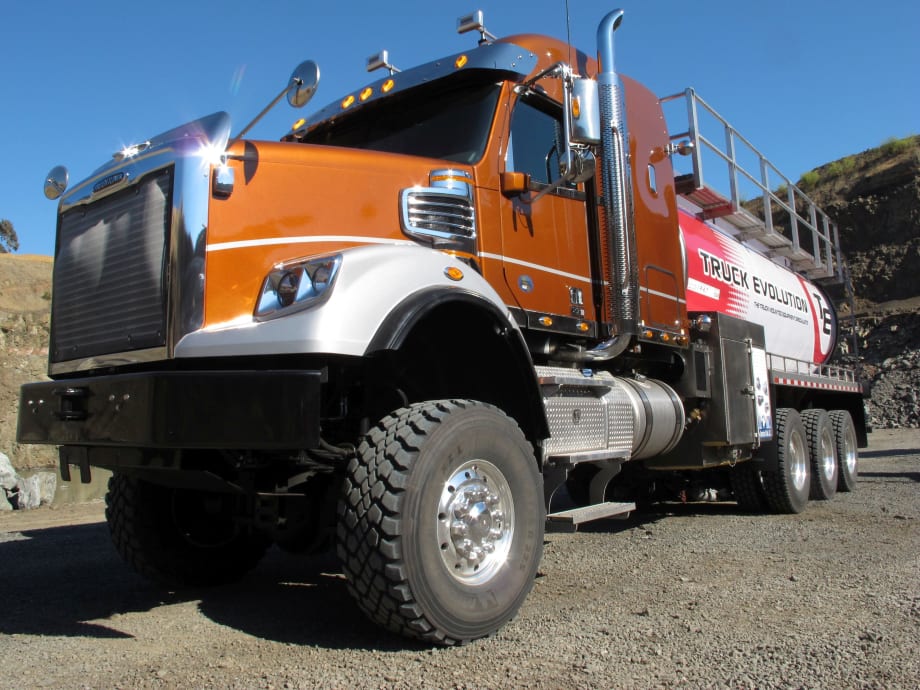
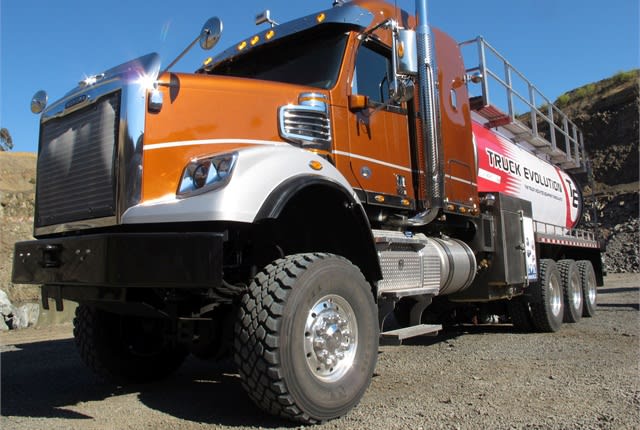
Freightliner can build its 122SD heavy-haul vocational chassis into any number of extreme configurations, but this oil-field hauler is one to be reckoned with. This truck lives for roads that would break your average highway hauler in half.
This 92,000-lb GVW oil tanker looked a little out of place in Napa, Calif., where we test drove it last summer.
3 min to read
This 92,000-lb GVW oil tanker looked a little out of place in Napa, Calif., where we test drove it last summer.
Freightliner can build its 122SD heavy-haul vocational chassis into any number of extreme configurations, but this oil-field hauler is one to be reckoned with. It boasts a gross vehicle weight of 92,000 pounds, a wheelbase of 306 inches, 8-wheel drive and a 600 horsepower engine cranking out 2,050 lb-ft of torque.
Ad Loading...
Vocational trucks are distinctly different from on-highway freight haulers. More often than not, the truck itself is just a platform that gets some other piece of equipment to a job site, like a crane or a vacuum tank. This truck is designed to haul crude oil and sour crude from oil wells to storage facilities in northern Alberta, Canada. It will be expected to survive 8 to 10 years in a mostly off-road environment.
On the showroom floor, it tips the scales at 42,000 pounds, but it will eventually be hooked to a three-axle pony trailer giving it a gross combination weight of 140,000 pounds.
Ad Loading...
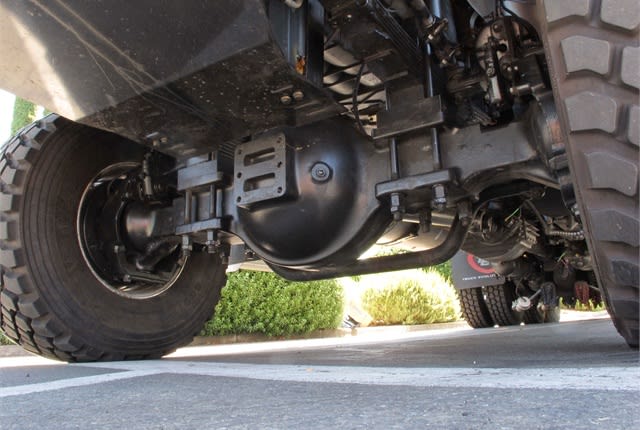
oad demands all-wheel drive and this truck has eight driving wheels. The tri-drive set up is a Meritor RZ-69-166 rated at 69,000 pounds. The driving front axle, also from Meritor, is rated at 23,000 pounds and it has a Fabco TC-142 two-speed transfer case.
“The 8-wheel-drive is built for carrying capacity as well as mobility in difficult conditions,” says Richard Saward, Freightliner’s general manager of vocational sales. “If you were operating on pavement most of the time, a tandem with a lift would be okay. But off-road demands three driving axles. The truck is a tool and you’re buying capacity.”
Given the size of the thing, I was mildly shocked at how well it maneuvered. Even with the wide triple-axle grouping and the restricted turning radius imposed by the driving steer axle, I had no trouble wheeling it through the confines of the Stony Point Quarry in Cotati, Calif., nor on the winding, hilly pass of the Oakville Grade Road near Napa. Sure, I had to plan the turns carefully, but the truck certainly didn’t get in the way.
The other big surprise was the ride. The quarry was badly wash-boarded, and with its share of ruts and humps, the 122SD took them in stride, and I emerged none the worse for the wear.
I was also a bit surprised to find an automated transmission in this truck. I would have guessed the folks working in the oil fields would be among the last to give up their manual transmissions. But I have to say, watching this 18-speed Ultrashift-Plus navigate the grades on the Oakville Pass I can understand the appeal of an AMT.
Ad Loading...
Ground clearance is king in off-road operations.
While this test drive opportunity hardly challenged the truck, the 600-hp/2,050 lb-ft DD16 would seem to be the engine for the job. Dragging 140,000 pounds up the side of a mountain takes a well-spec’d machine.
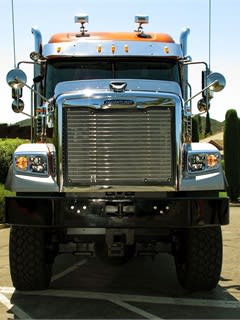
There were other notable features, too, like a very quiet and comfortable cab with all the comforts highway haulers have come to expect. The big hood has a 24-degree slope, so visibility is better than you’d expect — and the height of the cab helps, too.
The 122SD, formerly the Coronado SD, can be spec’d in a mind-boggling number of configurations. This truck, built for Canadian weights in a harsh off-road environment, shows just how versatile the chassis is. But for all its rugged componentry, it’s still a truck that will pamper its pilot.
The driving steer axle gets the 122SD through spots that would stop a tandem drive in its tracks.
Explore how telematics help refrigerated fleets improve visibility, uptime, efficiency, compliance, and cargo protection across connected cold chain operations.
Escalating U.S.-Canada tariffs could disrupt cross-border freight, reduce truck volumes, raise costs, and create new uncertainty for carriers on both sides of the border.
The American Transportation Research Institute wants to know what's worrying trucking fleet managers, drivers, and other stakeholders in its annual Industry Issues survey.
HDT Truck Fleet Innovator Adam Buttgenbach helped PepsiCo build one of North America’s largest EV fleets by focusing on where electric trucks make operational sense.
HDT Truck Fleet Innovator Deen Albert makes sure people are still at the heart of operations at Grand Island Express, even while adopting artificial intelligence tools. AI-assisted dispatch helped boost revenue 25% with the same number of trucks.