




Quick Spin: Peterbilt Model 220
Peterbilt's new Class 6/7 COE is ideally suited for city P&D as well as landscaping applications.

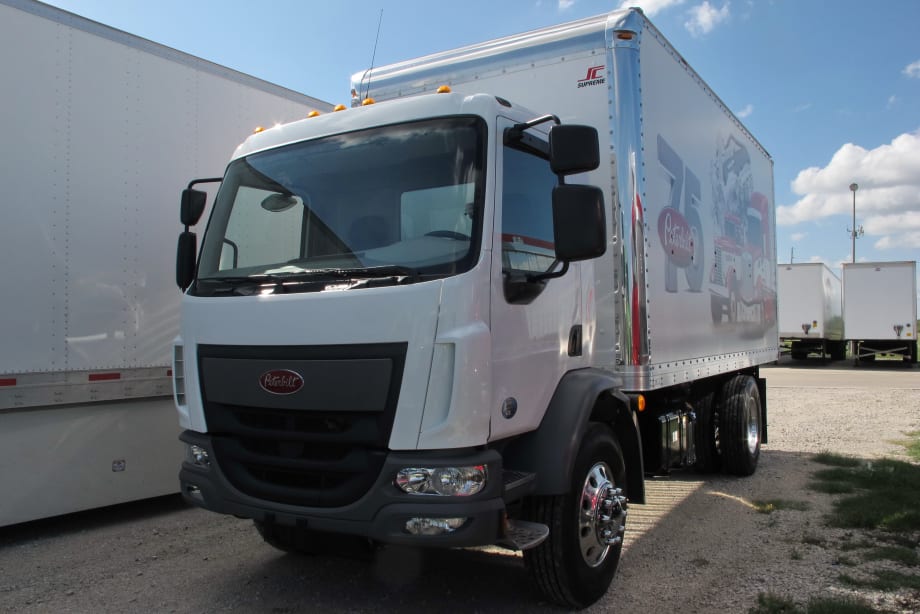
Peterbilt’s Model 220 features the PX-7 engine, Allison automatic transmission and all the visibility a driver could hope for.
Peterbilt’s Model 220 features the PX-7 engine, Allison automatic transmission and all the visibility a driver could hope for.
Peterbilt had just began full production of its Model 220 this summer when we spotted one at the company’s plant in Denton, Texas, and begged for a short drive.
Billed as a Class 6 or 7 chassis with a GVW up to 33,000 pounds, the Model 220, introduced in March, is ideally suited for city P&D as well as landscaping applications. You could add specialty bodies for applications such as refuse, street sweeping, striping or roll-off. It’s a versatile chassis, made more so by its COE design, which allows maximum frame space for the body plus excellent turning radius and maneuverability.
Available in a bumper-to-bumper length of up to 35 feet, the Model 220 can be upfitted with 16- to 28-foot bodies.
It’s powered by a Paccar PX-7, 6.7-liter engine driven through an Allison 2000- or 3000-series 6-speed automatic transmission. The engine is available at 200 or 220 horsepower with 660 pounds-feet of torque.
The distinctively European tall COE cab has a 2,500-square-inch windshield that offers a panoramic view. It’s coupled with huge side windows and big, well-positioned mirrors.
Inside, drivers will find amenities not often seen in urban P&D trucks, such as a multi-function driver information display showing vehicle and driver performance. The display is easy to see, even in bright sunlight, and the instrumentation is clear and easy to understand.
There are compartments in the door panels, along the back wall, in the header and on the dash, but they are on the small side. You would be hard-pressed to get a lunch box or a hardhat into them. This truck had the optional between-the-seats storage compartment with two well-placed cup holders.
It was surprisingly quiet, given that you’re perched right beside the engine. With the windows rolled up, it was nearly as quiet as the Model 579 I was driving a day earlier.
The driver’s position in the cab is terrific. Everything is within easy reach and what needs to be seen is easy to see. Sitting ahead of the front wheels will come as a pleasant surprise to any driver new to a low-COE. You’re on top of the action, literally, and that makes it surprisingly easy to maneuver in tight spaces. It’s very smooth, too, as you’re sitting ahead of the suspension.
The doors open to a full 90 degrees, so there’s lots of room to get in, but the steps will take a bit of getting used to for drivers accustomed to conventional-style trucks.
Driving Impressions
I love COE trucks so I might be biased, but this truck handles as well as a car. The steering is very positive, although in a tight turn it does feel a little odd at first to swing out ahead of the wheels.
I’m not sure which rating of the PX-7 I drove, but the box was empty, so I can’t truly evaluate the performance. As it was, it was pretty peppy. The 6-speed Allison tends to shift at fairly high rpm, but I could modulate that by not applying the throttle quite so aggressively. The driver display reminded me a couple of times that I was operating a little outside of the peak-efficiency range of the engine.
Backing the truck was easy thanks to the big windows and the large mirrors, but I found the mirrors vibrated a little at idle. But I’ll trade a little vibration for visibility any day.
Because you sit closer to the road compared to some conventional trucks, it’s more like driving a pickup truck than a Class 7 truck — but that’s part of the appeal. If you keep the registered gross weight down, drivers won’t need a CDL, and that will broaden hiring options considerably.
There’s very little I’d change on Peterbilt’s Model 220. The mirror mounts could be beefed up a little, but if they make them too strong, they might not “breakaway” the way they are supposed to if they hit something. And chances are they’ll be hit several times over their lives working in close quarters. That’s a trade-off I can live with.
More Equipment

How Volvo Updated Its D13 for EPA 2027 [Watch]
Volvo’s updated D13 promises lower emissions without sacrificing performance or fuel economy. Take a closer look at what changed inside the engine in this HDT Spotlight video.
Read More →
Michelin Tire Improves Efficiency and Durability for Regional Fleets
The Michelin X Multi Energy D2 is a regional haul drive tire engineered to help fleets improve fuel efficiency, durability and traction in demanding stop-and-go operations.
Read More →
ZF Expands Commercial Vehicle Push in North America
ZF is expanding its North American commercial-vehicle presence with new transmission applications, electrification, trailer technology and autonomous-driving systems.
Read More →
Tesla Wants a Self-Driving Semi. Are Cameras Enough?
Could Tesla’s camera-only autonomous driving technology work on an 80,000-pound Semi? In this commentary, HDT's Deborah Lockridge takes a look at Tesla, Cybercab, and how autonomous trucks see the road.
Read More →
Kodiak: Driverless Long-Haul Truck Launch on Track for 2026
Kodiak AI says its driverless long-haul safety case is 93% complete and it remains on track to begin commercial operations by year-end 2026.
Read More →
What DOT’s Automated Vehicle Strategy Means for Trucking
The U.S. Department of Transportation issued a new automated-vehicle strategy that outlines plans for driverless-truck regulations, cross-state freight corridors, and federal safety standards.
Read More →
East Coast Port Launches $45M Electric Truck Push
The Port Authority of New York and New Jersey announced millions in incentives for zero-emission drayage trucks, yard tractors, and new charging hubs near the port.
Read More →
PlusAI Going Public to Fund Autonomous Truck Launch
A SPAC deal could provide PlusAI with up to $300 million as it works toward a 2027 commercial launch of factory-built autonomous trucks.
Read More →
NHTSA Moves to Rewrite Truck Fuel-Economy Rules
The National Highway Traffic Safety Administration says it lacks authority to regulate medium- and heavy-duty truck engines separately from complete vehicles, but the existing standards have not yet been eliminated.
Read More →
Detroit Opens Orders for EPA 2027 Engines
Detroit isn’t starting from scratch to meet EPA 2027 diesel emissions standards. Its Gen 6 DD13 and DD15 engines keep much of today’s platform while updating the fuel and aftertreatment systems.
Read More →