




Owner-Operators: Today's New Breed
Think the owner-operator is dead? Think again. Today's independents are smarter, more professional and more business-savvy than ever

Think the owner-operator is dead? Think again. Today's independents are smarter, more professional and more business-savvy than ever.
There are three kinds of people in this world: those who make things happen, those who watch things happen and those who wonder what happened. The recent recession culled many owner-operators from the latter category.
The result is an industry with fewer but smarter and more demanding owner-ops - about 28% fewer, according to reliable estimates. Today's successful owner-operators, those who survived the great purge of 2008-2009, are business professionals as well as truckers.
Many have shed the cowboy mentality and are taking the business of trucking seriously. Better business skills got them through the recession, and they are now starting to reap the benefits of being among the last bunch standing.
The better owner-operators who made it through the recession are looking to get more out of the business, says Joe Rajkovacz, director of regulatory affairs at the Owner-Operator Independent Drivers Association. "They have a better handle on their costs, and they are a lot pickier about who they'll partner with."
The level of technical sophistication of the owner-operator population has increased along with the availability of information about rates, costs, etc., says Noel Perry, managing director and senior consultant with FTR Associates.
"If you're a smart and tech-savvy owner-operator already, you're finding it a lot easier to stay ahead of the curve today," he says.
Consequently, the brighter lights in that crowd are exercising their options, and one of them is remaining with their carrier partners through thicker and thinner times than before.
Trent Dye, director of Paramount Freight Systems, says many of the old "cowboy" types seem to have learned that just pulling up stakes at the first sign of trouble isn't always the best course of action.
"I'm not sure if it's something we are doing right or if they have just changed their mentality," he says. "I actually think it's a little bit of both."
That presents a good opportunity for fleets on the retention end of the equation. Among the possibilities are business courses and financial services packages.
Michael Fife, spokesperson for On-Ramp Transportation Services, says his company offers a host of tax, bookkeeping and accounting packages through its subsidiary, Equinox Owner-Operator Solutions. On top of that, there's Equinox University, a series of 30-to-45-minute modular learning programs offered online through subscription.
"An owner-operator once had to take up to a week off work to attend some business skills courses," Fife says. "Now they go online from their cab in a parking lot and do a module or two at their own pace. We've done surveys that show over 50% of owner-ops and drivers now have laptops or mobile devices, making this an ideal delivery solution for a mobile population."
Sometimes all that's needed is a little encouragement. Equinox and other programs are third-party services, too, so they won't jeopardize the independent status of your contractors.
"A willingness to partner is one of the distinguishing characteristics of the new breed of owner-operator," Fife says. "The old breed was fiercely independent. They would try to do everything themselves, and there wasn't always the time to manage it all properly and still get the driving in.
"The new breed is a little more open to partnering and recognizing that his or her skills are OK for the job of trucking, but bookkeeping, filing taxes and other business stuff might be better left to a partner."
Partnerships
Even while maintaining the necessary legal separation between the carrier and the contractor, carriers can help their contractors get ahead and do better with their businesses. Fuel and service programs are pretty common now, and while health care insurance can be tricky, third parties can manage that too. Still, don't overestimate the uptake on such products.
David Pike, director of recruiting and contractor relations at Universal Truckload Services, says while a lot of owner-operators ask about such offerings, few actually take advantage of them.
"Things like discounts on PMs and tires, medical plans and the like, they all want to see that, but fewer take advantage of them than you'd expect," he says. "But if you don't have it, people won't be knocking on your door. Get these programs in place and make them part of your sales pitch. A fuel program that can save 25 cents a gallon means thousands of dollars a year for the owner-operator."
The other type of partnership worth mentioning is with owner-operators themselves. Many, according to OOIDA's Rajkovacz are opting to go it alone, with their own authority. However, going solo isn't for the faint of heart or for the newbie. Accumulated experience, knowledge of the market, excellent mechanical, business and interpersonal skills all contribute to the independent's success. There's no handholding in that world, but a close relationship with a trusted partner never hurt.
"Even during the depths of the recession, our Business Services department was doing a roaring trade with owner-operators wanting to set up their own operation," he says. "On top of the number of motor carriers that are pushing their owner-operators in that direction to protect their CSA SMS scores, we have seen a huge increase in the number of individual filings over the past few years."
These are men and women who are better at trucking and want more out of the business, says Rajkovacz. "They have the business skills, they understand their costs, and they know there's good money to be made outside the traditional lease arrangement."
Greg Weber of Sacramento, Calif., is such an operator. He was formerly leased on with a medium-sized truckload carrier based in Denver, but he wanted more independence than that carrier could offer.
"It was safe working for them, but I was never going to get ahead," he says. "There was usually enough miles, the rate wasn't bad, and they had a good fuel program, but it seemed that when I was having a good month, they'd cut me back in the last week or so. They gave trips to other drivers that I could have had and left me sitting. I'm not in this just to get by. I'm interested in making money and getting ahead."
Weber says the Internet made the difference. Like a growing number of owner-operators, the idea of going out on his own sprang from watching the online load boards. When parked, he'd log in to various load boards and watch what was moving in the lanes he wanted to run. He eventually worked out contract arrangements with a couple of carriers in that market (including one he worked for as a lease operator) and began hauling their loads under his authority and insurance. That has since blossomed into a modestly profitable single-truck operation.
"I've got a few steady runs now, and I'm now billing two customers directly," he says.
Weber is a good example of the so-called new breed. He's running a fuel-efficient 2010-model truck with wide-base single tires, a 13- liter engine and an automated transmission. He's got all the electronic bells and whistles too, including smart phone, laptop (which he claims he hardly uses anymore), tablet computer and the like.
He watches fuel prices like a hawk as well as the load boards, and he's constantly updating his closer customers of his whereabouts just in case something pops up. At age 31, he's much younger than average, and his career is still very much ahead of him.
Grow your own
Some carriers are trying to resolve the scarcity of owner-operators and drivers internally.
"What we are finding is that more carriers are electing to grow their own drivers," says Lana Batts, a partner in the consulting and research firm, Transport Capital Partners, and former president of the Truckloa
More Fleet Management
Enhance Fleet Performance with High-Efficiency Auxiliary Power Units
Drive sustainable cost savings while increasing driver comfort during short- and long-haul logistics operations.
Read More →
Is Your Parts Procurement Process Reactive or Proactive?
Ready to revamp your parts procurement process? Learn how now with “Strategic Parts Purchasing: A Process Checklist”
Read More →
What Trucking Events are Happening in 2026?
Looking for trucking-related conventions, expos, and other events? Heavy Duty Trucking has developed this list of national and larger regional trucking shows and events.
Read More →
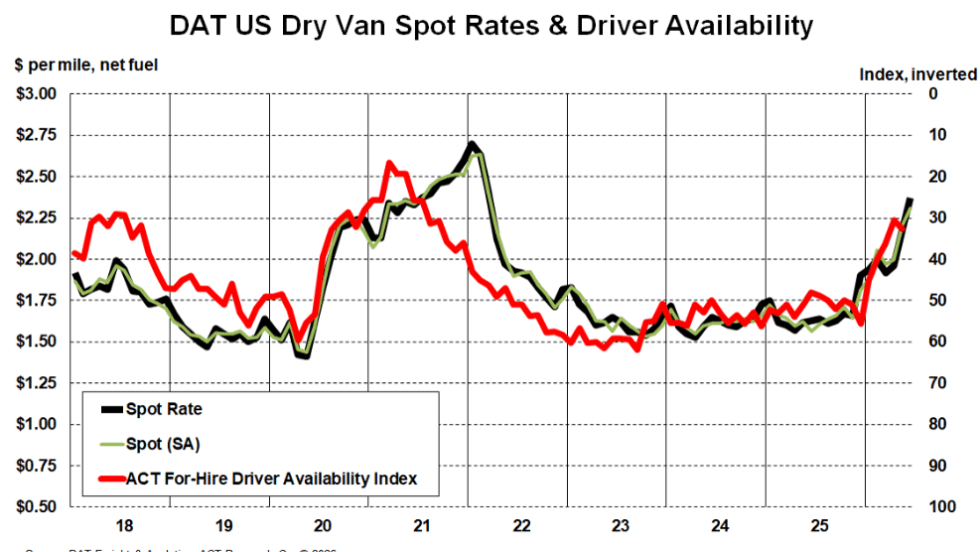
Truckload Rates Keep Rising as Tight Capacity Fuels Freight Market Recovery
Spot and contract rates continued climbing in May and June, not because freight demand is surging, but because fewer trucks and drivers are available.
Read More →
What Geotab's New AI Connector Means for Fleets
Fleets can now ask their usual AI assistants questions about maintenance, safety, fuel use, and vehicle performance, using their live Geotab data, and take action on the answers without leaving their preferred AI tool.
Read More →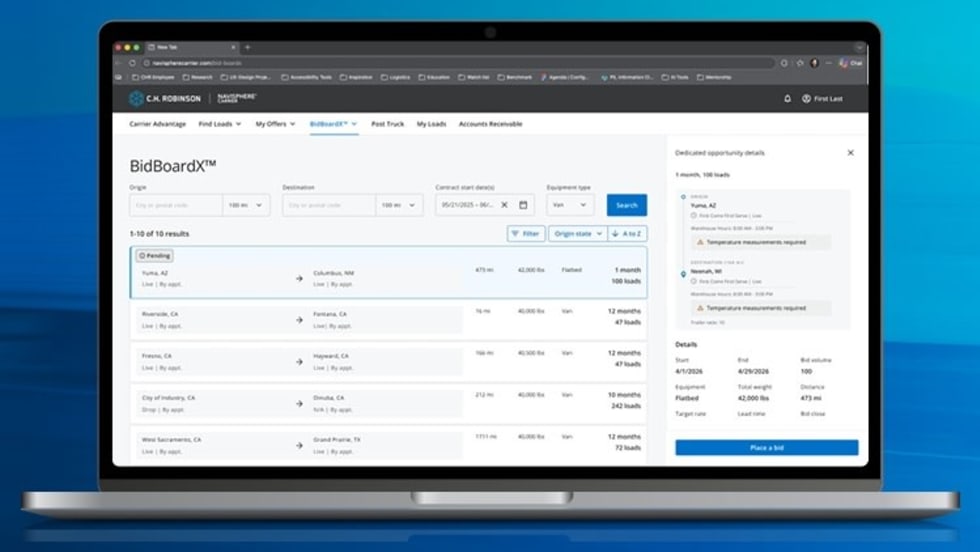
New C.H. Robinson Tool Opens Door to More Predictable Freight
BidBoardX lets carriers search, bid on, and secure committed freight opportunities through a single digital marketplace.
Read More →
New York City's Microhub Project is Delivering Results
Trucking, last-mile delivery companies, and environmental advocates like what they are seeing so far with New York's microhub program.
Read More →
Why Truck Detention Keeps Costing Fleets Time and Money
A 2024 ATRI study found detention affects nearly 40% of truckload stops and costs the industry more than $15 billion annually. Despite the toll on drivers, fleets, and supply chains, the problem remains stubbornly persistent.
Read More →
Time is Running Out to Apply for Exclusive HDT Event
Heavy Duty Trucking Exchange brings fleet managers and suppliers together for the deeper conversations that lead to ideas, partnerships, and solutions. Time is running out to apply for the September event.
Read More →
Amazon Launches Less-Than-Truckload Freight Offering for All Businesses
This launch is the latest addition to Amazon Supply Chain Services, a portfolio of supply chain capabilities from Amazon, including freight, distribution, fulfillment, and parcel shipping.
Read More →