





Related: How Dash Cams Improved Safety at Florida Construction Fleet
Northwest Logistics Ropes in Heavy Haul Business
Northwest Logistics Heavy Haul went from steel chains to fiber ones to reduce time, damage, and injury.
June 4, 2020
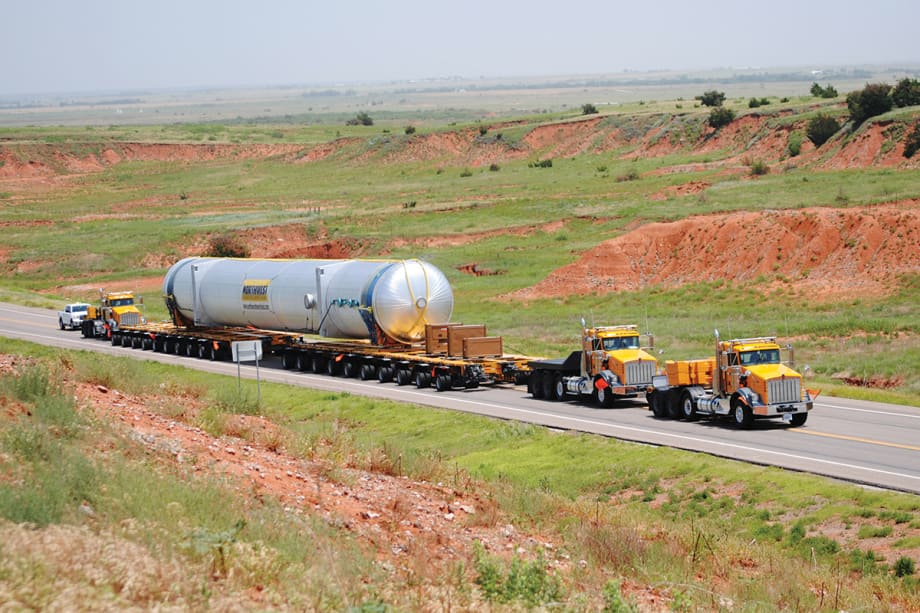
This demethanizer, which is used in a refinery to separate natural gas from a light hydrocarbon gas mixture stream, was transported 653 miles through the Rocky Mountains and weighed 1.19 million pounds gross — a 270-ton payload.
Photo: Northwest Logistics Heavy Haul
3 min to read
Moving freight around the country is hard enough, but just imagine your load takes four trucks with four drivers to manage.
“[We had] a demethanizer that was transported 653 miles, traversed steep grades through harsh winter conditions in the Rocky Mountains, weighed 1,192,000 pounds gross (a 270-ton payload), had a 186-foot vessel length, and measured 430 feet truck-to-truck from front to back,” says Ace Carter, and engineer for Northwest Logistics Heavy Haul, which is part of Northwest Companies, a family of companies in Oklahoma that has specialized in moving components of heavy industry since 1968.
As a heavy hauler, Northwest’s fleet faces obstacles that other carriers do not, including a lack of state harmonization regarding permit restrictions, traffic control, access to proper parking, expensive specialized and often very custom equipment, specialized equipment maintenance expenses, additional fuel expenses, and a limited driver pool, since extensive experience is required to haul some of the monstrous loads that the fleet handles. This includes jobsite and/or customer-specific safety orientation and training; specialized trailer features, i.e., hydraulic, pneumatic, or electrical systems; fall protection; and oversize/overweight load securement.
It takes more than just a few straps to secure these loads to Northwest’s trailers, which is why they started looking for an alternative to the process they had in place.
Using materials such as carpet, rubber, fire hose, and other liners for the required chains was necessary to keep everything in place while protecting the load, as well as requiring more time to apply. The liners reduced any chance of the steel chains scratching the painted finish on some of the tanks the company transports.
The process involved was also cumbersome. It would take two men to set the 30-foot chains in position, depending on the tank. After one worker threw a guide rope over the tank, the employee on the opposite side of the trailer would then pull the chain up and over the vessel as the first person helped feed it.
“The act of simply securing the tanks was time-consuming and physically demanding,” Carter says.
The process has since been improved by using Doleco’s DoNova PowerLash Textile Lashing Chain and Tie-down System, which uses fiber links instead of steel and comes in the same 30-foot lengths. The fiber chains weigh 85% less and have a 22,000-pound working load limit, compared to the 15,000 WWL of the half-inch steel chains they replaced. “So now we only needed 10 tie-downs to do the job of 14 steel chains,” Carter says.
The new equipment not only saves time, it also saves the crew from straining themselves just carrying the tiedowns to the trailer. Carrying the fiber chains from their storage location on the truck or support vehicle to each securement point on the trailer has reduced fatigue and the potential for injuries, according to Carter.
Subscribe to Our Newsletter
More Safety & Compliance

FMCSA Pauses Biennial-Update Enforcement Amid Motus Transition
Carriers whose updates were due on or after June 1 have more time, while FMCSA works to stabilize its new registration system and warns of phishing sites impersonating its new carrier registration system, Motus.
Read More →
ZF Expands Commercial Vehicle Push in North America
ZF is expanding its North American commercial-vehicle presence with new transmission applications, electrification, trailer technology and autonomous-driving systems.
Read More →
Truck Drivers Need More Than Another Alert
Fleets have more visibility into truck health, safety events, and driver activity than ever. The next challenge is turning all that information into useful guidance for the person who has to decide what to do next.
Read More →
Tesla Wants a Self-Driving Semi. Are Cameras Enough?
Could Tesla’s camera-only autonomous driving technology work on an 80,000-pound Semi? In this commentary, HDT's Deborah Lockridge takes a look at Tesla, Cybercab, and how autonomous trucks see the road.
Read More →
What DOT’s Automated Vehicle Strategy Means for Trucking
The U.S. Department of Transportation issued a new automated-vehicle strategy that outlines plans for driverless-truck regulations, cross-state freight corridors, and federal safety standards.
Read More →
NYC Expands Speed, Pedestrian Safety Tech Across Fleet
New York City is expanding intelligent speed assistance and pedestrian-alert systems across its municipal fleet, moving the technologies from pilot programs into vehicle procurement and retrofit requirements.
Read More →
FMCSA Removes 110 Truck Driver Training Schools from Certified ELDT List
Federal regulators also are targeting more than 160 additional training providers and launching a nationwide audit of third-party CDL skills testers as part of a broader crackdown on trucking fraud.
Read More →
Beyond DOT Compliance: What Makes a Trucking Fleet Truly Safe?
A trucking fleet can follow every rule and still make unsafe decisions. The real test comes when safety conflicts with freight, productivity, or cost.
Read More →
Hours of Service Pilot Programs: FMCSA Readies for 2027 Rollout
Two pilot programs could eventually reshape hours-of-service rules, giving truck drivers options to pause their 14-hour clock or use longer split sleeper rest periods.
Read More →
New Guide Offers Pet Safety Tips for Truck Drivers
Hundreds of thousands of pets travel in truck cabs. A new safety guide from Volvo Trucks and the Center for Pet Safety offers practical advice for truck drivers who bring dogs and cats along for the ride.
Read More →