How Dash Cams Improved Safety at Florida Construction Fleet
Vallencourt Construction has dash cameras in every one of its 100 vehicles. It’s not a common practice among construction fleets, but for Risk Manager Troy Betts, the decision to install dash cams from Samsara two years ago has gone above and beyond his expectations.
For its nearly 20 CDL drivers, the Samsara system also includes a built-in electronic logging device.
Photo: Vallencourt Construction
3 min to read
Vallencourt Construction has dash cameras in every one of its 100 vehicles, from pickup trucks up to Class 8 tractors that pull lowboys transporting heavy equipment. It’s not a common practice among construction fleets, but for Risk Manager Troy Betts, the decision to install dash cams from Samsara two years ago has gone above and beyond his expectations.
Ad Loading...
The Jacksonville, Florida, construction company works in a four-county area and has 400 employees. The fleet is recognizable in the area, Betts explains, and no matter what the situation was in the case of an accident, “It seemed like we were always going to be at fault and always pay someone money. There were times when I felt civilians were not being truthful. I wanted to get dash cams to prove our innocence.”
But the company realized an unexpected benefit. “What I did not expect to happen was the dashcams made our guys so conscious and aware of their driving – I think we had like one accident the first year.”
Ad Loading...
The Samsara system is more than just cameras. A GPS feature allows the fleet to track driver location, speed, and potential safety-related incidents. Vallencourt gets alerts to his phone when the system detects events such as harsh braking, turns and acceleration. “We also know when a vehicle is getting cranked up and driven after hours without permission.”
In addition to the alerts, Betts receives a one-minute block of video so he can immediately evaluate the situation and determine how it needs to be addressed.
“Sometimes the harsh braking might be because the stoplight turned yellow,” he says. “If it is something egregious, I will address it with the driver. If it continues to be a problem, there could be disciplinary action involved.”
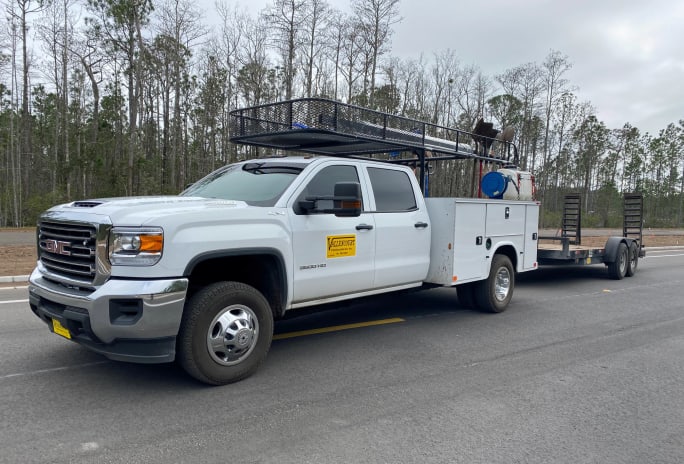
Vallencourt's fleet of 100 vehicles ranges from pickup trucks up to tractor-trailers.
Photo: Vallencourt Construction
The reaction from drivers when Vallencourt first installed the system wasn’t as bad as Betts had feared.
“A few complained, but at this point they’ve gotten used to them and recognize the benefit.”
Ad Loading...
Betts uses videos for training, both for individual driver coaching and for broader safety training classes. He might decide to focus a class on red-light running after noticing a rash of such incidents. Or he may show videos of an accident where the video showcases who was at fault. “I’ve shown videos of an accident where you can see they could have tried to blame us but we have footage that shows [our driver is] not at fault,” Betts says. “The guys like that. They’re eligible for profit sharing, and if I have to pay $100,000 on this accident, that’s money that’ll come out of their profit sharing.”
The cameras also have captured things on the jobsite such as theft, altercations between people, and collisions between two pieces of construction equipment, he says.
“The longer we’ve had them, the more we’ve realized they do more for us.”
Fleet Snapshot
Who: Vallencourt Construction
Where: Jacksonville, Florida
Fleet: 100 vehicles, from pickups to tractor-trailers
Operations: Construction fleet operating in a four-county area
Fun Fact: Vallencourt has three people devoted full-time to safety.
Carriers whose updates were due on or after June 1 have more time, while FMCSA works to stabilize its new registration system and warns of phishing sites impersonating its new carrier registration system, Motus.
ZF is expanding its North American commercial-vehicle presence with new transmission applications, electrification, trailer technology and autonomous-driving systems.
Fleets have more visibility into truck health, safety events, and driver activity than ever. The next challenge is turning all that information into useful guidance for the person who has to decide what to do next.
Could Tesla’s camera-only autonomous driving technology work on an 80,000-pound Semi? In this commentary, HDT's Deborah Lockridge takes a look at Tesla, Cybercab, and how autonomous trucks see the road.
The U.S. Department of Transportation issued a new automated-vehicle strategy that outlines plans for driverless-truck regulations, cross-state freight corridors, and federal safety standards.
New York City is expanding intelligent speed assistance and pedestrian-alert systems across its municipal fleet, moving the technologies from pilot programs into vehicle procurement and retrofit requirements.
Federal regulators also are targeting more than 160 additional training providers and launching a nationwide audit of third-party CDL skills testers as part of a broader crackdown on trucking fraud.
Two pilot programs could eventually reshape hours-of-service rules, giving truck drivers options to pause their 14-hour clock or use longer split sleeper rest periods.
Hundreds of thousands of pets travel in truck cabs. A new safety guide from Volvo Trucks and the Center for Pet Safety offers practical advice for truck drivers who bring dogs and cats along for the ride.