




Inspecting Your Tires
Inspecting tires on a routine and regular basis is the key to succeeding in maximizing your tire removal miles. The goal of every tire program is to ensure that the tires are running smoothly and evenly without irregular wear.
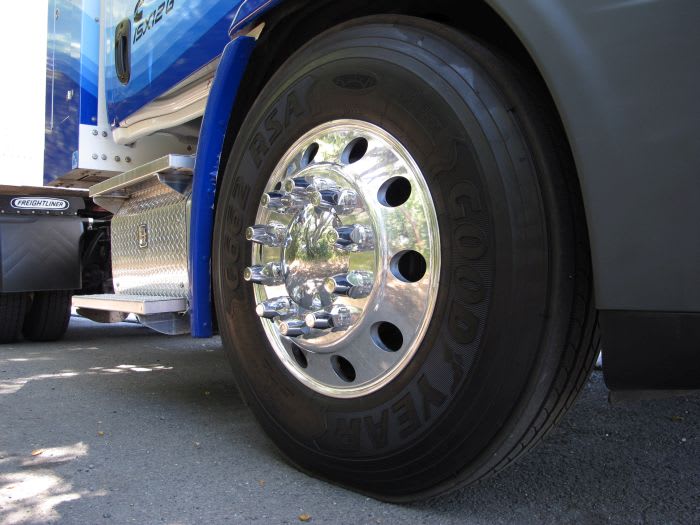
Inspecting tires on a routine and regular basis is the key to succeeding in maximizing your tire removal miles. Drivers, technicians, and outside vendors who service your vehicles can all play a significant role in getting the most miles out of your tires.
The goal of every tire program is to ensure that the tires are running smoothly and evenly without irregular wear. Fuel economy is maximized when tires are running without irregular issues such as shoulder cupping, one-sided wear, fast shoulder wear on both shoulders, and heel/toe wear. Fuel economy will be adversely affected and tires will be removed prematurely due to uneven wear; and the cost/mile will show a dramatic increase.
Training drivers, technicians, and your vehicle servicing network will go a long way to maximizing tire removal miles with the side benefit of fuel economy improvement. A serious on-going tire training program is essential and should include identifying specific wear patterns, their probable cause and how to correct the issue. A few facts your training should include:
Steer tires develop different wear patterns versus drive, trailer, and dolly tires. Sometimes the irregular wear can be directly related to the vehicle alignment. Many times too much wheel-end play and worn suspension components can be the leading cause.
Underinflated tires will lead to significant irregular wear since the tire footprint becomes longer and distorted. The added heat due to a combination of excessive idewall flexing and the longer footprint (more rubber on the road) can also lead to major irregular ear and even tire failures.
Another major reason tires develop irregular wear occurs when vehicle loads change. Since air carries the load, the tire pressure specification must be based on the worst or heaviest load scenario. Fleets running 100 psi loaded could run somewhat less pressure unloaded, however, the higher the pressure the more it benefits fuel economy, which more than offsets the slight tire wear in unloaded back haul situations.
Checking tires with a calibrated pressure gauge will identify tires running out of spec. The more frequently your team can check tire pressures, the better. In the real world, just because you checked tire pressures before leaving the yard it has minimal benefit when the vehicle runs over a nail just a few minutes later.
Never take air out a hot tire as a hot tire is running about 15% higher pressure than the “cold” or room temperature pressure setting. Tires take four to six hours, depending on the size, tread depth, materials and tire pattern before cooling back down to its cold pressure setting after running on the highway fully loaded.
From the Commercial Fleet Tire Digest, published by Pressure Systems International, the maker of the Meritor Tire Inflation System by PSI. Used with permission.
More Fuel Smarts

How Volvo Updated Its D13 for EPA 2027 [Watch]
Volvo’s updated D13 promises lower emissions without sacrificing performance or fuel economy. Take a closer look at what changed inside the engine in this HDT Spotlight video.
Read More →
Diesel Price Spike Shortens Payback for Natural Gas Trucks, Report Says
Energy Vision estimates fleets could recover the higher purchase price of an RNG-fueled Class 8 tractor in 1.3 to 2.8 years under current fuel-price scenarios.
Read More →
Calstart Becomes Catalyst Mobility, Reflecting Broader Focus
Calstart is now Catalyst Mobility, reflecting the nonprofit’s growing national role in clean transportation, including zero-emission trucks, infrastructure and incentive programs.
Read More →

Record Diesel Prices Squeeze Trucking Fleets
Average U.S. diesel prices have climbed to nearly $6 a gallon, surpassing the 2022 record as tight refinery capacity and Middle East disruptions keep fuel costs elevated.
Read More →
How Fuel Delivery Shapes Engine Performance
Fuel delivery depends on more than what happens at the injector. For fleet, maintenance and technical professionals, looking at the full path from pump to injector can provide useful context for understanding engine performance.
Read More →
East Coast Port Launches $45M Electric Truck Push
The Port Authority of New York and New Jersey announced millions in incentives for zero-emission drayage trucks, yard tractors, and new charging hubs near the port.
Read More →
California Bill Could Shed Light on Electric Truck Prices
Why do battery-electric Class 8 trucks remain so expensive? A California bill headed to Gov. Gavin Newsom would give fleets and state agencies more visibility into what manufacturers charge.
Read More →
Detroit Opens Orders for EPA 2027 Engines
Detroit isn’t starting from scratch to meet EPA 2027 diesel emissions standards. Its Gen 6 DD13 and DD15 engines keep much of today’s platform while updating the fuel and aftertreatment systems.
Read More →
Zero-Emission Truck Corridor Planned for West Coast
California, Oregon, Washington, British Columbia and Baja California are coordinating plans for truck charging and hydrogen fueling from Canada to Mexico.
Read More →
A Closer Look at Kenworth’s Electric T880E Vocational Truck [Video]
Learn more about Kenworth's T880E battery-electric vocational truck at the Paccar Technical Center, including its range, applications, upfitting considerations, and PTO options, in this HDT Spotlight video.
Read More →